10 Game-Changing GCSE Revision Techniques to Ace Your Exams
- Gavin Wheeldon
- Feb 14
- 17 min read

Exams creeping up? Whether you're planning a last-minute rescue mission or aiming to lock down those top grades, the old ways of cramming and rereading just don't cut it. For too long, students have been told to just highlight notes and stare at textbooks. But what if there's a smarter, more efficient way to prepare? This isn't about working harder; it's about working smarter. The difference between feeling overwhelmed and walking into the exam hall with confidence comes down to your strategy. Passive learning, like watching a video or glancing over a page, gives you a false sense of security. Real mastery comes from actively grappling with the material.
This guide cuts through the noise and gives you a game plan built on solid science. We are diving straight into 10 powerful, evidence-based GCSE revision techniques that actually work. Forget vague advice. We'll show you exactly how to use methods like Spaced Repetition, Active Recall, and Interleaved Practice, with practical steps you can use today. You'll find examples for subjects like Maths, Science, and English, helping you apply these concepts directly to your own revision schedule.
Think of this list as your blueprint for effective revision. It's designed to move you from just consuming information to actually commanding it, making sure the knowledge sticks not just for tomorrow, but for the day of the exam. Let’s get into it.
1. Spaced Repetition
Forget cramming. One of the most powerful, evidence-based GCSE revision techniques is spaced repetition. Based on the work of psychologist Hermann Ebbinghaus and his "forgetting curve," this method involves reviewing information at increasing intervals. Instead of desperately re-reading a textbook the night before an exam, you revisit topics just as you’re about to forget them. This clever timing stops the forgetting process in its tracks and locks the knowledge deep into your long-term memory.

This isn’t just a theory; it’s a proven strategy used by medical students to memorise huge amounts of complex information and by language learners to master thousands of new words. For your GCSEs, this means instead of grinding away at one topic for a week and then forgetting it, you'll cycle through all your topics consistently.
How to Implement Spaced Repetition
The key is consistency and timing, not all-night sessions. Here’s how to make it work for you:
Start Early: Begin your spaced revision at least a few months before your exams. The earlier you start, the longer the "spacing" intervals can become, which leads to much stronger memory.
Use Technology: Trying to manually track what to review and when is a massive headache. Platforms like MasteryMind integrate spaced repetition into their design. The AI automatically schedules quizzes for you, ensuring you review the right content at the perfect time to beat the forgetting curve.
Combine Techniques: Spaced repetition is powerful, but it’s even better when paired with active recall (our next point). Instead of just re-reading your notes during a review, test yourself on the material.
Schedule Smart: Plan your review sessions for times when you feel sharpest. Trying to absorb information when you're tired is like trying to fill a leaky bucket.
2. Active Recall
If spaced repetition is when you revise, active recall is how you revise. This technique flips traditional, passive studying (like re-reading notes or highlighting textbooks) on its head. Instead, it forces your brain to actively pull information out of your memory without any clues. This effort, as shown by learning scientists like Roediger & Karpicke, creates much stronger and longer-lasting brain connections than just recognising information you’ve seen before.
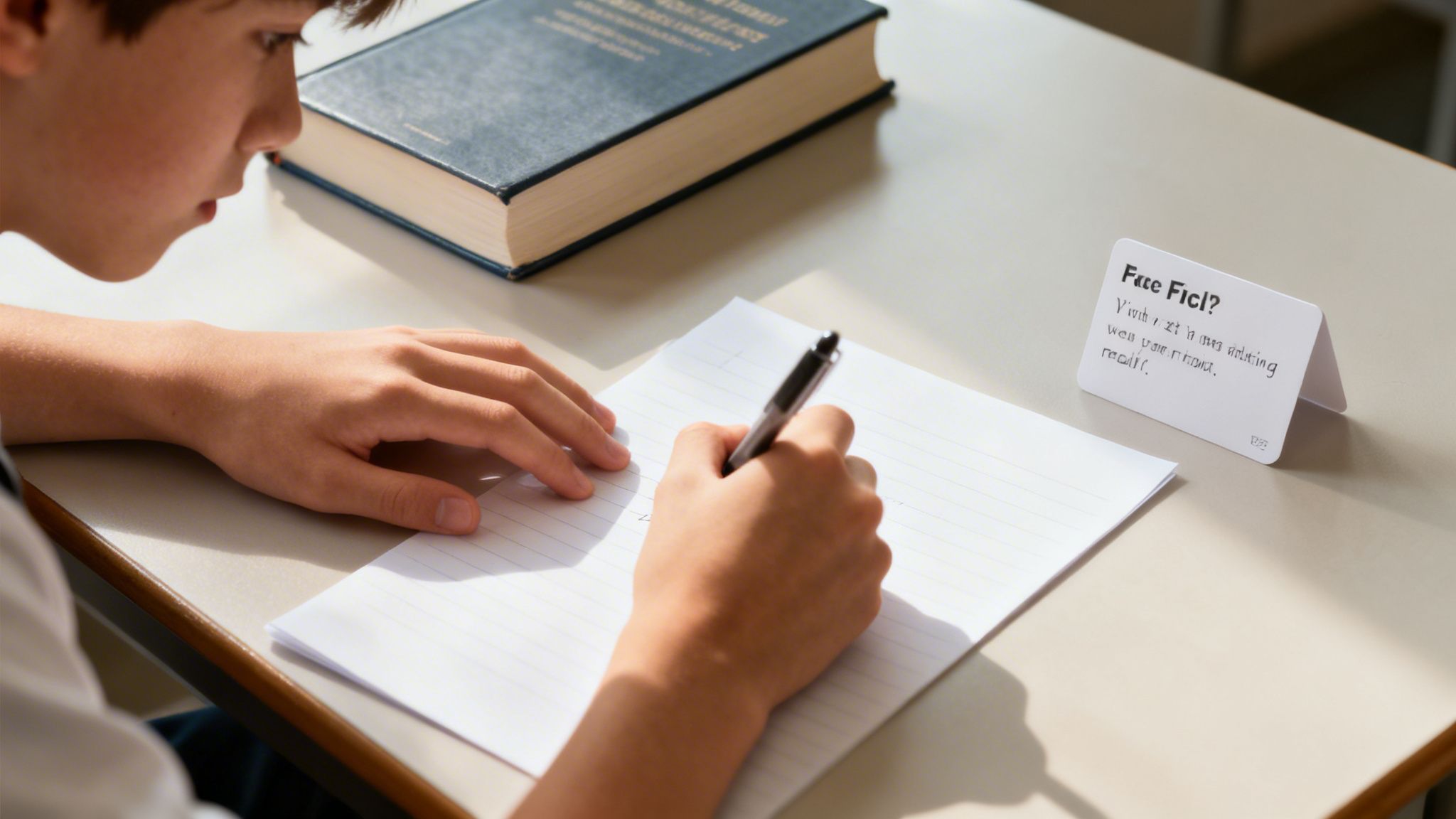
Think of it like this: reading notes is like walking a familiar path, but active recall is like drawing a map of that path from memory. The second one is harder, but it proves you truly know the way. For your GCSEs, this means testing yourself constantly to find out what you don't know, so you can fix it. It’s about producing answers, not just consuming them.
How to Implement Active Recall
The goal is to make retrieval a habit, even when it feels tough. Here’s how to integrate this powerful GCSE revision technique:
Start with a Blank Page: Before opening your textbook for a topic like the causes of the Cold War, grab a blank piece of paper and write down everything you can remember about it first. That initial struggle primes your brain for learning.
Use the Right Tools: MasteryMind’s mixed-topic quizzes are designed for this. They pull questions from different subjects and topics, forcing real recall, not just remembering what you saw on the last page. The Blurt Challenge feature takes it a step further, prompting you to speak your answers aloud—great practice for organising your thoughts under pressure.
Embrace the Struggle: Active recall is meant to feel difficult. That feeling of effort is the memory-building process at work. Don't be discouraged if you can't remember everything; the very act of trying strengthens the memory.
Combine with Feedback: After trying to recall something, immediately check your answers against your notes or use MasteryMind’s instant, examiner-style feedback. This lets you correct mistakes straight away, so you don't end up remembering the wrong thing.
3. Interleaved Practice (Mixed-Topic Learning)
While studying one topic at a time (blocking) feels organised, research shows it’s one of the less effective GCSE revision techniques. Enter interleaved practice, a method where you mix up different topics or problem types in a single study session, rather than mastering one before moving on.
This approach forces your brain to work harder. Instead of mindlessly applying the same formula to 30 similar maths problems, you have to constantly ask, "What kind of problem is this?" and "Which strategy do I need?" This process is exactly what you need to do in a real exam, where questions are deliberately mixed up. It builds mental agility and improves your ability to apply knowledge flexibly.
For example, a GCSE Science student might work through a few questions on cell biology, then switch to a question on electrical circuits, and then tackle a chemical equation. Similarly, a Maths student would alternate between algebra, geometry, and statistics problems. It feels more difficult in the moment, but this "desirable difficulty" leads to deeper, longer-lasting learning.
How to Implement Interleaved Practice
The goal is to copy exam conditions and build flexible thinking, not just memorise processes in isolation. Here’s how to make it work:
Mix, Don’t Block: Instead of a "Chemistry hour," have a "Science hour" where you deliberately mix questions from Biology, Chemistry, and Physics. Don't just work through one chapter of a textbook at a time.
Embrace the Challenge: Interleaving will feel harder and slower than blocking. This is a sign it’s working. Resist the urge to go back to the comfy method of topic blocking; the long-term benefits are worth the initial struggle.
Use examiner-aligned tech: Manually creating mixed-topic quizzes is a pain. MasteryMind’s platform is built on this principle; its AI-powered quizzes automatically mix questions from different topics you’ve studied, ensuring you get proper interleaved practice without the hassle. You can learn more about its Features - Interleaved Practice.
Combine with Active Recall: As you tackle a mixed question set, focus on actively retrieving the information from memory first. Only check your notes or the answer if you are completely stuck. This combination is one of the most powerful GCSE revision techniques you can use.
4. Retrieval Practice with Elaboration
Retrieval practice is a game-changer, but what separates a good student from a great one? The ability to explain why an answer is correct. This is where elaboration comes in. This powerful GCSE revision technique involves not just recalling information, but explaining the reasoning behind it, connecting it to other concepts, and talking through the 'how' and 'why'. It forces your brain to build stronger, more meaningful connections, moving you beyond surface-level memory.
This approach transforms passive recall into active, deep learning. For GCSEs, this means instead of just stating that a chemical reaction happens, you explain why the bonds break and reform. You don't just list the causes of a historical event; you explain how they are interconnected. This is how you start thinking like an examiner and hitting those top-grade marking criteria.
How to Implement Retrieval Practice with Elaboration
Pushing beyond the right answer is key to securing the highest marks. Here's how to integrate elaboration into your revision:
Explain it Aloud: Try the "Feynman Technique" in miniature. Once you've answered a practice question, explain the concept to an imaginary person (or a willing family member). If you get stuck or have to over-simplify, you’ve found a gap in your knowledge.
Embrace the 'Why': After every practice question, ask yourself "Why is this the answer?" For GCSE Maths, don’t just get the right answer; write down the reasoning for each step. For GCSE English, don't just identify a metaphor; explain the specific effect the author wanted to achieve with it.
Use Examiner-Style Feedback: Getting a question wrong is a learning opportunity. MasteryMind's AI provides step-by-step verification, particularly for maths and science, showing you precisely where your reasoning went wrong, not just that the final answer was incorrect. This lets you fix the flawed thinking process itself.
Focus on Assessment Objectives (AOs): Examiners use AOs to award marks for analysis and evaluation (AO2/AO3). By practising elaboration, you are directly training the skills needed to score highly in these areas, turning a potential pass into a definite distinction.
5. Graduated Difficulty & Adaptive Learning
Jumping straight into the hardest past paper questions can be demoralising and counterproductive. A smarter approach is graduated difficulty, where you start with foundational concepts and progressively tackle more complex problems as your understanding grows. This method ensures you are always challenged but never overwhelmed. It’s about building a solid base of knowledge before adding layers of complexity.
This prevents the frustration that comes from hitting a brick wall and builds the confidence needed to tackle those tricky 9-mark questions later on. In GCSE Maths, you wouldn't attempt complex algebra without first mastering basic equations. Similarly, in GCSE English, analysing themes comes after you have a firm grasp of plot and character. This structured progression is one of the most effective GCSE revision techniques for building genuine mastery.
How to Implement Graduated Difficulty & Adaptive Learning
The goal is to build momentum by matching the challenge to your current skill level. Here’s how to put it into practice:
Embrace the Journey: Don't skip the "easy" questions. They build the foundation and fluency required for more difficult tasks. In GCSE Science, this means locking in definitions and basic principles before moving on to applying them in unfamiliar experimental contexts.
Let AI Guide You: Manually finding questions at the right level is almost impossible. The AI Powered Revision on MasteryMind is designed for this. It starts you with quick-fire, multiple-choice questions to build foundational knowledge. As you demonstrate mastery, its adaptive algorithm will automatically introduce more challenging formats, like short-answer questions and eventually complex essays.
Track Your Progress: Watching yourself move from one difficulty level to the next is a powerful motivator. Use your mastery dashboard to see your progress visually. If you're stuck on a topic, the system will keep you on foundational questions until you're ready to advance.
Trust the Struggle: When the questions get harder, it’s a sign the system is working. Struggling with a challenging question means you are learning at the edge of your ability, which is exactly where deep, long-term knowledge is built.
6. Practice Testing & Exam Simulation
You can know your subject inside out, but exams are a performance. Practice testing and exam simulation are your dress rehearsals, turning theoretical knowledge into actual marks by training you for the pressures of the exam hall. This technique involves completing past papers under authentic, timed conditions. It is one of the most effective GCSE revision techniques for bridging the gap between knowing the content and proving you know it.
Taking a mock exam isn't just about finding out what you don't know; it’s about building stamina, perfecting your timing, and getting used to the question style your exam board uses. Regularly simulating this experience demystifies the final exam, reduces anxiety and ensures you can perform at your best when it counts.
How to Implement Practice Testing & Exam Simulation
The goal is to make the real exam feel like just another practice session. Here's how to master it:
Create Authentic Conditions: Don’t just casually answer questions. Set a timer, put your phone and notes away, and work in a quiet space. This copies the pressure and focus needed in the actual exam, making it a powerful form of preparation.
Start Small, Build Big: Begin with individual timed questions or single exam sections. As you build confidence and the exams get closer, progress to completing full papers (e.g., Biology Paper 1) in one sitting.
Use Exam-Board Specific Material: AQA, Edexcel, and OCR all have different question styles. Using generic papers won't cut it. Platforms offering Exam Practice for GCSE ensure you’re practising with questions perfectly aligned to your specific exam board, providing instant, examiner-style feedback to pinpoint exactly where to improve.
Review, Don't Just Mark: After each test, your most important job begins. Don’t just look at the score. Analyse every mistake: was it a knowledge gap, a misread question, or a timing issue? This targeted review is what drives real improvement.
7. Elaborative Interrogation ('Why' & 'How' Questions)
One of the best GCSE revision techniques to move beyond surface-level memorisation is elaborative interrogation. This powerful method involves actively questioning the material by constantly asking 'why' and 'how'. Instead of passively accepting a fact, you challenge yourself to explain its cause and its connections to other knowledge, forcing your brain to process the information on a much deeper level.
This isn't about just knowing what happened; it's about understanding why it happened and how it works. For example, in GCSE History, don't just learn that the Industrial Revolution started in Britain. Ask: 'Why Britain specifically?' and 'How did the invention of the steam engine change society?' This technique creates richer memories because you are building a network of interconnected ideas rather than trying to remember isolated facts.
How to Implement Elaborative Interrogation
Turning this theory into a practical revision habit is straightforward. The goal is to make curiosity your default setting.
Make it a Habit: For every new concept you learn, immediately ask yourself a 'why' or 'how' question about it. In GCSE Biology, when you learn that DNA carries genetic information, ask, 'How does its structure allow it to store this information?' or 'Why do we need two copies of each chromosome?'
Write It Down: Don't just think about these questions. Physically write down your questions and the answers you find. This act of writing reinforces the learning process and gives you a powerful revision resource to look back on.
Use Feedback as a Guide: When you get a question wrong (or right) on a platform like MasteryMind, don't just move on. Examine the explanation and ask, 'Why was my initial answer incorrect?' or 'How does this explanation connect to what I already know about this topic?' This turns every question into a learning opportunity.
Explain it to Someone Else: One of the best ways to test your understanding is to teach the concept to a friend or family member. This forces you to elaborate on the 'whys' and 'hows' in a clear, simple way, cementing the knowledge in your own mind.
8. Self-Explanation & Metacognitive Monitoring
Simply memorising facts is one thing; truly understanding them is another. This is where self-explanation comes in. It involves talking through your thought process as you solve a problem or learn a concept, basically forcing you to make sense of the material rather than just passively absorbing it. It’s like being your own teacher.
This is paired with metacognitive monitoring—the crucial skill of checking your own understanding. It’s about stopping and asking, "Do I really get this, or have I just memorised the words?" This dual approach helps you spot weaknesses in your reasoning before an examiner does.
How to Implement Self-Explanation & Metacognitive Monitoring
This technique moves you from a passive learner to an active one. It’s about making your thinking visible so you can analyse and improve it.
Verbalise Your Steps: When tackling a maths or science problem, talk yourself through it aloud. For example: "Okay, this is a quadratic equation. First, I need to get it into the form ax² + bx + c = 0. Now I need to decide whether to factorise or use the formula..." This makes any logical errors immediately obvious.
Write It Down: Don't just give the final answer. For subjects like History or English, write out a brief explanation for why you structured an essay plan a certain way or chose a specific piece of evidence. This solidifies your reasoning.
Practise with Technology: MasteryMind's Blurt Challenge is built for this. It prompts you to speak your answers aloud and then compare them against examiner-aligned criteria. This provides immediate, structured feedback on your explanations, showing you exactly where your reasoning might have gone wrong.
Become Your Harshest Critic: Constantly ask yourself, "Could I explain this to a friend who knows nothing about it?" If the answer is no, you haven't truly understood it yet. Use MasteryMind's mastery dashboards to get an honest, data-driven view of your knowledge gaps, helping you pinpoint which topics require deeper explanation.
9. Command Word Mastery & Exam Technique
You can know your subject inside out, but if you don't answer the exact question the examiner asks, you're throwing away marks. This is where command word mastery, one of the most critical GCSE revision techniques, comes in. It’s the art of understanding precisely what instructions like 'Explain', 'Analyse', and 'Evaluate' are demanding. Misinterpreting a command word is like being asked to bake a cake and making a sandwich instead; you've used ingredients, but you haven't fulfilled the brief.
Understanding the nuance is key. 'Describe' asks for the features of something, while 'Explain' demands you give reasons why it is the way it is. 'Analyse' requires you to break a topic down, whereas 'Evaluate' needs you to make a final, evidence-backed judgement. Getting this right is often the difference between a grade 6 and a grade 8.
How to Master Command Words
This isn't about learning more content; it's about showing what you know in the right way. Here’s how to make your answers hit the mark every time:
Create a Cheat Sheet: Make a simple table listing common command words ('Compare', 'Justify', 'Assess', 'Discuss') and write a short, clear definition of what each one requires. Keep it visible where you revise.
Analyse the Question First: Before you start writing, take five seconds to identify and underline the command word. Consciously ask yourself, "What is this word asking me to do?" This simple habit stops you from going off-topic.
Use Targeted Practice: Don’t just do past papers; do them with a focus on technique. Platforms like MasteryMind are built for this. Every AI-generated question is aligned with specific Assessment Objectives (AOs) and command words, so you know exactly which skill you're practising and get feedback on whether you've met the question's demands.
Focus on High-Mark Questions: Pay special attention to complex command words like 'Evaluate' or 'To what extent...'. These often appear in higher-mark, essay-style questions where demonstrating the correct skill is essential for getting into the top mark bands.
10. Conceptual Mapping & Knowledge Organisation
Linear notes are useful, but they don’t always show the bigger picture. Conceptual mapping is a powerful GCSE revision technique that involves creating visual diagrams to connect ideas. Using tools like mind maps or flow charts, you can visually organise how different facts and concepts relate to one another, moving beyond simple memorisation to real understanding. This method forces you to think about the links between topics, revealing gaps in your knowledge and creating memorable mental structures.
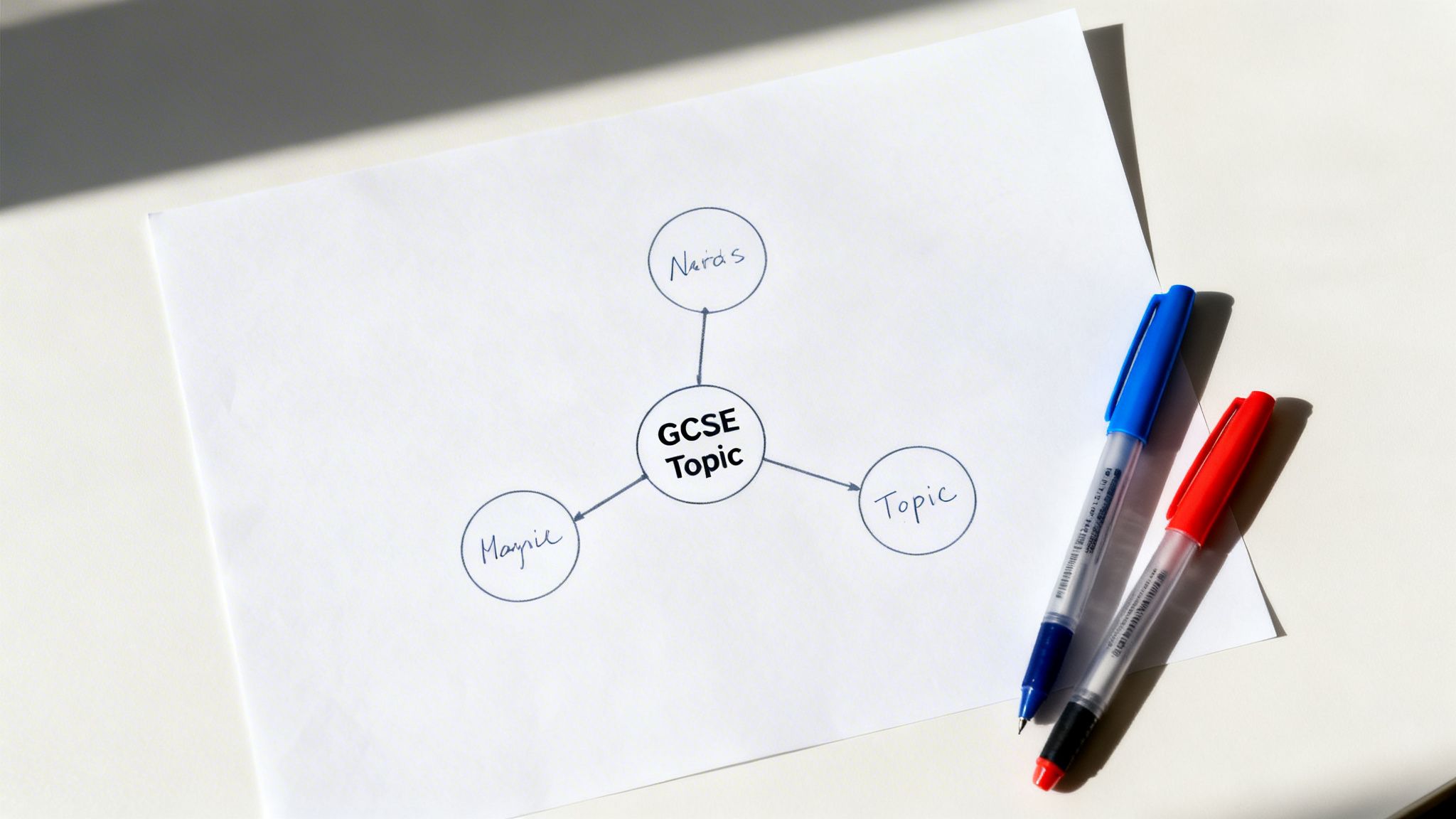
This isn’t just about making pretty notes; it’s about putting your understanding down on paper. For example, a GCSE History student could create a flowchart showing the causes, key events, and consequences of the Cold War. A GCSE Biology student might create a mind map for photosynthesis, with inputs, processes, and outputs branching out. This visual approach organises information in a way that your brain finds easier to recall under pressure.
How to Implement Conceptual Mapping
The goal is to build a web of knowledge, not just a list of facts. Here’s how to get started:
Map After Learning: Create your concept maps after you’ve learned a topic. They are tools to organise and connect information you've already covered. Start with a central idea and branch out.
Identify Connections: Use your MasteryMind topic dashboard to spot related topics. If you see several areas in a subject are at 70% mastery, try creating a map to link them together and push your understanding to the next level. This is key for answering those big, multi-topic exam questions.
Use Colour-Coding: Organise your map visually. You could use one colour for key terms, another for examples, and a third for links to other topics. This makes the information easier to digest at a glance.
Go Digital or Analogue: Pen and paper work great, but digital tools like Coggle or MindMeister allow for easy editing. Find what works best for you.
Test Yourself: Once you’ve created a map, put it away and try to recreate it from memory. This combines conceptual mapping with active recall, one of the most effective GCSE revision techniques available.
10-Point Comparison of GCSE Revision Techniques
Technique | 🔄 Implementation complexity | ⚡ Resource & time efficiency | 📊 Expected outcomes | 💡 Ideal use cases | ⭐ Key advantages |
|---|---|---|---|---|---|
Spaced Repetition | Moderate — scheduling + consistent engagement required | High long-term efficiency; low daily time once set up | Strong long-term retention; measurable exam gains | Language vocab, cumulative subjects, long-term revision | Reduces cramming; boosts retention and recall |
Active Recall | Low–Moderate — simple to implement but needs feedback | Very efficient learning per minute | Substantial retention and gap identification | Quick drills, flashcards, mixed-topic quizzes | Highly effective for memory; mirrors exam retrieval |
Interleaved Practice (Mixed‑Topic) | Moderate — needs curated mixed pools and planning | Slower initial learning; efficient transfer over time | Better problem selection and transfer to novel problems | Maths, science problem-solving, mixed-topic revision | Improves strategy selection and exam resilience |
Retrieval Practice with Elaboration | High — requires prompts and quality explanatory feedback | Time‑intensive per item but deeper payoff | Deeper conceptual understanding and transfer | Essays, multi‑step reasoning, higher‑order maths/science | Combines recall with reasoning for durable mastery |
Graduated Difficulty & Adaptive Learning | High — needs adaptive algorithms and accurate measurement | Efficient personalised progression; saves wasted practice | Tailored mastery and steady confidence building | Learners with varying levels; scaffolded curricula | Prevents overwhelm; adapts pace to student ability |
Practice Testing & Exam Simulation | Moderate — assemble authentic papers and timing protocols | Time‑intensive (full papers) but realistic practice | Strong predictor of exam performance; reduces anxiety | Final exam prep, full‑syllabus checks, timed practice | Most exam‑authentic; trains timing and exam stamina |
Elaborative Interrogation ('Why' & 'How') | Moderate — requires guided questioning and reflection | Time‑consuming but improves depth of processing | Increased conceptual links and long‑term retention | Concepts needing causal/functional understanding | Promotes deeper connections and meaningful learning |
Self‑Explanation & Metacognitive Monitoring | Moderate — habit formation and reflection prompts needed | Time‑consuming up front; prevents entrenched errors | Reveals misconceptions; improves independent learning | Problem solving, essay planning, complex tasks | Exposes faulty reasoning and improves self‑regulation |
Command Word Mastery & Exam Technique | Low — teach mapping of words + focused practice | Very efficient — small time investment, high impact | Immediate improvement in exam‑answer relevance | Any subject with structured exam questions | Directly reduces mark loss from misreading prompts |
Conceptual Mapping & Knowledge Organisation | Moderate — requires synthesis and visual design skills | Time‑consuming to create; quick to review later | Better integration, recall, and gap visibility | Complex topics, revision summaries, planning essays | Makes relationships explicit; great visual memory aid |
Your Next Move: Turn These Techniques into Top Grades
You’ve just been given a toolkit of the ten most powerful, evidence-based GCSE revision techniques out there. From the clever scheduling of Spaced Repetition to the deep thinking of Elaborative Interrogation, you now have the blueprint for effective learning. We’ve broken down how to move beyond passive reading into Active Recall, how to build flexible knowledge with Interleaved Practice, and how to fine-tune your exam performance with Command Word Mastery.
The crucial takeaway is this: revision shouldn’t feel easy. If your current methods feel comfortable, like re-reading notes or highlighting a textbook for the fifth time, it’s a red flag. Real learning, the kind that builds strong, recallable knowledge, feels like a workout. It involves struggle, effort, and actively pulling information from your brain. This mental effort is what builds strong connections, turning fragile, short-term memories into exam-ready knowledge.
From Knowledge to Action: Your Three-Step Plan
Simply knowing about these methods isn’t enough. The gap between an average grade and a top grade is closed by consistent, smart action. Here’s how to start turning these ideas into a real revision system that gets results.
Do a 'Revision Audit': Look at your current study habits. Are you a passive re-reader? An obsessive note-copier? Be honest. Find one or two passive habits you can replace right now. For example, instead of re-reading your Biology notes on the carbon cycle, commit to creating a Conceptual Map on a blank sheet of paper.
Start Small, Be Specific: Don’t try to do all ten techniques tomorrow. That’s a recipe for getting overwhelmed. Choose two to focus on this week. A powerful combination is Active Recall and Spaced Repetition. At the end of each study session, write down three key questions about what you just covered. The next day, before you start revising again, try to answer them without looking at your notes.
Embrace the Discomfort: When you try Retrieval Practice and can’t remember a key formula, or you attempt an exam-style question and miss the mark, don't see it as failure. See it for what it is: a crucial diagnostic tool. These difficult moments pinpoint the exact gaps in your understanding. This is where real progress is made. Resisting the urge to immediately check the answer and instead truly grappling with the problem is the most productive thing you can do.
The System is the Solution
Ultimately, the best GCSE revision techniques are the ones you use consistently. The goal is to build a reliable system, not just to cram frantically before an exam. By integrating methods like Practice Testing and Self-Explanation into your regular routine, you shift from last-minute panic to continuous, structured improvement. You begin to understand how you learn, which helps you identify weaknesses and adapt your strategy long before you walk into the exam hall.
This strategic approach does more than just prepare you for your GCSEs; it gives you learning skills that will be invaluable for A-Levels, university, and beyond. You're not just learning facts; you're learning how to learn. So, pick a technique, schedule it into your timetable, and start building your system for success today. Your future self will thank you for it.
Ready to automate your revision and put these techniques into practice effortlessly? MasteryMind integrates examiner-aligned Spaced Repetition, Active Recall, and mixed-topic quizzing to build you a personalised study plan. Stop guessing and start revising smarter by visiting MasteryMind to begin your journey to exam mastery.
Comments