A Guide to mock exams gcse: Study Tactics to Boost Success and Avoid Burnout
- Gavin Wheeldon
- Jan 28
- 16 min read

GCSE mock exams are a vital part of your preparation, acting as a full-scale dress rehearsal for the real exams. They're specifically designed to mirror the final exam experience, giving you the perfect chance to find and fix any knowledge gaps and get your timing down well before the actual GCSEs.
Mocks Are Training Runs, Not The Final Race
It’s easy to see mock exams as just another mountain of stress. Whether you’re chasing the top grades or feeling like you’re already behind, the pressure can feel immense, as if it’s a final judgment on all your hard work. But it's time to flip that script.
Think of your final GCSEs as a marathon. You wouldn't just turn up on race day having never run the distance before, would you? Of course not. That’s precisely what mock exams are: they're your crucial training runs. They aren’t about smashing your personal best or sprinting out of the gate. They’re about finding your rhythm, seeing where you get tired, and learning the twists and turns of the course.
The Real Purpose of a Training Run
Just as an athlete uses training runs to get race-ready, you can use mocks to build up your exam-day stamina. This isn't about exhausting yourself before the main event; it's about smart, strategic preparation in an environment where the stakes are low. You don't give everything on the training run before the big race.
A marathon runner uses training to figure out:
Pacing: How to spread their energy across the full 26.2 miles.
Weak Spots: Which muscles cramp up and need more conditioning.
Strategy: When to take on water or an energy gel.
In the same way, mock exams are a powerful diagnostic tool. They provide you and your teachers with a clear snapshot of what's working and what isn't, which allows for much smarter, more focused revision. For your teachers, the results offer priceless insights that help them tweak their teaching and give you targeted support exactly where you need it most.
Think of your mock results not as a final grade, but as raw data. It’s the feedback you need to turn a good performance into a brilliant one. It's your personalised map showing you the most direct route to improvement.
Turning Practice Into Performance
The true value of mock exams shines through in what you do after you get your results back. A disappointing grade isn't a failure—it's a massive signpost pointing directly to the topics or skills that need more of your attention. Did you run out of time? Misunderstand a question? Panic on a particular topic?
This is the kind of intel that transforms last-minute cramming into focused, efficient revision. By treating your mocks as a launchpad rather than a final verdict, you start building the confidence and technique needed to truly perform when it counts. They are your opportunity to make mistakes, learn from them, and build a rock-solid plan to conquer the real marathon ahead.
Why Mocks Are Your Secret Weapon For Top Grades

Let’s be honest, nobody looks forward to sitting a two-hour paper in a silent hall. It's easy to see GCSE mock exams as just another stressful hurdle to get over, but that’s one of the biggest mistakes you can make. Think of them less as a test and more as a powerful strategic tool – a secret weapon that can completely transform your approach to the final exams.
The real magic of mocks lies in their ability to mirror the final exam experience. Everything, from the unnerving silence and the pressure of the ticking clock to the specific format of the paper, is designed to get you ready for the real thing. This isn't about intimidating you; it's about building your resilience so you can conquer exam-day nerves before they even have a chance to show up.
It’s a bit like a pilot in a flight simulator. They don't just read the manual; they get in a cockpit and practise dealing with turbulence and tricky landings in a safe, controlled setting. Your mocks serve exactly the same purpose.
More Than Just A Grade
One of the most valuable things to come out of mock exams is the feedback they generate—for you and your teachers. A teacher can look at a class's results and immediately spot which topics need revisiting, allowing them to adjust their lesson plans to fill those gaps. For you, the student, the feedback is even more personal and far more powerful.
Your mock result is essentially a personalised roadmap, showing you exactly where you need to focus your revision. It helps you answer crucial questions that vague revision plans often ignore:
Knowledge Gaps: Which specific topics tripped you up? Was it covalent bonding in Chemistry or analysing poetic techniques in English?
Technique Flaws: Did you misunderstand command words, maybe 'evaluating' when the question asked you to 'describe'?
Pacing Issues: Did you run out of time and have to rush or leave high-mark questions at the end?
This kind of detailed insight shifts your revision from guesswork to a focused mission. You can stop wasting time covering things you already know inside out and direct your energy where it’ll make the biggest difference.
Predicting The Path To Success
Historically, mock results have been a surprisingly accurate predictor of final performance. This isn't just a teacher's hunch; the data shows a clear link between how students do in mocks and their final GCSE outcomes. For instance, research from FFT Education Datalab found a correlation of 0.95 between a school's 2019 GCSE results (for achieving a grade 7/A) and its historical averages. The vast majority of schools' results landed within 5 percentage points of their previous performance, showing just how much consistent practice helps stabilise results. You can explore the full findings on how historical data benchmarks GCSE results on their website.
This connection really underlines how important mock exams are. They don’t just prepare you; they give you a realistic forecast of where you stand, making it much easier to plot a course toward your target grades.
A low mock grade is not a sign of failure. It's an instruction manual. It's telling you exactly what to fix to get a higher grade when it actually matters.
At the end of the day, mock exams aren't the final race. They are the essential training sessions where you learn to manage the pressure, perfect your technique, and build the stamina you'll need on the day. If you embrace them as a tool for improvement rather than a final judgement, you unlock their true potential as your secret weapon for achieving the grades you’re really capable of.
How To Revise Smart For Your Mocks
Alright, you get it: mocks are the dress rehearsal, the training run before the big race. But what does a good training plan actually look like? Spoiler: it’s not about pulling all-nighters and cramming until your brain feels like mush. It’s about revising smart, not just hard.
Think of it this way: trying to revise for twelve hours straight is like attempting to sprint a full marathon. You’ll burn out before you even hit the halfway mark, and your performance will plummet. The real goal is to build genuine knowledge and exam stamina without hitting a wall.
So, let's ditch the panic-fuelled, caffeine-powered study sessions. Instead, we’re going to focus on proven, science-backed methods that help your brain actually hold onto information for the long haul.
The Power Duo: Active Recall and Spaced Repetition
Forget passively re-reading your notes until your eyes glaze over. If you want to make information stick, the two most powerful techniques in your arsenal are active recall and spaced repetition. They might sound a bit technical, but the ideas behind them are simple and incredibly effective.
Active Recall: This is all about pulling information out of your brain, not just shoving it in. Instead of reading a chapter on photosynthesis for the tenth time, close the book and try to explain the process out loud. Scribble down everything you remember on a blank piece of paper. This struggle is what forges stronger neural pathways, making the memory stick.
Spaced Repetition: Our brains are designed to forget things over time—it’s called the 'forgetting curve'. Spaced repetition is the perfect antidote. It works by prompting you to review information at increasing intervals. You might look at a topic again a day after learning it, then three days later, then a week later. This process signals to your brain, "Hey, this is important! Move it into long-term storage."
When you combine these two, you create a powerful revision cycle that builds deep, lasting understanding. You’re actively testing yourself on topics right at the sweet spot, just before you’re about to forget them.
Trying to learn everything in one go is like trying to drink from a fire hose—most of it just washes over you. Smart revision is about taking small, regular sips. This is how you build confidence and avoid burnout.
Building Your Sustainable Revision Timetable
A smart timetable isn't about scheduling every waking moment. It's about creating a rhythm of short, focused bursts of effort followed by proper breaks to let your brain recover and consolidate everything you've just learned.
A brilliant way to structure your sessions is with the Pomodoro Technique. It’s incredibly simple:
Pick a topic to work on.
Set a timer for 25 minutes and give it your absolute focus. No distractions.
When the timer pings, take a short 5-minute break. Get up, stretch, grab a drink—do anything but study.
After four of these 'Pomodoros', treat yourself to a longer break of 15-30 minutes.
This method keeps you fresh and prevents that dreaded mental fatigue that makes revision so unproductive. It also helps to mix up your subjects. A morning wrestling with Chemistry concepts could be followed by an afternoon analysing poetry. This keeps your brain engaged and actually improves how much you remember.
A well-structured week might look something like this. Notice how it mixes different subjects and includes dedicated time for both reviewing old material (spaced repetition) and relaxing.
Example Of A Smart Revision Timetable
Day | Morning Session (90 mins) | Afternoon Session (90 mins) | Evening Session (45 mins) |
|---|---|---|---|
Monday | Maths: Algebra Practice | History: WWI Source Analysis | Biology: Quick Quiz on Cells |
Tuesday | English: Essay Planning | Physics: Review Topic A (from last week) | Geography: Review Case Studies |
Wednesday | Biology: New Topic - Genetics | French: Vocabulary Practice (Active Recall) | Free Time / Hobbies |
Thursday | History: Review WWI Notes | Maths: Geometry Problems | English: Read Anthology Poems |
Friday | Physics: New Topic - Forces | Chemistry: Past Paper Questions | Relax - Watch a film |
Saturday | Review week's hardest topics | Free Time / Sport / Social | Light Reading / Planning |
Sunday | Rest Day | Rest Day | Plan the week ahead (15 mins) |
This is just a template, of course. The key is to find a rhythm that works for you, one that’s balanced, targeted, and, most importantly, sustainable.
Turning Theory into Practice
This is where your mock results become your secret weapon. Use them to pinpoint exactly where you need to focus. Don't just glance at the grade; dig into the feedback. Where did you drop marks? Was it a specific topic in Biology? Or perhaps you struggled with analysing sources in History? This is your roadmap for targeted revision.
Platforms like MasteryMind are designed to put these principles on autopilot. They use spaced repetition algorithms to schedule your revision and offer tools like voice-powered Blurt Challenges to make active recall a core part of your routine. The data backs this up: research from 2019 showed a correlation of 0.95 between mock performance at grade 7 and the final GCSE results, proving just how powerful this kind of practice is for stabilising outcomes. When you use tools that embed these learning science principles, you can boost your retention by as much as 50%.
By blending smart techniques with targeted practice, you turn revision from a chore you dread into a manageable and effective process. You can even build confidence with quick-fire quizzes that reinforce knowledge using active recall. This is how you train for the marathon—not with one exhausting sprint, but with consistent, intelligent effort over time.
Turning Mock Results Into A Personalised Action Plan
Getting your mock exam results back is a big moment. Whether you’re buzzing with a great grade or feeling a bit deflated, the paper in your hand is so much more than just a number. It's the starting point, not the finish line.
The real value of your mock exams gcse isn’t in the headline grade itself, but in the rich, detailed feedback hidden within it. Think of that grade as a signal, pointing you towards exactly what you need to do next to climb higher. It’s time to move past that immediate feeling of relief or disappointment and turn those results into a powerful, personalised action plan.
Digging Deeper Than The Grade
Your first instinct might be to glance at the grade and move on. But the most successful students treat their returned mock papers like a detective investigating a case. They hunt for clues that reveal not just what they got wrong, but why.
Was it a simple slip-up, or a sign of a deeper issue? The marks you dropped can usually be traced back to one of three common culprits:
Knowledge Gaps: You simply didn't know the information. Perhaps you forgot the formula for calculating moles in Chemistry or the key dates for a historical event.
Technique Errors: You misunderstood the question. This is a classic—misreading a command word like 'explain' when it asked you to 'evaluate', or not structuring a 9-mark answer correctly.
Pacing Problems: You ran out of time. Maybe you spent too long on the low-mark questions at the start and had to rush the big ones at the end, leaving easy marks on the table.
Figuring out which of these is your main stumbling block is the first step toward making massive improvements. After all, a low grade caused by running out of time needs a very different fix to one caused by not knowing the content.
Creating Your Error Analysis Log
To do this properly, you need a system. Grab your mock paper, a pen, and a fresh sheet of paper (or open a spreadsheet). This is where you’ll create a simple but incredibly effective Error Analysis Log.
Go through your paper question by question, focusing only on where you lost marks. For each one, make a note under these headings:
Question Number: The specific question you’re looking at.
Topic: What part of the syllabus was it testing? (e.g., Coastal erosion, Shakespeare's language).
Reason for Error: Be honest. Was it a knowledge gap, a technique error, or a timing issue? Write a short, clear note.
Action Step: What concrete step will you take to fix this? (e.g., "Create flashcards for key quotes," "Practise 6-mark 'explain' questions," "Attempt the last two questions of the next past paper first").
This process turns a disappointing result from a vague feeling of failure into a clear, actionable to-do list. Your revision is no longer generic; it’s now perfectly targeted at your specific weak spots.
Getting your mock paper back is like a doctor giving you a diagnosis. The grade is the symptom, but the detailed feedback on each question is the prescription for getting better. Follow it, and you're guaranteed to see improvement.
The diagram below shows how you can turn this analysis into a smart, repeatable revision cycle.
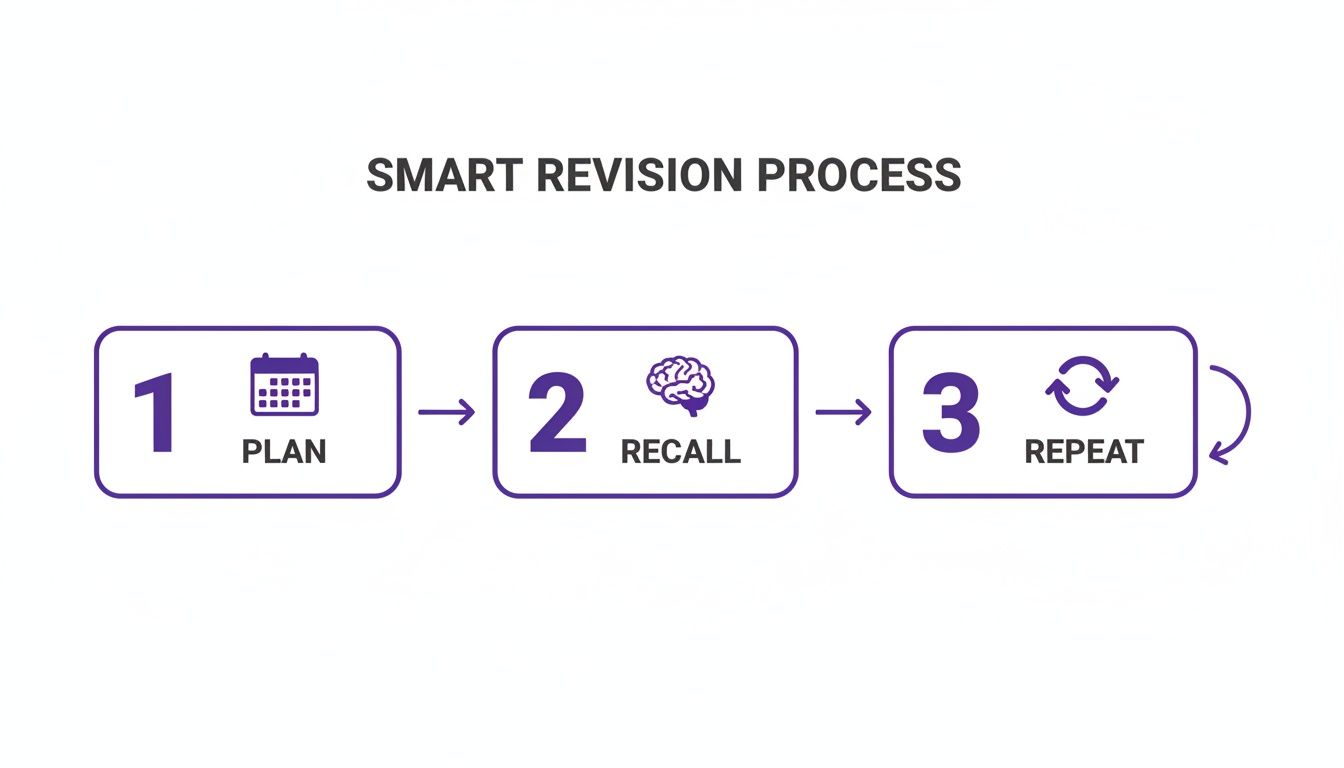
This just goes to show that real improvement comes from a continuous loop of planning based on feedback, actively recalling information, and then repeating the process.
Using Technology to Pinpoint Problems
For both teachers and students, this kind of deep analysis gets even more powerful when you bring in the right tools. Instead of manually logging every single error, some digital platforms can automate the whole process, giving you instant, examiner-style insights.
This screenshot shows how a platform can break down performance by specific assessment objectives, pinpointing exactly where a student is excelling or struggling. This kind of detailed breakdown automatically shows whether marks were lost on simple knowledge recall (AO1) or more complex analysis (AO3), creating a data-driven revision plan in seconds.
When your feedback is broken down by Assessment Objectives (AOs), it's like having an examiner whispering in your ear. Platforms like MasteryMind analyse your answers against the official mark schemes from exam boards like AQA and Edexcel. This means you see exactly what the examiner is looking for, turning every mock exam into a laser-focused lesson. Whether your grade was a 4 or an 8, this approach transforms it into a clear roadmap for success in your final exams.
Simulating Exam Conditions for Peak Performance
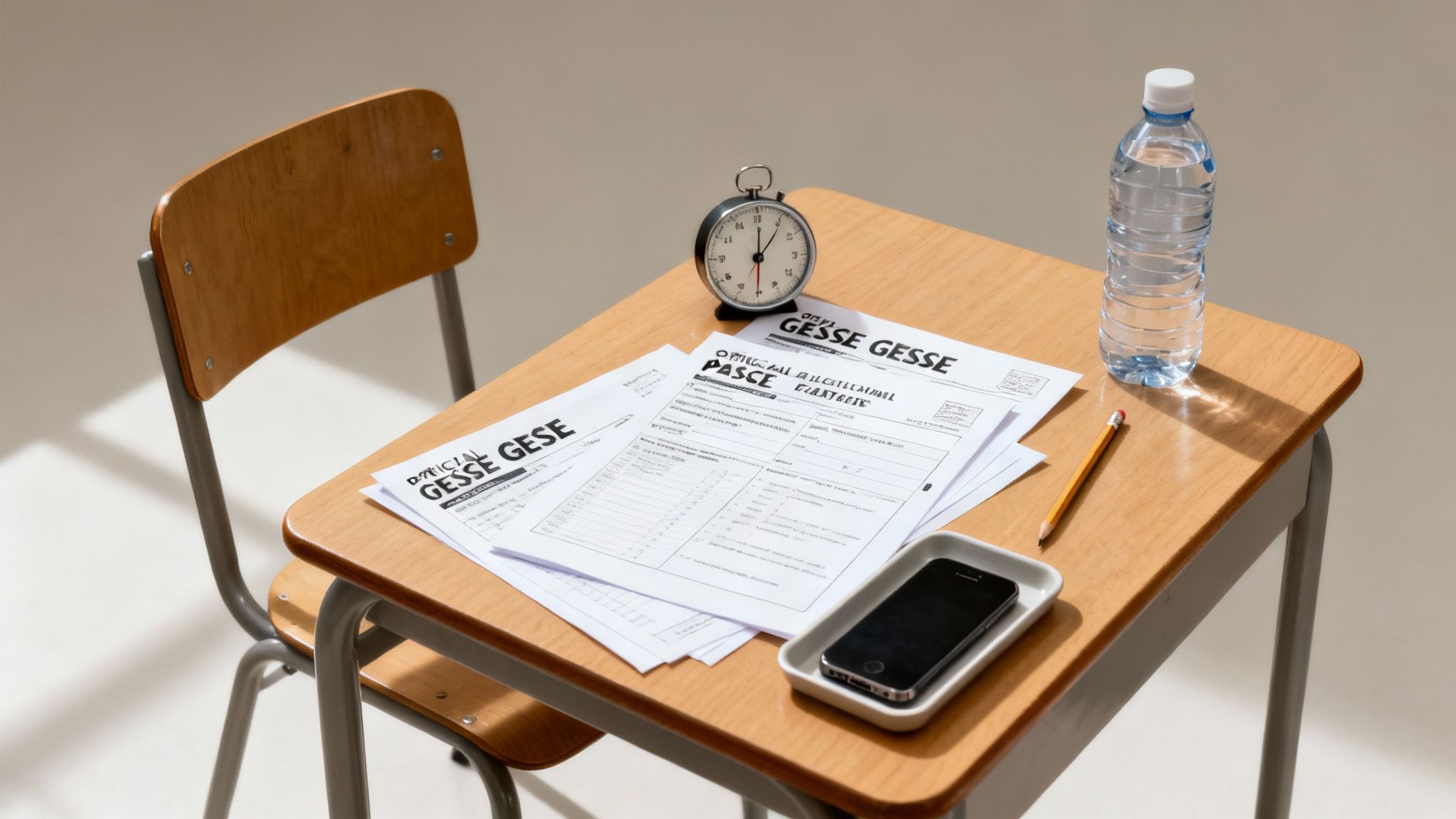
We've already talked about mocks being the training runs for your big GCSE marathon. But any runner will tell you that for training to work, you have to mimic race-day conditions as closely as you can. It's not just about knowing the route; it's about performing under real pressure.
This is why how you practise is just as crucial as what you practise. The whole point is to train your brain to stay cool and focused when the clock is ticking and you can feel the pressure mounting. Creating a realistic exam environment at home is one of the most powerful ways to prepare, turning a simple practice paper into a full-dress rehearsal.
To skip this step is like a sprinter only ever training on a treadmill. Sure, they might get fit, but they'll be completely thrown by the starting blocks, the feel of the track, and the noise of the crowd on the day. Simulating exam conditions is your chance to get used to the track.
Creating Your Exam-Day Simulation
So, how do you turn your desk into a believable exam hall? It’s easier than you might think and just comes down to a few hard-and-fast rules. The aim is to shut out every possible distraction and recreate that focused, silent atmosphere of the real thing.
Here’s your checklist for the perfect home simulation:
Find a Quiet Space: Let everyone in the house know you're starting a timed exam and can't be interrupted. Shut the door and clear your desk of everything except the absolute essentials.
Set a Strict Timer: Your phone is fine as a timer, but it must be on aeroplane mode, placed face down, and kept out of arm's reach. As soon as that alarm goes off, it's pens down. No cheating, not even for a few seconds.
Use Official Papers: Always try to get your hands on official past papers from the exam boards like AQA, Edexcel, or OCR. These are the gold standard for your mock exams gcse practice because they use the exact wording and question formats you'll see on the day.
This disciplined approach does more than just test what you know. It builds serious mental stamina and gets you comfortable with the feeling of working against the clock. Each time you do it, the real exam hall feels that little bit less scary.
Think of it like this: each simulated mock is a vaccine against exam-day panic. By exposing yourself to the pressure in small, controlled doses, you build up an immunity, allowing you to stay calm and perform at your best when it really counts.
Levelling Up With Digital Simulators
While past papers are a must, technology now offers an even more precise way to replicate the exam experience. This is where modern revision platforms really shine, offering digital simulations that get you as close to the real thing as possible from home.
These tools are built to mirror the structure and challenge of actual papers. For instance, MasteryMind's Exam Mode feature lets you sit full-length digital mocks that are perfectly aligned with your specific exam board's syllabus. It’s not just a random quiz; it's a meticulously structured experience.
The advantage here is twofold. First, you get instant feedback that shows you not just a score, but a proper breakdown of how you performed against the different Assessment Objectives—just like a real examiner would mark it. Second, it completely removes the temptation to sneak a peek at the mark scheme or give yourself an extra five minutes. The platform is the invigilator, making sure your practice is honest and truly effective.
This isn’t just about avoiding a nasty shock on results day. It’s about being proactive, getting familiar with the format, and building the resilience you need to walk into that hall with quiet confidence.
Common Mock Exam Mistakes And How To Avoid Them
It’s a familiar feeling: walking out of a mock exam kicking yourself. Maybe you ran out of time, totally misread a question, or were blindsided by a topic you’d completely skipped in revision. But here’s the thing—those moments aren’t failures. They’re signposts, pointing directly to where you can score more marks next time.
Recognising these common trip-ups is the first step toward fixing them. This isn't about beating yourself up for what went wrong; it's about spotting the patterns so you can make small, powerful tweaks to your exam technique. Think of it like a post-match analysis—what can you do differently to nail it on game day?
Misreading The Question
This is the absolute classic, the mistake that catches out even the most knowledgeable students. You spot a familiar keyword, dive straight in, and write down everything you know, only to realise far too late that the question asked you to ‘evaluate’, not just ‘describe’. Just like that, easy marks are gone.
The fix is almost laughably simple but incredibly effective: before your pen even hits the paper, highlight or underline the command word. Is it asking you to ‘explain’, ‘compare’, ‘analyse’, or ‘evaluate’? That single word is your instruction manual for how to structure the entire answer. Taking just five seconds to do this forces your brain to slow down and actually process what’s being asked of you.
Poor Time Management
Another all-too-common pitfall is pouring far too much effort into the low-mark questions. It feels great to write a mini-essay for a 2-mark question you know inside out, but it's a terrible strategy when it leaves you with only minutes to tackle a 9-mark monster at the end.
To get around this, you need to become ruthless with your timing. A solid rule of thumb is to allocate roughly one minute per mark. A 5-mark question gets about five minutes of your time, no more. This simple mental maths helps you maintain a steady pace throughout the paper, making sure the high-value questions get the time and attention they truly deserve.
A low grade on a mock exam isn't a judgement of your intelligence. It's feedback. It’s your personalised guide, showing you exactly what to tweak to unlock a better grade when it really matters.
Generic Answers and Wasted Intros
When the clock is ticking, it’s so easy to fall back on vague, waffly introductions that don’t actually say anything. Examiners see this constantly. An essay that kicks off with "In this essay, I will be discussing..." is just wasting ink and precious time.
Your aim should be to get straight to the point. Instead of a fluffy opening, start with a sentence that directly answers the question with a clear argument. For instance, rather than a generic paragraph about the author, jump straight in with: "Shakespeare uses Macbeth’s growing paranoia to directly explore the corrupting nature of ambition." It’s confident, it’s specific, and it starts earning you marks from the very first line.
Your GCSE Mock Exam Questions Answered
Still have a few lingering questions about your GCSE mocks? Don't worry, you're definitely not alone. Let's tackle some of the most common worries so you can walk into that exam hall feeling prepared and in control.
How Much Do Mocks Count Towards My Final Grade?
This is the big one, isn't it? The simple, official answer is that your mock exam results do not count directly towards your final GCSE grade. That final grade is determined solely by how you perform in the summer.
But—and this is a big but—they are still incredibly important. Your teachers use your mock performance to generate your predicted grades, which are vital for sixth form or college applications. So, while they don't count on paper, they absolutely matter in the real world.
What if I Get a Really Bad Result?
It's a horrible feeling, but a disappointing mock result is far from a disaster. In fact, you can flip it on its head and see it as one of the most useful bits of feedback you'll get all year. A poor result acts like a huge spotlight, showing you exactly which topics need your attention and where your exam technique is letting you down.
Think of your mock exam as a diagnostic test, not a final judgement. It’s highlighting the problem areas now so you have plenty of time to fix them. It's not a failure; it's a personalised roadmap for what to do next.
Should I Go All Out And Treat It Like The Real Thing?
In a word, yes—but with a bit of perspective. You should absolutely replicate the conditions of the real exam. Stick to the timings down to the second, work in silence, and apply all the proper exam techniques you've been taught. This is your best chance to get used to the pressure.
That being said, don't burn yourself out. Remember, this is a dress rehearsal, not the main performance. The goal is to test your knowledge and strategy, not to hit your absolute peak months too early. Give it your best shot, but keep your main mental and emotional reserves for the summer.
Ready to turn mock feedback into your secret weapon? MasteryMind provides instant, examiner-style feedback on your practice papers, pinpointing exactly where you need to focus. Start revising smarter at https://masterymind.co.uk.
Comments