Ace Your Exams: The Best Way to Revise and Smash Your Goals in 2026
- Gavin Wheeldon
- Feb 13
- 17 min read

It’s that time of year again. The exam hall is looming, and whether you're aiming for a last-minute rescue mission or to absolutely nail those top grades, the pressure is real. The advice flying around from teachers, parents, and friends can be a total overload: ‘just make notes,’ ‘do past papers,’ ‘don’t cram.’ But what actually works? And how can you make it stick without wasting precious time?
This isn't just another boring list of tips. We're diving into ten proven revision strategies that actually get results, especially for UK students tackling the beast that is GCSEs and A-Levels. We’ll break down the science behind each method in plain English, showing you exactly how to use them for maximum impact. Forget staring at your textbook until your eyes glaze over; we’re talking about active, smart techniques that build real memory and understanding.
For students, think of this as your game plan to revise smarter, not just harder. You'll learn how to turn lazy highlighting into powerful recall, transform chaotic study sessions into focused, effective learning, and analyse your mistakes like a pro. For teachers, this is a resource grounded in solid cognitive science that you can confidently share, offering your students practical steps to prepare without the fluff.
Our goal is to help you find the best way to revise for exams that truly clicks for you. Let’s get started on turning that exam panic into a solid plan and last-minute cramming into unshakable confidence.
1. Spaced Repetition
Spaced repetition is a seriously smart revision technique that fights the "forgetting curve" – our brain's natural habit of ditching information over time. Instead of cramming a topic once and hoping for the best, you review stuff at strategically increasing intervals. This method cleverly shifts knowledge from your shaky short-term memory into your more reliable long-term memory, making it a cornerstone for anyone looking for the best way to revise for exams.
The idea is simple: when you first learn something, you review it again soon. Each time you get it right, the gap before the next review gets longer. For example, you might look at a concept after one day, then three days, then a week, then a month. This process basically tells your brain, "Hey, this info is important – hang onto it."
How to Implement Spaced Repetition
This technique works best when you start early, giving the "spacing" enough time to work its magic.
Manual Method (The Leitner System): Use physical flashcards and a few boxes. Get a card right, it moves up to the next box (reviewed less often). Get it wrong, it goes back to the first box (reviewed more often).
Digital Tools: Loads of apps automate this. Platforms that offer AI Powered Revision are especially useful, as they often build spaced repetition right into their quizzes, matching review times with what you need for exam boards like AQA and Edexcel.
Top Tip: The point isn't just to see the information again; it's to actively pull it out of your memory. Always try to answer the question or recall the idea before you flip the card or check the answer. It’s this effort that strengthens the connections in your brain.
By scheduling your revision like this, you’re reinforcing topics just as you’re about to forget them. This makes your study time way more efficient and effective, turning a frantic cramming session into a structured, long-term learning strategy.
2. Active Recall with Voice-Powered Blurt Challenges
Active recall is all about pulling information out of your memory, not just passively reading or listening to it. It's probably the single most powerful study strategy because it’s exactly what you have to do in an exam: drag knowledge out of your brain under pressure. This makes it a non-negotiable part of the best way to revise for exams, as it builds strong, lasting memory connections.
Instead of just staring at your notes on the carbon cycle, active recall means closing the book and trying to sketch it out from memory. That struggle is what makes the learning stick. A cool, modern way to do this is with voice-activated tools that challenge you to explain what you know out loud, just like you would when writing an essay or a long-answer question.
How to Implement Active Recall with Blurt Challenges
This method is brilliant for making sure you properly understand complex topics and for practising your exam technique, especially for subjects like History, English, or Biology that need detailed explanations.
Verbal Explanation: Pick a topic and explain it out loud in as much detail as you can, without peeking at your notes. This is often called "blurting".
Digital Tools: Platforms like MasteryMind take this to the next level with a voice-powered Blurt Challenge. You speak your answer, and an AI gives you instant, examiner-style feedback and asks smart follow-up questions, pushing you to go deeper and fill in any gaps. For GCSE students, this is amazing practice for tackling those tricky command words under timed pressure.
Top Tip: When using a voice tool, speak in clear, full sentences like you’re writing an exam answer. Afterwards, record your response and listen back. This self-check helps you spot any waffle and see where your explanation is a bit weak or vague.
By forcing yourself to explain concepts out loud, you move beyond just recognising keywords and into actually understanding them. It’s way more demanding than passive reading, but the results are so much better, making your revision sessions more productive and getting you ready for the exam hall.
3. Exam Simulation with Past Papers
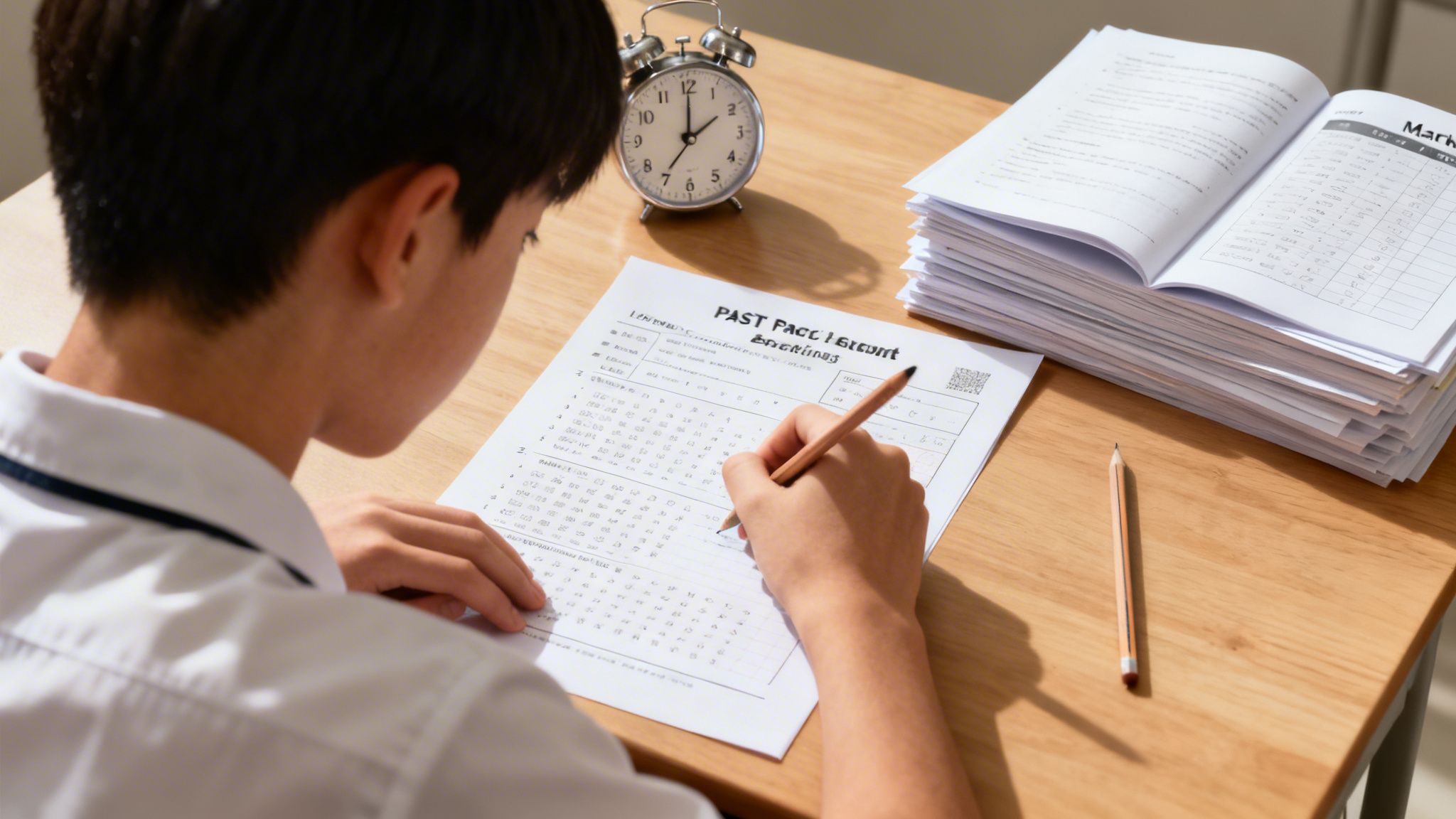
Using past papers is a must-do for effective revision, but just casually answering questions isn't enough. Simulating the real exam environment turns this from a casual task into powerful preparation. This means doing whole past papers under strict, timed conditions to build your stamina, sort out your timing, and get used to the exact style of questions you'll face. This approach is arguably the best way to revise for exams because it prepares you for the pressure of the day.
By recreating exam conditions, you find weaknesses in your knowledge and technique that only show up under pressure. You learn how to split your time between sections, what to do when you get stuck, and how to understand the specific command words used by exam boards like AQA and Edexcel. It’s the closest thing to a dress rehearsal, building both your skills and your confidence.
How to Implement Exam Simulation
This technique is most valuable in the final weeks before your exams, once you've got a decent grip on the content.
Create the Environment: Find a quiet space, put your phone away, and set a timer for the exact length of the paper. Only use the stuff you're allowed in the real exam.
Use Digital Platforms: For a more modern approach, platforms offering Exam Practice for GCSE can replicate the experience online. They give you instant feedback based on the mark scheme, so an A-Level Physics student, for example, could complete an OCR past paper and immediately see where they went wrong.
Top Tip: Don't just do the paper and check your score. The real learning happens when you analyse your mistakes. Go through the mark scheme and any examiner comments to figure out why you dropped marks and how to get them next time.
Simulating exam conditions gets rid of the element of surprise and cuts down on exam-day nerves. It means that when you walk into the hall, the format, timing, and question style feel totally normal, letting you focus all your energy on showing what you know.
4. Interleaved (Mixed-Topic) Practice
Interleaved practice means mixing up different topics or types of questions in one study session, instead of just hammering one topic at a time (which is called "blocking"). It might feel harder at first, but it forces your brain to work harder to tell the difference between concepts and problem-solving methods. This deeper processing is a highly effective, evidence-backed method and a real contender for the best way to revise for exams.
The idea, made popular by cognitive psychologist Robert A. Bjork, is that by switching between subjects, you train your brain to pick the right strategy for a problem without needing the context clue. In a real exam, questions on algebra, geometry, and stats are all jumbled up; interleaving copies this environment, getting you ready for the real thing and stopping you from getting stuck in one way of thinking.
How to Implement Interleaved Practice
This technique is about building mental flexibility and works best once you have a basic understanding of the individual topics.
Mix Your Subjects: Instead of a two-hour block on just Biology Paper 1, try 30 minutes on cell biology, 30 on genetics, and 30 on ecology. For GCSE Maths, you could do a few questions on algebra, then switch to trigonometry, and finish with probability.
Use Past Papers: Past papers are naturally interleaved. Doing them forces you to switch between topics just like the exam board wants you to, making them a great tool for this kind of revision.
Top Tip: Don't just switch topics randomly. Make a mini-plan for your session. For instance: "I'll do 20 minutes of poetry analysis, then 20 minutes of language paper questions, then back to 20 minutes on a different poem." This structure stops you from just jumping to the easiest stuff.
By interleaving, you’re not just memorising facts; you're learning to pick and use the right knowledge at the right time. This skill is vital for hitting the top grades and makes your revision much more resilient and adaptable to whatever the exam throws at you.
5. Dual Coding and Mind Maps
Dual coding is based on the idea that our brains handle information through two separate channels: a verbal one (for text and words) and a visual one (for images and diagrams). Popularised by Allan Paivio, the theory is that we learn and remember things way better when we combine both. Instead of just reading notes, creating a mind map or diagram forces you to process the information differently, building stronger and more varied connections in your brain. This makes it a super effective and often more engaging candidate for the best way to revise for exams.
The principle is simple: pair words with relevant pictures. When you need to recall the information in an exam, your brain has two routes to access it, doubling your chances of remembering. It turns passive reading into an active, creative task, helping to make complex topics feel more manageable and connected.

How to Implement Dual Coding and Mind Maps
This technique is great for organising big topics, summarising chapters, or linking different ideas together.
Mind Maps: Start with a central topic in the middle of the page. Branch out with key sub-topics, using keywords, short phrases, and simple icons or doodles to represent ideas. For example, a History student could map the causes and effects of a major event, using different colours for political, economic, and social factors.
Diagrams and Flowcharts: For processes in Biology (like digestion) or sequences in Computer Science (like an algorithm), drawing a visual flowchart can be much clearer than a page of text. Add notes to each stage to link the picture with the key terms you need to know.
Top Tip: Keep it simple and clear. The goal isn't to create a masterpiece but a functional revision tool. Use consistent colour-coding (e.g., green for good points, red for bad points) and stick to one main topic per map to avoid information overload.
By visually organising information, you're not just memorising facts; you're understanding the relationships between them. This deeper level of understanding is crucial for answering those big-mark, synoptic questions that separate the top grades in GCSE and A-Level exams.
6. Feynman Technique
The Feynman Technique is a mental model for learning that forces you to face up to what you actually understand versus what you think you understand. Made famous by Nobel Prize-winning physicist Richard Feynman, it’s based on the idea that if you can't explain something in simple terms, you haven't really got it. This method pushes you past passively reading notes and into a deeply active form of learning, making it a truly powerful and best way to revise for exams.
The process sounds simple but it's incredibly effective. You pick a concept, try to teach it to someone else (or even an imaginary person), spot the gaps in your own explanation where you get stuck or use jargon, and then go back to your notes to fill those gaps. This cycle of explaining and refining is what really cements the knowledge in your mind.
How to Implement the Feynman Technique
This technique is perfect for tackling complex topics you find hard to get your head around, from electron configurations in A-Level Chemistry to character motivations in GCSE English.
Step 1: Choose Your Concept. Pick a single topic from your revision list, like ‘photosynthesis’ or ‘dramatic irony’.
Step 2: Teach It. Grab a blank piece of paper or open a document and explain the concept as if you were teaching it to a 12-year-old. Use simple language, analogies, and avoid technical jargon as much as you can.
Step 3: Identify Gaps. As you explain, you’ll definitely hit a point where your explanation gets fuzzy or you have to rely on complicated words. Circle these areas – they are the weak spots in your understanding.
Step 4: Review and Simplify. Go back to your textbooks or revision guides to strengthen your knowledge on those specific weak points. Then, try explaining the whole thing again, aiming for a simpler, clearer explanation.
Top Tip: Record yourself explaining the concept out loud on your phone. When you play it back, listen for moments where you hesitate or your explanation is messy. This is a brilliant way to check your own understanding and see exactly where you need to focus your revision.
By forcing yourself to explain complex ideas simply, you uncover gaps in your learning that just memorising would hide. It turns your revision into an active process of discovery and true mastery.
7. Elaboration and Self-Explanation
Elaboration is about connecting new information to stuff you already know, while self-explanation involves explaining concepts to yourself in your own words. Instead of just passively reading your notes, this active technique forces your brain to build a richer, more connected web of knowledge. This deep processing method is fundamental to finding the best way to revise for exams because it goes beyond memorising to genuine understanding.
The basic idea is to constantly ask "how" and "why". When you read a fact or learn about a process, you don't just accept it; you question it, link it to other topics, and rephrase it until it makes total sense to you. This builds stronger memory connections, making information easier to recall under exam pressure because you understand the logic behind it, not just the surface-level facts.
How to Implement Elaboration and Self-Explanation
This technique can be used in almost any revision activity, from reviewing notes to doing practice questions.
Ask Probing Questions: As you review a topic, constantly ask yourself questions. For example, when studying mitosis in Biology, don't just memorise the phases. Ask, "Why is prophase the first step?" or "How does the alignment of chromosomes in metaphase make sure each new cell gets a full set of DNA?"
Teach the Concept: Imagine you have to explain the topic to someone who knows nothing about it. Try saying your explanation out loud or writing a quick summary in your own words. If you can't explain it simply, you haven't understood it deeply enough yet.
Top Tip: After answering a practice question, even if you got it right, take a moment to explain to yourself why that's the correct answer. For instance, after a MasteryMind quiz, you could add a note to each question explaining the logic behind the mark scheme. This small step turns simple practice into a powerful learning opportunity.
By actively elaborating on and explaining concepts, you’re not just reviewing information; you're reorganising and strengthening it in your mind. This leads to a more flexible and lasting understanding that is vital for tackling complex exam questions and hitting those higher grades.
8. Pomodoro Time-Management Technique
The Pomodoro Technique is a time-management method that breaks down your revision into focused, manageable chunks. Instead of facing a scary three-hour study session, you work in short, 25-minute sprints (called "Pomodoros") with short breaks in between. This approach boosts concentration, stops you from getting mentally drained, and is a fantastic way to build momentum, making it a key part of the best way to revise for exams.
Developed by Francesco Cirillo in the 1980s, the technique is based on the idea that frequent breaks can improve mental focus. By committing to just 25 minutes of solid, uninterrupted work, the task feels way less daunting. This cycle of intense focus followed by a short rest helps you stay productive over a longer period, preventing the burnout that often comes with marathon revision sessions.

How to Implement the Pomodoro Technique
This method is incredibly easy to start and just needs a timer. It’s perfect for beating procrastination and getting started on topics you've been putting off.
Set Your Goal: Choose a single task to work on, like planning a GCSE English essay or doing a set of Maths problems.
Work for 25 Minutes: Set a timer for 25 minutes and work on your chosen task with zero distractions. That means phone away, and irrelevant tabs closed.
Take a Short Break: When the timer goes off, take a 5-minute break. Get away from your desk, stretch, or grab a drink.
Repeat and Rest: After four Pomodoros, take a longer break of 15-30 minutes. This longer rest lets your brain reset before you dive into the next set of tasks.
Top Tip: Be strict with your timings. The magic of the Pomodoro Technique is in its structure. Resist the urge to quickly check a notification during a work sprint or to keep working into your break. That discipline is what builds focus and stops you from burning out.
By structuring your revision this way, you train your brain to focus intensely for short bursts. This makes your study time more efficient, helping you cover more ground with better understanding and less stress.
9. Metacognitive Reflection and Feedback Analysis
Metacognitive reflection, or simply "thinking about your thinking," is about understanding how you learn best. When you combine it with feedback analysis, it turns revision from just doing work into smart work. Instead of blindly doing past papers, you actively analyse your performance, spot weaknesses, and strategically change your approach. This makes it a crucial part of the best way to revise for exams.
The idea is to step back after a study session or mock exam and ask important questions: What did I get wrong? Why did I get it wrong? Was it a gap in my knowledge, did I misread the question, or was it a silly calculation error? This systematic review helps you find recurring mistakes and things you don't quite understand, letting you target the exact areas holding you back instead of wasting time re-studying stuff you already know well.
How to Implement Metacognitive Reflection
This technique is most powerful when it becomes a regular habit, turning every bit of revision into a chance to learn.
Manual Tracking: Keep an "error log" in a notebook. For every mistake in a practice test, write down the topic, the question, and why you think you made the error. Before your next session, look at this log to remind yourself what to watch out for.
Digital Tools: Advanced platforms can automate this analysis. For example, when you complete adaptive quizzes, you can track your topic mastery scores, easily spotting your persistent weak areas. Seeing your score on "Trigonometry" is always lower than others is a clear sign to schedule a dedicated session on it.
Top Tip: Schedule a 15-minute reflection session at the end of each week. Look over your work and your error log. Ask yourself: "What's the most common mistake I made this week, and what one thing can I do next week to fix it?" This focused approach leads to real, measurable improvement.
By regularly analysing your own performance, you take control of your learning. You go from being a passive student to an active strategist, making sure your revision time is spent as efficiently and effectively as possible, directly fixing the gaps in your knowledge and exam technique.
10. Peer Teaching and Collaborative Study Groups
One of the most powerful and often overlooked revision methods is teaching what you've learned to someone else. The act of explaining a concept out loud forces you to organise your thoughts, find gaps in your own understanding, and simplify complex information. This makes peer teaching a genuinely effective and active form of revision, making knowledge stick far better than passive reading ever could.
Collaborative study groups build on this by creating a supportive space where you can discuss tricky topics, solve problems together, and get fresh perspectives. Hearing a classmate explain a difficult concept in a different way can often be the lightbulb moment you need. This approach is a clear contender for the best way to revise for exams because it mixes active recall, problem-solving, and social accountability.
How to Implement Peer Teaching and Study Groups
Getting this right means more than just sitting in a room together; it needs to be structured to be effective.
Assign and Teach: Before meeting, give each group member a specific topic or sub-topic from one of your Subjects to become the "teacher" for. They are responsible for preparing a mini-lesson to give to the group.
Rotate Roles: To keep sessions interesting, switch roles. One person could be the "explainer," another the "question-setter" who makes up practice problems, and a third the "critic" who challenges explanations and looks for flaws in the logic.
Use Shared Tools: For subjects like A-Level Maths, groups can use shared online quizzes to compete and compare scores. This adds a fun, competitive element that motivates everyone to prepare properly and spot collective weak areas.
Top Tip: Don't just explain what you know well. Actively choose the topics you find hardest to teach. The process of preparing to explain something you're unsure about is an incredibly powerful revision tool. It forces you to face your weaknesses head-on and fill those knowledge gaps before the exam.
By turning individual revision into a team effort, you not only reinforce your own learning but also benefit from the collective knowledge of your friends. This method transforms revision from a lonely chore into an engaging, interactive, and highly productive activity.
Top 10 Exam Revision Strategies Compared
Method | Implementation Complexity 🔄 | Resource Requirements ⚡ | Expected Outcomes ⭐ / 📊 | Ideal Use Cases 💡 | Key Advantages ⭐ |
|---|---|---|---|---|---|
Spaced Repetition | Moderate 🔄🔄 | Low–Moderate ⚡⚡ (software/time) | High ⭐⭐⭐ · Strong long-term retention 📊 | Memorisation, vocab, formulae; long-term exam prep | Efficient retention; focuses weak items |
Active Recall (Voice Blurt) | High 🔄🔄🔄 | Moderate ⚡⚡ (microphone, quiet space) | High ⭐⭐⭐ · Rapid gap identification 📊 | Oral practice, timed Q&A, language recall | Multisensory engagement; instant feedback |
Exam Simulation (Past Papers) | Moderate 🔄🔄 | Low–Moderate ⚡⚡ (papers, timer) | High ⭐⭐⭐ · Improved timing & exam technique 📊 | Final exam prep; time management practice | Real exam familiarity; reduces anxiety |
Interleaved (Mixed-Topic) Practice | Moderate 🔄🔄 | Low ⚡ (question bank) | High ⭐⭐⭐ · Better adaptability & discrimination 📊 | Mixed-problem subjects (e.g., maths) | Enhances transfer; robust learning |
Dual Coding & Mind Maps | Low–Moderate 🔄🔄 | Moderate ⚡⚡ (drawing tools/time) | Moderate–High ⭐⭐📊 · Clarifies complex concepts | Concept-heavy subjects (history, biology) | Visual cues aid memory; clarifies relationships |
Feynman Technique | Moderate 🔄🔄 | Low ⚡ (time, peer/recording) | High ⭐⭐⭐ · Deep conceptual understanding 📊 | Difficult conceptual topics; peer teaching | Exposes gaps; simplifies understanding |
Elaboration & Self-Explanation | Low 🔄 | Low ⚡ (writing time) | High ⭐⭐📊 · Deeper processing & meaningful links | Essay subjects; concept integration | Encourages deeper thinking; links knowledge |
Pomodoro Time-Management | Low 🔄 | Very Low ⚡ (timer) | Moderate ⭐⭐ · Improved focus & reduced fatigue 📊 | Long study sessions; task-focused work | Boosts focus; prevents burnout |
Metacognitive Reflection & Feedback Analysis | Moderate 🔄🔄 | Moderate ⚡⚡ (dashboards, review time) | High ⭐⭐⭐ · Targeted revision & self-awareness 📊 | Ongoing course monitoring; exam planning | Identifies persistent gaps; informs strategy |
Peer Teaching & Collaborative Study Groups | Moderate 🔄🔄 | Moderate ⚡⚡ (peers, coordination) | Moderate–High ⭐⭐📊 · Reinforced learning & varied approaches | Group revision; problem-solving practice | Accountability; diverse problem-solving methods |
Your Personalised Revision Blueprint
We've explored ten powerful, evidence-backed strategies, moving far beyond the old advice of just re-reading your textbook until your eyes glaze over. The truth is, there isn’t one single, magic “best way to revise for exams” that works for everyone. The real secret is to build a personalised system that works for you, your brain, and your schedule. The goal is to stop being a passive passenger in your revision and become an active, strategic driver.
Think of these techniques not as a rigid checklist, but as a toolkit. Your job now is to be the architect of your own success. You might find your perfect formula is mixing several methods: maybe using the Pomodoro Technique to structure focused 25-minute blocks of interleaved practice, followed by a quick Feynman Technique explanation to lock in a tricky concept. Or maybe you'll save weekends for full exam simulations and use a voice-powered Blurt Challenge for quick active recall sessions on your commute.
From Theory to Action: Your Next Steps
The difference between knowing these strategies and actually getting better grades is action. Just reading about active recall or spaced repetition won't improve your results; using them consistently will. The most important thing to remember is this: effective revision is an active process. It involves pulling out information, making connections, and finding your own knowledge gaps. Passive methods like highlighting and re-reading feel comfortable, but they create a false sense of security that psychologists call the "illusion of competence". Real confidence comes from proving to yourself that you can recall and apply information under pressure.
To make this happen, here's your immediate action plan:
Experiment with two or three methods this week. Don't try to do all ten at once. Pick one time management technique (like Pomodoro) and one active learning strategy (like past papers or the Feynman Technique) and commit to using them for your next few study sessions.
Schedule your revision like it’s a non-negotiable appointment. Block out time in your calendar. A vague plan to "revise more" is useless. A specific plan like "Tuesday 4-5 pm: A-Level Biology, interleaved quiz on respiration and photosynthesis" is a commitment.
Embrace the struggle. If you find a topic difficult during active recall, that’s a good thing. It’s a sign telling you exactly where to focus your energy. This "desirable difficulty" is where real learning happens, building stronger connections in your brain that you can rely on in the exam hall.
Ultimately, mastering these revision techniques is about more than just passing your exams. It's about learning how to learn effectively – a skill that will serve you well beyond your GCSEs and A-Levels, through university and into your future career. By taking an active, strategic approach, you're not just memorising facts for a test; you're building a foundation of deep, lasting understanding. You are taking control of your learning, building resilience, and developing the confidence that comes from knowing you’ve prepared the right way. Start today, be consistent, and prove to yourself what you're truly capable of.
Ready to stop guessing and start implementing these powerful techniques? MasteryMind integrates spaced repetition, active recall quizzes, and examiner-style feedback into one platform, turning the best way to revise for exams into your daily routine. Build your personalised revision blueprint and unlock your potential at MasteryMind.
Comments