How to Improve GCSE Grades: Quick, Science-Backed Revision Tips
- Gavin Wheeldon
- Jan 26
- 17 min read

If you really want to improve your GCSE grades, the first step is to stop guessing. It’s easy to fall into the trap of thinking "I'm just bad at maths," but that’s not a plan. The real breakthrough comes when you know exactly what's holding you back – maybe it's simultaneous equations that always trip you up, or perhaps you just can't get your head around the Pythagorean theorem.
That's where a proper strategy comes in.
A Proven 3-Step Plan to Stop Guessing and Start Improving
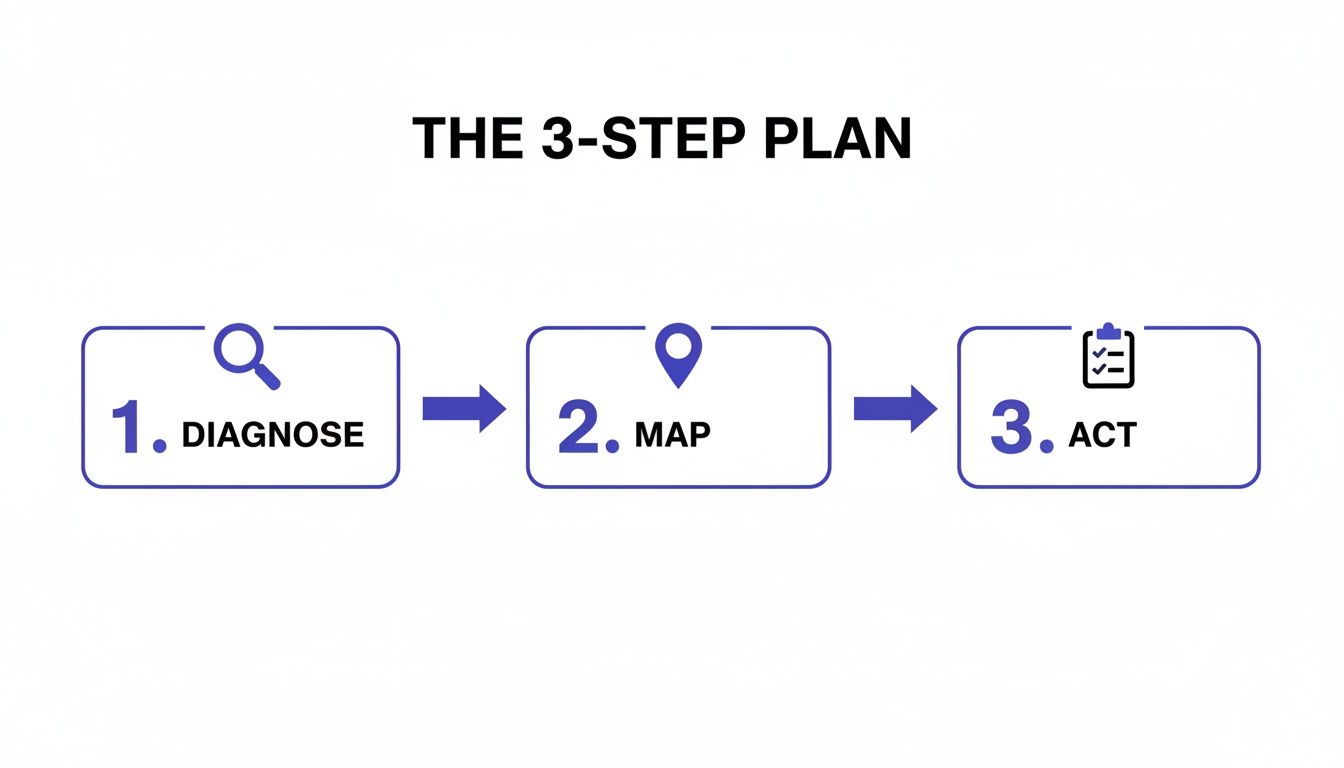
Feeling swamped by the sheer mountain of revision ahead? You're not alone. Whether you’re chasing 9s or just trying to bounce back from a disappointing mock result, the pressure is real. But here's the good news: the most important step isn't about locking yourself away for hundreds of hours. It’s about working smarter.
This all starts with a brutally honest look at where you actually are right now. Too many students fall into one of two traps: they either revise what they already know (because it feels good) or they completely avoid the topics that intimidate them. A strategic approach does the exact opposite. It makes you confront your weaknesses head-on.
Diagnose Your Strengths and Weaknesses
The bedrock of any successful revision strategy is an accurate diagnosis. Think of your mock results, past papers, and end-of-topic tests not as judgements, but as powerful diagnostic tools. They’re a data-rich map showing you exactly where the gaps in your knowledge are.
So, instead of seeing a 5 in Biology and feeling defeated, dig into the details. Was it the questions on required practicals that let you down? Did you blank on the specifics of the nitrogen cycle? Getting this specific is what separates passive revision from active improvement.
A one-size-fits-all approach just doesn't cut it. Government data reveals that only 45.8% of 16-year-olds in England achieve a grade 4 or above in seven or more GCSEs. This shows just how many students get left behind without a focused, personal plan. You can see more insights from the Department for Education on this.
Conduct a Personal Revision Audit
Now, let's turn that diagnosis into a clear roadmap. It's time to conduct a personal 'Revision Audit'. This is a simple but incredibly powerful exercise. Grab a piece of paper or open a new spreadsheet and let’s get started.
Here's a simple template to honestly assess where you stand in each subject and what you need to focus on to improve your grades.
Your Personal Revision Audit Template
Subject | Current Grade or Confidence (1-5) | Target Grade | Top 3 Weakest Topics | Top 3 Strongest Topics |
|---|---|---|---|---|
History | 4 | 6 | Medicine Through Time (1250-present), Elizabethan England, Source analysis skills | Cold War tensions, Normans, Basic essay structure |
Chemistry | 5 | 7 | Organic chemistry, Quantitative chemistry (moles), Bonding | Atomic structure, Periodic table, Acids and alkalis |
English Lit | 6 | 7 | A Christmas Carol (context), Unseen poetry comparison, Shakespearean language | Macbeth plot, An Inspector Calls themes, Poetry analysis (single poem) |
Fill this out for every one of your subjects. Be completely honest with yourself—no one else needs to see it.
This audit transforms a huge, terrifying task into a series of smaller, manageable problems. Instead of "I need to revise all of physics," it becomes "I need to master the equations for momentum and then tackle electromagnetism." That shift in perspective is everything.
Build a Revision Timetable That Actually Works

You’ve done the hard work of auditing your performance, giving you a brutally honest picture of your strengths and weaknesses. Now, it's time to build a plan.
Let’s be honest, though. We’ve all seen those beautifully colour-coded timetables stuck proudly on the wall, only to be completely ignored by Wednesday. They fail because they’re rigid, unrealistic, and don’t account for how our brains actually learn.
A revision timetable that gets results isn't a prison sentence; it’s a flexible guide built on solid learning science. It should force you to tackle the topics you identified as weaknesses without letting your stronger subjects go stale. The goal is to build a sustainable routine that prevents burnout, not one that guarantees it.
This means you have to ditch the idea of cramming one subject for an entire day. Instead, we’re going to build your plan around two powerful techniques that top-performing students swear by: Spaced Repetition and Interleaving.
Spaced Repetition and Interleaving: The Basics
These might sound like jargon, but the concepts are simple and incredibly effective. In our experience, they are the foundation of any real advice on how to improve GCSE grades because they work with your brain, not against it.
Spaced Repetition: This is the absolute opposite of cramming. Rather than trying to master a topic in one marathon session, you revisit it at increasing intervals. For instance, you might study the causes of the Cold War on Monday, review it briefly on Wednesday, then again the following Tuesday. This process signals to your brain that this information is important and needs to be shifted into your long-term memory.
Interleaving: This just means mixing up different subjects or topics within a single study session. So, instead of grinding through three hours of maths, you could do an hour of algebra, followed by an hour analysing a poem for English, and then an hour on cell biology. It feels tougher at first, but it forces your brain to switch gears and pull different types of information from memory, which dramatically strengthens your problem-solving skills.
Since exams returned to their pre-pandemic format in 2022, students who properly adopted spaced repetition have seen some of the biggest gains. UK education stats show that consistent practice that mirrors the style of exam boards like AQA and Edexcel boosts retention by hitting weak spots early. This exact approach contributed to the 1.1 percentage point rise in top grades (grade 7 and above) since 2019. You can read the full analysis on GCSE trends to see the data for yourself.
How to Build Your Dynamic Timetable
So, what does this actually look like day-to-day? A good timetable is a weekly template, not a minute-by-minute script. It needs to balance your 'must-do' subjects with your 'could-do' ones and, crucially, include proper downtime.
Here’s a simple way to structure it:
Block Out Your Non-Negotiables: Before you even think about revision, block out school hours, travel, meals, sports practice, and any other fixed commitments. Be realistic about your energy levels, too—scheduling a heavy physics session for 9 pm on a Friday is setting yourself up to fail.
Give Weak Areas Priority: Look at your Revision Audit. Dedicate your prime study slots—those times when you feel most alert—to the top three weakest topics you identified in your core subjects.
Mix It Up (Interleave): Plan to cover two or three different subjects each evening. A productive session might look like this: 45 minutes of Maths practice, a 15-minute break, 45 minutes on History flashcards, another quick break, and then 30 minutes reviewing French vocabulary.
The secret is consistency over intensity. Four focused 45-minute sessions spread across the week are far more effective than a single, miserable four-hour cramming session on a Sunday.
Finally, remember this plan isn't carved in stone. If you master a topic quicker than expected, adjust. If you’re feeling totally drained, take a proper break. Modern AI-powered tools like MasteryMind can automate this whole process, creating an adaptive schedule that ensures you’re always working on the topics that will make the biggest difference to your final grades.
Ditch Passive Learning and Master Active Recall

You’ve got a timetable that works. Brilliant. Now we need to get real about how you revise, because this is where so many students go wrong.
Let’s be blunt: rereading your notes, highlighting pages until they’re fluorescent, and just staring at a textbook is one of the least effective ways to study. It feels like you’re doing something productive, but it’s a trap.
This is passive learning, and its biggest danger is the false sense of security it creates. Your brain recognises the words on the page, which feels a lot like knowing the material. But recognition isn’t recall. When you’re sat in the exam hall, you won’t have the textbook in front of you.
To see a real jump in your GCSE grades, you have to switch to active recall. Think of it as a mental workout. It’s the act of deliberately pulling information out of your memory, which is what builds strong, lasting connections. It’s the difference between watching a football match and actually playing in one.
Why Your Brain Needs the Struggle
Imagine your memory is a path through a dense forest. Passively rereading your notes is like taking a casual stroll down a path that’s already well-trodden. It’s easy, almost mindless.
Active recall, however, is like being dropped in the middle of that forest and forced to find the path yourself. It’s tough. You might take a wrong turn. But the effort of navigating your way back strengthens your internal map. That struggle is precisely where real learning happens.
Trying to retrieve information from your brain is a far more powerful learning event than having information put into your brain. This single shift in your revision strategy can be the difference between a grade 5 and a grade 7.
This isn’t just a nice idea; it’s backed by decades of cognitive science. Students who make retrieval the centre of their revision consistently outperform those who just reread. So, how do you actually do it?
Practical Ways to Use Active Recall Today
Breaking old habits can be difficult, but these methods are simple to implement and give you a massive return on your time. The trick is to close the book and make your brain do the heavy lifting.
Here are three powerful techniques you can start using right away:
The Feynman Technique: Take a concept you find tricky—osmosis in Biology, say, or dramatic irony in An Inspector Calls. On a blank piece of paper, try to explain it in the simplest terms you can, as if you were teaching a 10-year-old. The moment you get stuck or find yourself using jargon you can't explain, that's your cue to go back to your notes, figure it out, and try again.
Smarter Flashcards: Don't just write a term and a definition. Create flashcards with real exam-style questions. Instead of "Treaty of Versailles," write, "What were the three main consequences of the Treaty of Versailles for Germany?" This forces you to retrieve a structured, detailed answer, not just a keyword.
Practice Questions (No Safety Net): This is the ultimate form of active recall. Do past paper questions under timed conditions. The crucial part? Do it without your notes open beside you. It's a true test of what you actually know and the closest you’ll get to simulating the real exam.
Supercharge Your Revision with Smart Technology
While these classic methods are fantastic, you can make active recall even more efficient with the right tools. Imagine being able to just talk about a topic and get instant, targeted feedback on what you missed.
This is where a feature like MasteryMind’s voice-powered Blurt Challenge comes into its own. You speak your revision notes aloud, and our AI analyses your response against the official curriculum. It instantly pinpoints the gaps in your knowledge and creates a personalised quiz to help you fill them.
You can learn more about how the Blurt feature turns a simple brain-dump into a dynamic, focused revision session. It’s about combining the proven power of retrieval with immediate, actionable feedback—making every single minute you spend revising count.
Think Like an Examiner to Unlock More Marks
Knowing your subject inside out is only half the battle. The other half? Proving what you know in the exact way the examiner wants you to.
Getting top GCSE grades is a game, and like any game, it has rules. The mark scheme is your rulebook.
Too many students drop marks, not because they don't know the material, but because their answers don't tick the specific boxes on the examiner's checklist. This is what we call exam technique, and it’s the secret to turning a good answer into a great one. It’s all about learning to speak the examiner’s language.
This means getting to grips with the hidden structure behind every question. You need to understand the command words that tell you what to do, and the Assessment Objectives (AOs) that dictate where the marks actually come from.
Demystifying Command Words and Assessment Objectives
Every GCSE subject is marked against a set of Assessment Objectives. Don't be put off by the jargon—they're just a breakdown of the different skills you need to show.
For example, in a History essay, AO1 covers your knowledge and understanding, while AO2 is all about explaining and analysing historical events. An essay might be worth 16 marks in total, with eight for AO1 and eight for AO2.
Knowing this is a massive advantage. If you just write a brilliant, detailed story of what happened, you’ve completely ignored the 50% of marks available for analysis. You have to decode what the question is really asking, and that starts with the command word.
Think of command words as your instructions. 'Describe' asks for a story. 'Explain' asks for the 'why'. 'Evaluate' asks you to make a judgement, weighing up the evidence. Ignoring the command word is like ignoring your satnav and then wondering why you’re lost.
A student who brilliantly describes the causes of a conflict when the question asks them to evaluate its consequences will score poorly, no matter how much they actually know. It’s a classic mistake.
Decoding Common GCSE Command Words
Understanding what examiners are asking for is crucial. This table breaks down common command words and what you need to do to get the marks.
Command Word | What It Really Means | Example Action |
|---|---|---|
Describe | Give a detailed account of something. Recount a series of events or features. | For Geography, you'd list the features of longshore drift without necessarily explaining the process. |
Explain | Give reasons why something happens. Make the relationships between things clear. | For Science, you would detail not just what happens during photosynthesis, but why light is essential for the chemical reaction. |
Analyse | Break something down into its separate parts and show how they are linked. | For English Literature, you'd deconstruct a poet's use of a metaphor and explain its specific effect on the reader. |
Compare | Identify similarities and differences between two or more things. | For Business Studies, you would look at the pros and cons of being a sole trader versus a private limited company. |
Evaluate | Make a reasoned judgement. Weigh up the arguments and evidence to come to a conclusion. | For History, you'd argue which factor was the most significant cause of a war, justifying your choice over other factors. |
See the difference? They all require your subject knowledge, but they ask you to use it in very different ways.
Structuring Your Answers for Maximum Marks
Once you’ve understood the question, you need to structure your answer to make it ridiculously easy for the examiner to give you marks. Remember, they have hundreds of papers to get through, so clarity is your best friend.
For shorter-answer questions, the classic P-E-E (Point, Evidence, Explain) structure is your go-to. Make your point, back it up with a specific piece of evidence, and then explain how that evidence proves your point. Simple and effective.
Essays, of course, need a bit more thought. A solid structure usually involves:
A clear introduction that sets out your main argument.
A few paragraphs, each exploring a different point (often using P-E-E within them).
A strong conclusion that ties everything together and directly answers the question again.
Using signposting language like "Firstly," "On the other hand," and "In conclusion," helps guide the examiner through your logic. Don’t leave them guessing.
This is where targeted practice really pays off. By working through GCSE past papers that are aligned with your exam board, you start to see the patterns in how questions are phrased and marks are awarded. It’s the single best way to train yourself to think like an examiner.
This is also where smart tech can give you an edge. Instead of waiting days for a teacher's feedback, you can get instant, examiner-style guidance. Imagine finishing a tricky multi-step maths problem and immediately seeing where you went wrong. Or writing a practice essay for AQA History and getting a breakdown of your performance against the AOs, showing you exactly where you missed out on analysis marks. This is how you systematically close the gap between a grade 6 and a grade 8.
Tailored Strategies for Core Subjects and Beyond
While powerful techniques like active recall and spaced repetition form the engine of your revision, you need to steer that engine in the right direction. To really accelerate your progress, you have to adapt your approach to the unique challenges each subject throws at you.
It's one thing to memorise the theory of photosynthesis, but it's another entirely to correctly interpret data from a required practical you've never seen before. You might know the plot of Macbeth inside out, but that won't help you analyse an unseen poem from a writer you’ve never even heard of.
This is where you graduate from general revision to targeted, subject-specific practice. It’s all about getting your hands dirty with the exact types of problems that separate the good grades from the great ones.
Cracking the Core Subjects
Every subject has its own hurdles. For some, it’s the sheer volume of content; for others, it’s about demonstrating specific skills under immense pressure. The secret to unlocking more marks is to focus your energy on these pinch points.
Here’s a look at some common stumbling blocks in the core subjects and how to get past them:
Maths: Forget just chasing the right answer. Examiners need to see your thinking. For any multi-step problem, get into the habit of writing down every single stage of your working out, even if it feels ridiculously obvious. "Showing your working" isn't just for the examiner; it's a lifeline that helps you trace your own steps and catch errors before they snowball.
English Literature: That unseen poetry question can feel like pure guesswork, but I promise you, it's a process. Start by reading the poem twice: once to get a general feel for it, then a second time with a pencil in hand to actively highlight interesting words, imagery, and structural features. Don't hunt for a single "right" answer. Instead, focus on building a convincing interpretation and backing it up with solid evidence from the text.
The Sciences (Biology, Chemistry, Physics): It's all about application, application, application. You absolutely have to connect your knowledge to required practicals and complex calculations. Instead of just memorising formulas, find practice questions that force you to rearrange them or apply them to unfamiliar scenarios. For the practicals, make sure you understand the why behind each step—why was that specific chemical added? Why was that exact temperature used?
The real jump in grades happens when you can confidently apply what you know to brand-new situations. This isn’t a talent you’re born with; it’s a skill that requires dedicated practice on the specific question types you'll face in the exam hall.
This kind of focused preparation is proving more effective than ever. Recent data on GCSE results shows gender gaps in top grades are narrowing, partly because revision is becoming more personalised. Boys' entries graded 7 or above rose to 20.5%, closing the gap with girls. This really highlights how effective it is when students use tools that adapt to their specific needs, whether that's for unseen poetry or tricky maths problems. You can discover more about the latest GCSE trends from Ofqual for more insight.
Beyond the Core: Your Secret Weapons
It isn’t just the big three subjects where specific strategies make a world of difference. From coursework-heavy projects to highly technical fields, a tailored approach is essential for anyone serious about improving their GCSE grades.
Think about the unique challenges in these areas:
Computer Science: This subject often boils down to pure, logical problem-solving. For understanding algorithms, you need to make trace tables your new best friend. Seriously. Work through binary and hexadecimal conversions until they become second nature. The more you practise these specific, repeatable skills, the more automatic they’ll become when the exam clock is ticking.
Coursework and NEAs: Subjects with a Non-Exam Assessment (NEA) component, like Design & Technology or Art, play by their own set of rules. The key here is structure and process. Break down your entire project into manageable chunks and give yourself strict mini-deadlines for each one.
This is where a smart tool can give you a significant edge without ever crossing the line into cheating. An AI-powered ‘NEA Coach’, for instance, can offer Socratic guidance. It can ask you probing questions about your project's structure or methodology, prompting you to think more critically about your own work. Crucially, it stays within JCQ rules by never giving you the answers directly, helping you build the skills you need to succeed on your own merit.
A Few Common Questions About Smashing Your GCSEs
Even with the best-laid plans, a few questions are bound to pop up. When you’re in the thick of revision, it's easy to get bogged down by doubts or lose a bit of perspective. Here’s some straightforward advice for the most common worries students have when aiming to boost their GCSE grades.
How Can I Realistically Improve My Grades in a Short Amount of Time?
Look, improving your grades quickly isn't about magic; it’s about being ruthlessly efficient. Forget trying to revise everything. The very first thing you need to do is triage your subjects using that Revision Audit we talked about. Find the subjects where you're hovering just below a grade boundary—those are your golden opportunities where a little focused effort will deliver the biggest, fastest wins.
Once you’ve got your targets, you need to flip your whole revision approach on its head. Aim to spend 80% of your time on active recall—that means doing practice questions, ideally under timed conditions—and only 20% on passively reading notes. This forces you to confront what you don’t know, which is far more productive than just rereading things you already feel comfortable with.
This is where an adaptive tool can be a game-changer. It ensures every minute is spent drilling down into your specific weak spots. When you combine that with instant, examiner-style feedback, you can fix fundamental mistakes in your technique fast, unlocking marks that were previously just out of reach. It’s simply the smartest way to make serious gains when the clock is ticking.
Is It Better to Revise One Subject All Day or Switch Between Them?
I know it can feel more productive to dedicate a whole day to a single subject, but the research on this is really clear. Switching between subjects, a technique known as interleaving, is far more effective for building strong, long-term memories.
Think of it like this: when you spend 90 minutes on Maths and then switch to analysing a poem for English, you're forcing your brain to work harder. It has to rummage around and pull the right information from different mental filing cabinets. This "desirable difficulty" actually strengthens the connections in your brain, making the knowledge much easier to retrieve under pressure in the exam hall.
Besides, slogging away at one subject for hours often leads to burnout and diminishing returns. A well-built revision timetable should have two or three different subjects scheduled each day, broken into 45- to 90-minute blocks with proper breaks. This keeps your mind fresh and makes every study session count.
My Predicted Grades Are Low. Is It Too Late to Turn Things Around?
Absolutely not. Predicted grades are just a snapshot in time, not a final verdict on what you can achieve. We've seen countless students make incredible progress in the final few months before their exams. The key isn’t to panic; it’s to commit to a completely new strategy.
If what you've been doing so far hasn't got you the results you want, it's time to ditch it. Stop rereading. Stop highlighting. And please, stop avoiding the topics you find difficult. Instead, you need to go all-in on the proven methods we’ve covered in this guide.
Predicted grades reflect your past performance, but your final grades will reflect your future effort and strategy. A focused, consistent push now can completely change the outcome.
Start today. Honestly assess your weaknesses. Build a new timetable based on spaced repetition and interleaving. Make active recall the absolute core of every single study session and get obsessed with mastering mark schemes and exam technique. It also helps to use tools that track your progress, as seeing those small wins can be a huge motivational boost, showing you just how far you’ve come.
How Do I Manage Exam Stress and Avoid Burnout?
Let's be clear: managing stress isn't a "soft skill"—it’s as crucial to your success as any revision technique. Your brain simply cannot learn and recall information properly when it’s flooded with the stress hormone, cortisol. Burnout is the real enemy of progress.
You need to treat your downtime as seriously as your study time. Schedule breaks into your timetable and, most importantly, actually take them. The Pomodoro Technique is a brilliant way to start: work in a focused 45-minute burst, then take a mandatory 15-minute break completely away from your desk. No phones!
Sleep is non-negotiable. Aim for 7-9 hours a night. Your brain consolidates memories and processes what you've learned while you rest. Skimping on sleep to cram more revision is one of the most counterproductive things you can possibly do.
Finally, try to keep some perspective. Your GCSEs feel like the most important thing in the world right now, and of course, they are important. But they don't define your intelligence or your entire future. Keep up with a hobby, see your friends, and get some fresh air. Just focus on doing your personal best—that's all anyone can ask.
Ready to stop guessing and start making real, measurable progress? MasteryMind replaces passive revision with an active, AI-powered plan that’s perfectly aligned with your exam board. Get instant, examiner-style feedback, tackle adaptive questions, and use tools like the Blurt Challenge to lock in knowledge for good. Start for free and see the difference a smarter strategy can make at masterymind.co.uk.
Generated with Outrank app
Comments