How to Prepare for Maths Exams Smartly for GCSE and A Level Success
- Gavin Wheeldon
- Feb 12
- 16 min read

The secret to acing your maths exams isn't about pulling endless all-nighters. It’s about having a smart plan. The most effective approach is to first figure out your weak spots, then laser-focus your practice where it’ll count, and finally, master the exam technique itself to squeeze out every last mark. This structured method turns random effort into real, measurable progress.
Your Smart Maths Revision Game Plan
Feeling the heat from your upcoming maths exams? Whether you're trying to pull your grade up at the last minute or you're gunning for a top grade, the secret isn't just working harder—it's about working smarter. This guide goes way beyond the standard 'do more past papers' advice. We’ll walk you through building a personalised revision plan that pinpoints your weaknesses, uses proven learning science, and helps you walk into that exam hall with genuine confidence.
This isn't just for the A* students. It's for anyone who feels like their current revision strategy just isn't cutting it. Maybe you're putting the hours in but your mock results don't reflect it. Or maybe you're just staring at a mountain of topics and don't know where on earth to start. The good news? A structured approach makes a world of difference, no matter where you're starting from.
The Three Pillars of Effective Maths Revision
A rock-solid strategy for maths revision boils down to three core activities: planning your time, identifying your knowledge gaps, and practising with purpose.
This simple flow chart lays it all out.
As you can see, each stage builds on the last. It’s a cycle designed to make your revision efficient and targeted squarely at boosting your grade.
We’re going to cover everything from creating a timetable that you’ll actually stick to, to understanding precisely what examiners are looking for. Think of this as your practical roadmap from confusion to clarity. For a deeper dive into the subject itself, check out our guide on mathematics for more resources.
The goal here is simple: make sure every minute of effort you put in translates into the grades you deserve. Forget last-minute cramming. Let’s build a proper foundation for success. This isn't about being a "maths genius"; it's about having a better process.
Find Your Weaknesses to Focus Your Revision
Jumping straight into past papers without knowing where you're losing marks is like driving without a map. It feels productive, but you could be going in circles. Honestly, the single most important thing you can do right now is figure out your weak spots. This isn't about feeling bad about what you don't know; it's about gathering intel to make your revision genuinely count.
Think of it as a diagnostic check. A doctor wouldn't prescribe medicine without first figuring out what's wrong, and your revision should be exactly the same. By identifying specific areas—whether it's trigonometry, algebraic fractions, or vector geometry—you can spend your precious time where it will have the biggest impact on your final grade.
This targeted approach is absolutely crucial. With so much pressure on UK students, every single mark matters. In the 2025 GCSE results, only 58.2% of students in England managed a grade 4 or above in maths. This starkly highlights that simply "doing maths" isn't enough; you need a strategy that directly addresses your personal knowledge gaps to get on the right side of those statistics. You can explore more about these trends and see what they mean for students gearing up for these exams.
Conduct a Personal Topic Audit
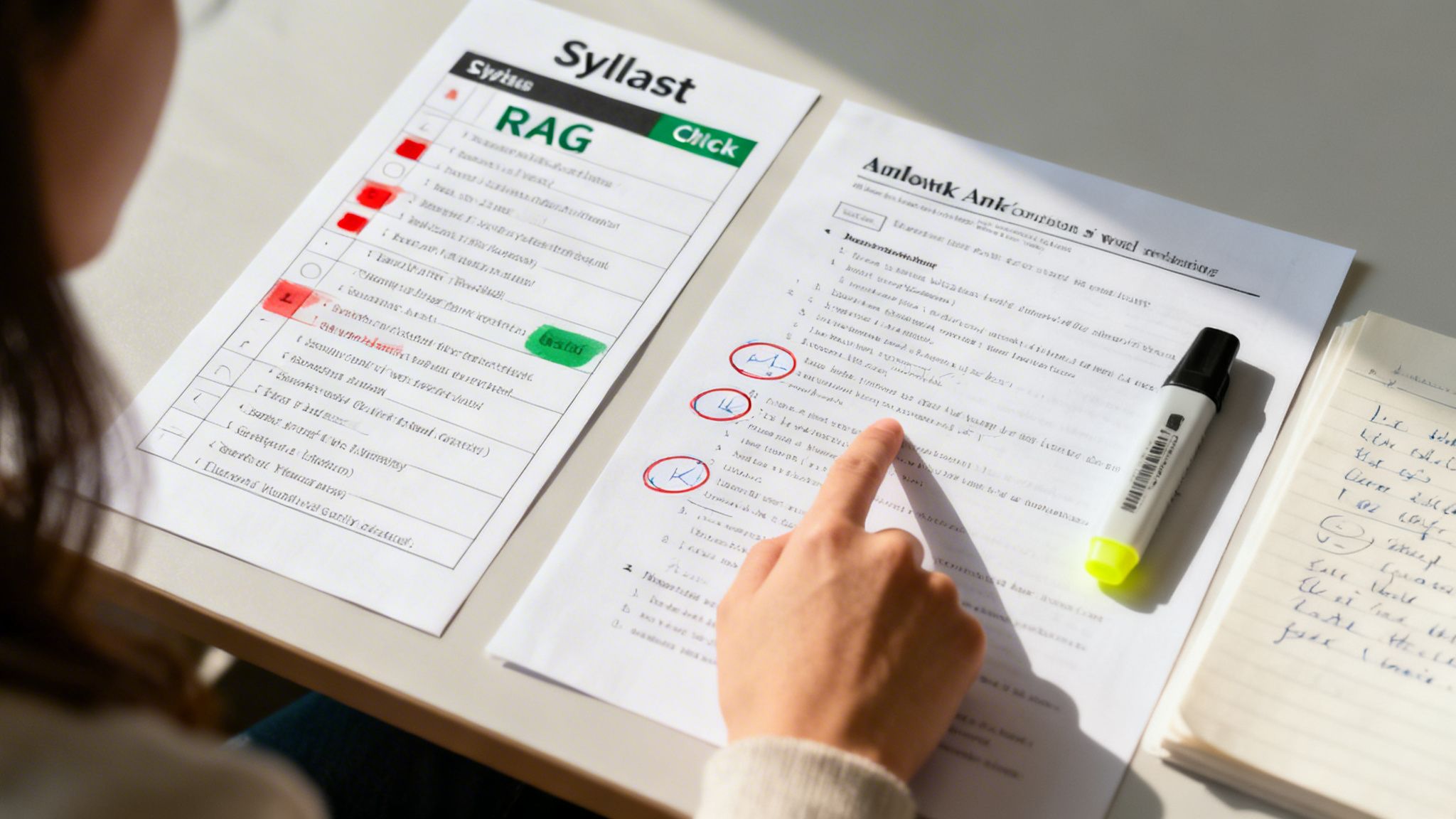
So, how do you actually find these weak spots? The classic method, and one I always recommend, is a Red-Amber-Green (RAG) list. It’s unbelievably simple but so effective.
First, get your hands on your exam board's syllabus (you can find it easily on the AQA, Edexcel, or OCR website) and a few highlighters. Now, go through every single topic listed.
Green: Highlight topics you are totally confident with. You feel like you could teach them to a friend and you consistently get the questions right.
Amber: These are the topics you're just 'okay' with. You get the main idea but sometimes slip up, especially on more complex problems.
Red: These are the topics that make your stomach drop. You avoid them, find them confusing, or just seem to get them wrong no matter what.
Once you’re done, you'll have a clear, visual map of your revision priorities. Those red topics are your new best friends. Why? Because they represent the biggest potential for improving your grade.
Your RAG list isn't just a to-do list; it's your strategic battle plan. It tells you exactly where to focus your energy to turn weaknesses into strengths, one topic at a time.
Analyse Your Last Mock Exam
Your most recent mock exam is a goldmine of information. Please don't just glance at the grade and shove it in a drawer. You need to perform a proper post-mortem on it.
Grab a fresh piece of paper and go through your mock question by question, with the mark scheme beside you. For every single mark you lost, write down two things: the topic of the question and why you lost the mark.
It usually boils down to one of these common reasons:
Knowledge Gap: You genuinely didn't know how to approach it. (This is a red topic!)
Careless Mistake: A silly slip in your calculation, like a misplaced negative sign or a simple arithmetic error.
Misread Question: You answered a different question to the one that was actually asked. It happens to everyone.
Poor Technique: You knew the method but didn't show your working correctly, or you messed up the layout.
This process gives you a clear, evidence-based picture of where things are going wrong. You might be surprised to find that 70% of your lost marks come from just three or four topics. Now you know exactly where to focus your revision for the biggest return. If you're looking for a more automated approach, tools like MasteryMind can run this diagnostic for you, using adaptive quizzes to map out your strengths and weaknesses from day one.
Master Exam Technique, Not Just the Maths
Knowing the maths is crucial, but it's only half the battle. Getting the right answer is one thing; presenting it in a way that scoops up every possible mark is a completely different skill. This is where solid exam technique comes in, and it's often the very thing that separates a grade 7 from a grade 9.
It’s a skill that, frustratingly, often gets pushed aside in the classroom rush to get through the syllabus.
This part of your revision is all about learning to see your paper through an examiner's eyes. Your job is to make it as easy as possible for them to award you marks. Through clear working, logically structured answers, and understanding what a question really wants, you can turn a good attempt into a perfect one.
Decode the Examiner's Language
Ever stared at a question and thought, "What on earth do they want me to do here?" You're not alone. Examiners use specific command words to ask for very specific things, and misinterpreting them is a classic way to throw away marks, even when your maths is spot on.
Here’s a quick rundown of some common ones you need to know:
Evaluate: This is a clear instruction to work out a numerical answer. Don't leave it as an expression or a formula; they want a final number.
Show that: The answer is literally given to you in the question. Your task is to produce a detailed, step-by-step logical proof that gets you there. You can't afford to skip any steps.
Hence: This word is a massive clue. It means "using what you've just done." You absolutely must use the result from the previous part of the question. Trying a different method, even if it works, will likely score you zero.
Prove: This demands a formal, rigorous mathematical argument. You need to build your case from first principles or established theorems, justifying each statement you make.
Getting familiar with these is a game-changer. It shows the examiner you understand the rules of the game, which is a key skill they're testing.
Think Like an Examiner with Mark Schemes
Mark schemes are your secret weapon. Most students glance at them just to see if their final answer is right, but their real value lies in showing you how marks are awarded along the way. When you mark your own practice papers, you need to put on an examiner's hat.
Look out for the different types of marks:
M marks (Method marks): Awarded for showing you know the right process. Crucially, you can get these even if a calculation slip-up means your final answer is wrong.
A marks (Accuracy marks): These are for getting the numbers right. You almost always need to have earned the preceding M mark to get the A mark.
B marks (Independent marks): Given for specific bits of information, like a correct statement or a reason, that don't depend on method marks.
By analysing these, you'll quickly realise that "showing your working" isn't just good advice—it's where the bulk of your marks are hidden. For a tough 5-mark question, you might get 3 method marks just for setting up the problem correctly and following the right procedure.
Don't just check your final answer against the mark scheme. Analyse it. Ask yourself, "Where exactly would I have earned each M mark and A mark in my working?" This transforms revision from just 'doing questions' to strategically learning how to score points.
Use Your Calculator Like a Pro
Your calculator is so much more than a number cruncher; it's a powerful tool that can save you precious minutes and catch silly mistakes. But only if you know how to use it properly.
Here’s a quick pre-exam checklist for your calculator:
Check the Mode: Is it in Degrees (DEG) or Radians (RAD)? Getting this wrong in a trigonometry question is a guaranteed way to lose every single accuracy mark.
Know Your Functions: Can you instantly find the functions for statistics, solving simultaneous equations, or finding the roots of a quadratic? These features can save you a huge amount of time.
Use the Answer Button: Get comfortable using the 'ANS' button to carry your previous result into the next calculation without re-typing it. This massively reduces the risk of input errors on multi-step problems.
Honestly, spending just one hour messing around with your calculator's advanced functions is one of the highest-return revision activities you can do. It's a simple step that will make you faster and more accurate when the pressure is on.
How to Use Past Papers for Peak Performance
Right, let’s talk about the single most powerful tool in your revision toolkit: past papers. Everyone knows you should do them, but how you use them is the difference between spinning your wheels and making real progress. Just ploughing through one paper after another isn't the smart way to do it. Think of it like a musician practising scales – it's the foundation, but it's not the whole performance.
The real magic happens when you use past papers strategically. It’s about more than just doing questions; it’s about simulating the exam experience to build your knowledge, stamina, and that all-important confidence. This is how you make sure there are no nasty surprises on exam day.
Start with Targeted Practice
Before you even think about sitting down for a full, timed paper, you need to be surgical. Remember that RAG list you created? It's time to put it to work. Forget doing a whole paper from start to finish for now. Instead, hunt down questions from past papers that specifically target your red and amber topics.
Why does this work so well?
It builds confidence. Nailing a few tricky trigonometry questions in a row is an incredible morale booster and shows you can do it.
It’s incredibly efficient. You're laser-focusing your precious time on plugging the biggest gaps in your knowledge, which is where you'll make the fastest gains in marks.
You can find plenty of websites that have already done the hard work for you, grouping past paper questions by topic for exam boards like AQA and Edexcel. Hammer these until your red topics turn amber and your amber topics feel solidly green.
Move to Timed Conditions
Okay, once you're feeling more comfortable across the board, it's time to add a bit of pressure. The next logical step isn't a full mock exam, but smaller, timed sections. The exam hall is a high-stakes environment, and learning to perform under the clock is a skill in itself.
Give this a try:
Pick a section of a paper – maybe the first third or half.
Calculate the time. A good rule of thumb is one minute per mark. So, if your paper is 90 marks in 90 minutes, a 30-mark section should take you 30 minutes.
Create exam conditions. Find a quiet spot. Phone off and out of sight. Set a timer and go. No interruptions.
This gets you used to the required pacing without the mental fatigue of a full two-hour slog. You’ll quickly get a feel for how long you can really afford to spend on a 5-mark question versus a quick 1-marker.
Tackling full past papers against the clock is the final piece of the puzzle. This builds the mental stamina needed to stay sharp from the first question right through to the last.
Mark Your Work Like an Examiner
This is, without a doubt, the most important step – and the one most students get wrong. Don't just glance at the back of the paper to see if you got the right number. You need to become a detective, using the official mark scheme to analyse your own work.
For every single mark you lost, ask yourself why. Was it a simple calculation slip? Did you misread the question? Or was it a genuine gap in your understanding?
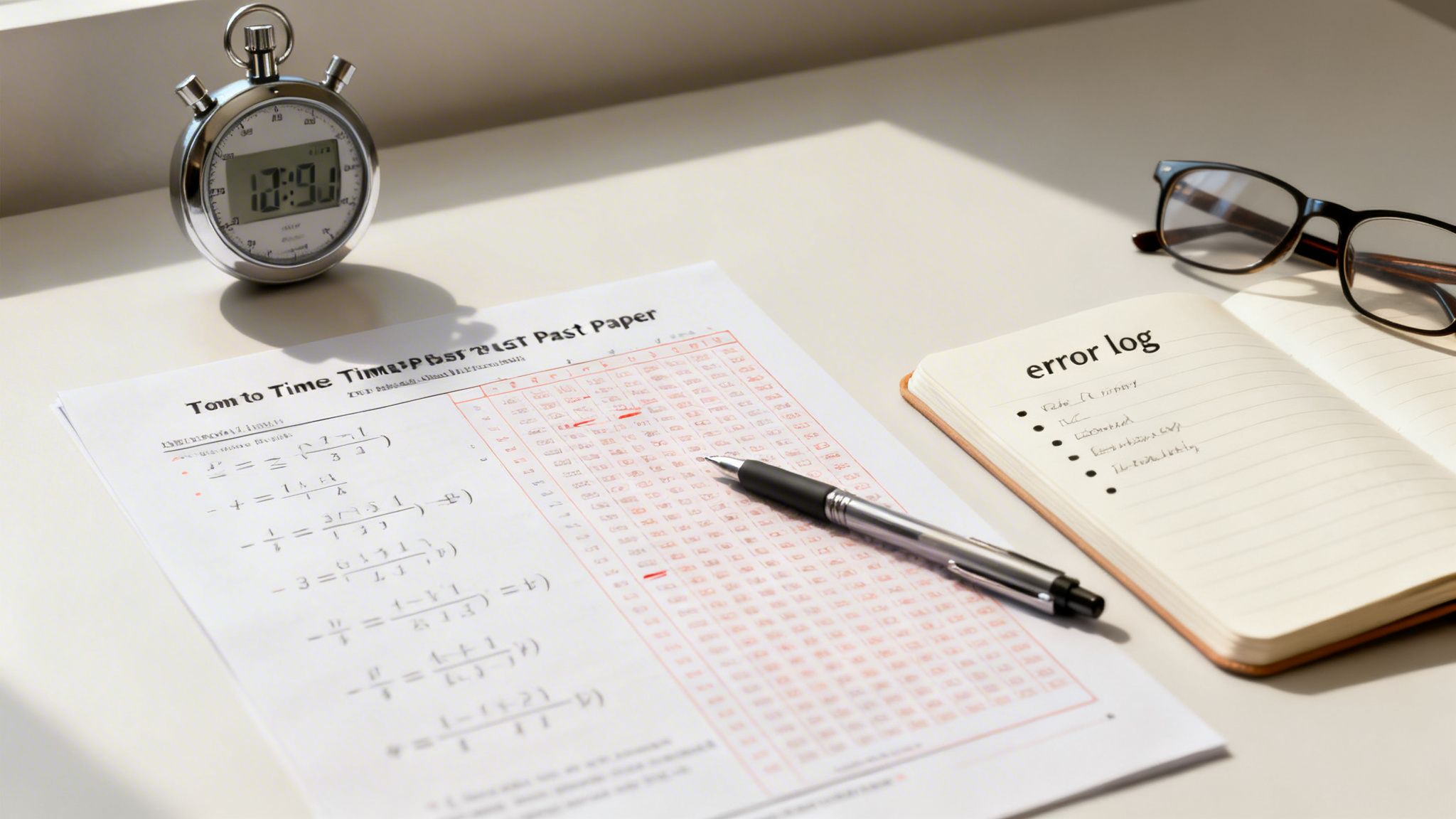
This is where you need to start an 'error log'. It doesn't have to be fancy; a notebook or a simple spreadsheet will do. For every mistake, log:
The topic of the question.
The root cause of the error (e.g., "forgot formula for the volume of a cone," "made a sign error in algebra," "confused 'perimeter' with 'area'").
A quick note on the correct method.
After a few papers, this log will show you undeniable patterns. Are you always rushing the arithmetic? Do you consistently misinterpret questions about inequalities? Your error log provides the hard evidence you need to fix your recurring issues.
This kind of methodical self-correction is what separates good students from great ones. At A-Level, where in 2025, 41.3% of UK maths students achieved an A or A, the competition is fierce. To be in that top bracket, you have to turn every single mistake into a learning opportunity. Our platform has a powerful way to practise with past papers, giving you instant, examiner-style feedback to make this whole process faster and more effective.
Beat The Forgetting Curve With Smart Study Methods
Ever spent a whole weekend cramming a topic, felt like you knew it inside out, and then a week later… nothing? It’s a frustratingly common experience, and there's a name for it in learning science: the forgetting curve. It’s a stark reminder of how quickly we lose information if we don't actively try to keep it.
Simply re-reading your notes or watching a video once is a passive act. It creates a weak memory that fades, fast. If you want to actually recall that knowledge under exam pressure, you need to use smarter, more active revision methods. Let’s look at two of the most powerful techniques that will make your maths revision stick for good.
Use Spaced Repetition To Remember More
Spaced repetition is the perfect antidote to the forgetting curve. Instead of hammering a topic in one marathon session, you review it at increasing intervals. Maybe you look at it again after one day, then three days, then a week, and so on.
Every time you revisit the material, you strengthen the neural pathway in your brain, making that memory much harder to forget. This is so much more effective than spending five straight hours on trigonometry in a single afternoon.
Here’s a simple way to put it into practice:
Day 1: Learn a new topic (e.g., sine and cosine rules) and do a few practice questions.
Day 2: Spend just 10-15 minutes briefly reviewing the key formulas and trying one or two quick questions.
Day 4: Spend another 10-15 minutes on a slightly trickier problem from that same topic.
Day 8: Fold it into a mixed practice paper with other topics.
This approach feels less intense, but believe me, it delivers far better long-term results.
Get Active With Your Recall
The second crucial technique is active recall. This is all about forcing your brain to pull information out, rather than just passively pushing it in by reading or listening.
Flicking through a textbook feels productive, but it’s often just recognition—you see the formula and think, "Yeah, I know that." Active recall is the real test; it proves you can generate it from scratch when faced with a blank page.
This active retrieval process is what builds strong, lasting memory connections. Think of it like this: it's the difference between recognising a friend in a photo and being able to draw their face from memory. One is easy recognition; the other is hard-won recall.
Active recall is the mental equivalent of doing a heavy lift at the gym. It might feel difficult, but it's the struggle that actually builds the muscle. Every time you force your brain to retrieve a formula or a method, you are making that memory stronger and more accessible for the exam.
A brilliant way to practise this is with the Blurt method. Just take a blank piece of paper, write a topic at the top (say, "Circles and Tangents"), and then splurge everything you can remember about it onto the page. Formulas, theorems, key steps, common mistakes—get it all down.
Only after you've exhausted your memory should you check your notes to see what you missed. This instantly shows you what you really know versus what you only thought you knew.
The need for smarter preparation is clear. With GCSE maths entries in England hitting 856,430 for summer 2025 and post-16 resits surging by 14%, the pressure is on. Even with stable pass rates, data shows that among students re-taking maths post-16, 33.2% improved their grades, but a similar number saw no change at all. This just proves that repeating the same old study methods isn't enough; you need better techniques to make real progress.
By combining active recall with spaced repetition, you create a powerhouse system for deep, long-lasting learning. Another great strategy to throw into the mix is interleaved practice, which involves mixing up different topics in your revision to build your problem-solving flexibility.
Your Final Countdown: The Week Before The Exam
The final week is not the time to be learning new topics. Honestly, trying to cram something you've never seen before will just send you into a spin. This last stretch is all about consolidation, building up your confidence, and getting your mind and body ready for the big day.
Think of it less as a frantic sprint and more as a cool-down lap. The goal is to walk into that exam hall feeling prepared and calm, not completely wiped out. Overdoing it now is one of the biggest mistakes students make – you risk burning out right when you need to be at your sharpest.
Your Final Week Game Plan
The best approach is to structure these last seven days to gently wind down, focusing only on the high-value stuff that shores up your confidence. Light, consistent review is your new best friend.
7 to 5 Days Out: Go back to your error log for one final look. You don't need to do full papers, just pick a handful of the trickiest questions you previously got wrong and work through them again. This is a powerful reminder of how far you've come and how you've learned to tackle those tough problems.
4 to 3 Days Out: Now it's time to switch to much lighter revision. Casually flick through your formula book or your summary sheets. The idea is simply to keep the key facts and methods ticking over in your mind, not to get bogged down in heavy problem-solving.
2 Days Out: Get your exam bag packed. Lay everything out: multiple black pens, pencils, a ruler, protractor, compass, and of course, your calculator. Pro tip: put fresh batteries in your calculator. It’s a tiny thing, but it prevents a world of panic on the day.
The night before the exam? It should be totally revision-free. No exceptions. Your brain needs downtime to process and store all the information you've fed it. Watch a film, listen to music, read a book—whatever helps you switch off. Trust the work you've put in.
The Morning Of The Exam
On exam day, your only job is to stay calm. Stick to your normal routine as much as possible.
Make sure you have a decent breakfast, but don't eat anything unusual that might not agree with you. Plan your journey with plenty of buffer time built in; arriving late is a stress-multiplier you just don't need.
When you get to the exam centre, try to avoid those frantic, last-minute chats with friends about that one impossible question on circles. It will only make you doubt yourself. You've done the prep. Now it's just about showing what you know.
Your Top Maths Exam Questions Answered
Even with the most solid revision plan, a few questions are bound to pop up. It's completely normal. Here, I'll walk you through some of the most common worries students have when preparing for maths exams, giving you some quick, practical answers to keep you moving forward.
How many hours a day should I revise for maths?
There’s no magic number, and quality will always beat quantity. A good target is 1-2 hours of properly focused, distraction-free maths revision each day.
Honestly, it's far more effective to break this up into smaller chunks. Try working for 25 minutes and then taking a short 5-minute break (this is often called the Pomodoro Technique). This is so much better than grinding through one long, draining session where you lose focus halfway through.
Consistency is what really makes the difference. An hour of sharp, focused work every single day will do more for you than a frantic seven-hour cramming session on a Sunday. And above all, listen to your brain. If you feel overwhelmed and can't concentrate, it’s a clear sign you need a proper break.
What should I do if I get stuck on a question?
First off, don't panic. It happens to everyone.
If you’re in the middle of an exam, the best thing you can do is circle it and move on straight away. Your time is precious, and it’s not worth losing easy marks elsewhere by getting bogged down on one difficult problem. You can always come back to it at the end if you have time.
When you're revising, though, getting stuck is a golden opportunity to learn. The trick is to avoid immediately flipping to the back of the book for the answer. Instead, really try to figure out the why behind the solution. Look for step-by-step guides, ask your teacher for help, or find a similar worked example online. The goal isn't just to get the answer to that specific question, but to understand the method so you can handle any similar problem that comes your way.
Getting stuck isn't a failure; it’s a signpost pointing directly to what you need to learn next. Embrace it as part of the process.
Is it better to revise one topic thoroughly or mix them up?
A bit of both, actually. This is where you can get clever with your revision.
When you first identify a weak area, it makes sense to focus just on that topic to build your confidence and get the core principles down. This is called blocked practice.
But once you feel you've got a decent handle on it, you need to start mixing things up. This is a technique called interleaving, and it's incredibly powerful. Real exams don't present questions in neat little topic-based sections. Interleaving forces your brain to recall and select the right method from your entire mental toolkit, which is a vital exam skill and has been proven to build much stronger long-term memory.
How do I stop making careless mistakes?
Those frustrating little errors are almost always a symptom of rushing or exam stress. The best way to beat them is to consciously slow down and make double-checking your work a non-negotiable habit.
Re-read the question: Before you even think about moving on, give the question one last read to make sure you’ve answered what was actually asked. It's amazing how often students answer a slightly different question.
Underline key info: Get into the habit of circling or underlining the important numbers, units, and command words (like 'calculate', 'explain', or 'show that...').
Estimate your answer: Before diving into the calculation, take a second to think about what a sensible answer might look like. If your final result is miles off, you know you’ve slipped up somewhere.
Keeping an error log during your revision is a fantastic way to spot patterns. You might realise you always trip up on negative numbers or when converting units. Once you know what your common mistakes are, you can actively work on fixing them before they cost you marks when it counts.
At MasteryMind, we’ve built our entire platform around these proven principles of smart revision. From adaptive quizzes that diagnose your weak spots to spaced repetition schedules and examiner-style feedback, we provide the tools you need to prepare effectively. Start turning your effort into results at https://masterymind.co.uk.
Comments