How to revise for a levels: Quick tactics to ace exams
- Gavin Wheeldon
- Feb 15
- 18 min read

A-Level revision is all about studying smarter, not just harder. This means ditching passive habits like re-reading notes and highlighting textbooks. Instead, we're going to focus on active, science-backed techniques like active recall (forcing your brain to retrieve information) and spaced repetition (reviewing content at increasing intervals) to make sure what you learn actually sticks.
The A-Level Revision Game Has Changed
Let's be real, starting your A-Level revision can feel like standing at the bottom of a mountain. The sheer volume of content is daunting, whether you're a high-flyer aiming for top grades or you've left things a bit late and need a solid recovery plan.
It’s easy to fall into the trap of thinking that hours spent with a highlighter and your textbook open means you're making progress. But this kind of passive study gives a false sense of security. The information just doesn't sink in. The real test in A-Levels isn't just understanding a topic; it's being able to pull that knowledge out of your head and apply it under serious exam pressure. And that's exactly where old-school revision methods let you down.
Why 'Studying Hard' Isn't Enough
The statistics paint a pretty clear picture. In a recent academic year, while the UK A-Level pass rate was a high 97.4%, only 28.2% of entries actually secured an A* or A grade. Digging deeper, just 2.1% of students taking three A-Levels managed to achieve straight A*s.
This tells us something crucial: passing is one thing, but hitting those top grades demands a completely different strategy. Research from UK education bodies has shown that techniques like spaced repetition can boost long-term retention by up to 200%, directly tackling this performance gap. To see more on this, you can check out these A-Level pass rates and statistics.
If you want to be in that top bracket, you have to shift your thinking. It's not about logging more hours; it's about making your hours count.
The goal is to move from being a passive 'information sponge' to an active participant in your own learning. Instead of just letting information wash over you, you need to actively engage with it, test yourself, and pinpoint your weaknesses.
Think of this guide as your base camp for the climb ahead. We'll cut through the noise and show you exactly what effective revision looks like. Forget those endless, draining study sessions. We’re going to build a smarter approach, giving you a clear map and the right tools for the journey, including modern methods of Online Revision for A-Level that can help structure the entire process.
Smart Revision vs Hard Revision a Quick Comparison
To really nail this down, let’s look at what separates low-impact 'hard work' from high-impact 'smart work'. The difference is often in the technique, not the time spent.
Revision Tactic | The 'Hard Work' Way (Low Impact) | The 'Smart Work' Way (High Impact) |
|---|---|---|
Reading Notes | Re-reading a chapter multiple times, hoping it sticks. | Reading once, then creating summary questions to test yourself on it later. |
Highlighting | Covering half the page in fluorescent ink. | Highlighting only key terms or trigger words to use for flashcards. |
Note-Taking | Copying out the textbook word-for-word. | Creating condensed mind maps or flashcards from memory. |
Practice | Doing past papers 'open book' and marking generously. | Simulating exam conditions (timed, no notes) and marking strictly. |
Reviewing | Glancing over old topics randomly before an exam. | Using a spaced repetition schedule to review topics at optimal intervals. |
The takeaway is simple: the smart approach is active, not passive. It forces your brain to work, which is exactly what builds strong, lasting memories.
The Core Principles of Smart Revision
So, what does this smarter approach really boil down to? It’s built on two core, science-backed principles that will underpin every strategy we discuss.
Active Recall: This is the simple act of pulling information out of your memory. Instead of re-reading a chapter on osmosis, you'd try to explain it out loud without looking at your notes, or you'd fire up some practice questions on it. This effort is what strengthens the neural pathways in your brain, making the information much easier to find next time.
Spaced Repetition: Our brains are designed to forget things over time—it's a natural process called the 'forgetting curve'. Spaced repetition is the perfect antidote. It works by getting you to revisit topics at increasing intervals. You might review a concept after one day, then three days later, then a week after that. This signals to your brain that the information is important, cementing it firmly in your long-term memory.
By embracing these two principles, you turn revision from a passive chore into a targeted, high-impact activity. You'll learn more effectively, remember it for longer, and walk into your exams with the kind of confidence that only comes from knowing you're properly prepared.
Building Your Personalised Revision Blueprint
Let’s be honest: a generic revision timetable you downloaded from the internet is next to useless. It doesn't know you, your subjects, or that you’d rather do anything than face Chemistry on a Friday afternoon. A plan that actually works has to be personal, built around your strengths, weaknesses, and even your daily energy levels.
The first thing you need to do is get specific. I mean really specific. Go and find the official exam board specifications for each of your subjects—whether you’re with AQA, Edexcel, OCR, or another board. Think of these documents as your treasure map; they list every single topic, sub-topic, and key concept that could possibly appear on your exam. Print them out or have them open in a tab and treat them as your master checklist.
Suddenly, a huge, intimidating subject like 'A-Level Biology' becomes a series of smaller, manageable chunks like 'Meiosis' or 'Glycolysis'. This simple act stops you from aimlessly 'revising Biology' and forces you to focus on concrete topics you can physically tick off a list. The psychological win here is huge.
From Vague Goals to a Concrete Plan
Once you have your topic lists, it's time to build a schedule that works for you, not against you. Forget those rigid, hour-by-hour timetables that fall apart the moment you have an off day. A much better approach is topic blocking.
Instead of scheduling 'Maths from 9-10 am', you assign specific topics to flexible blocks of time. For example, Monday might be for 'two blocks of Maths and one of History'. This gives you the structure you need without the punishing rigidity.
Work with your energy: If you’re a morning person, that’s when you tackle your toughest subject. Leave the easier topics or reviews for when your energy naturally dips in the afternoon.
Prioritise your weaknesses: It’s so tempting to revise the stuff you already know well—it feels good! But real progress comes from diving into the topics that make you nervous. Be brutally honest with yourself and give more time to the areas you’ve been avoiding.
Bake in spaced repetition: Don't just cover a topic and tick it off forever. Your plan needs to have review sessions built right in. If you cover 'The Cold War' on Monday, pencil in a quick 15-minute review for Wednesday and a more detailed recap the following week.
A revision timetable isn't a prison sentence. It’s a living document designed to guide your efforts. If a certain schedule isn't working after a week, change it. The best plan is the one you actually stick with.
This is all about shifting from a passive, 'read-and-hope' method to a more strategic, brain-friendly approach.
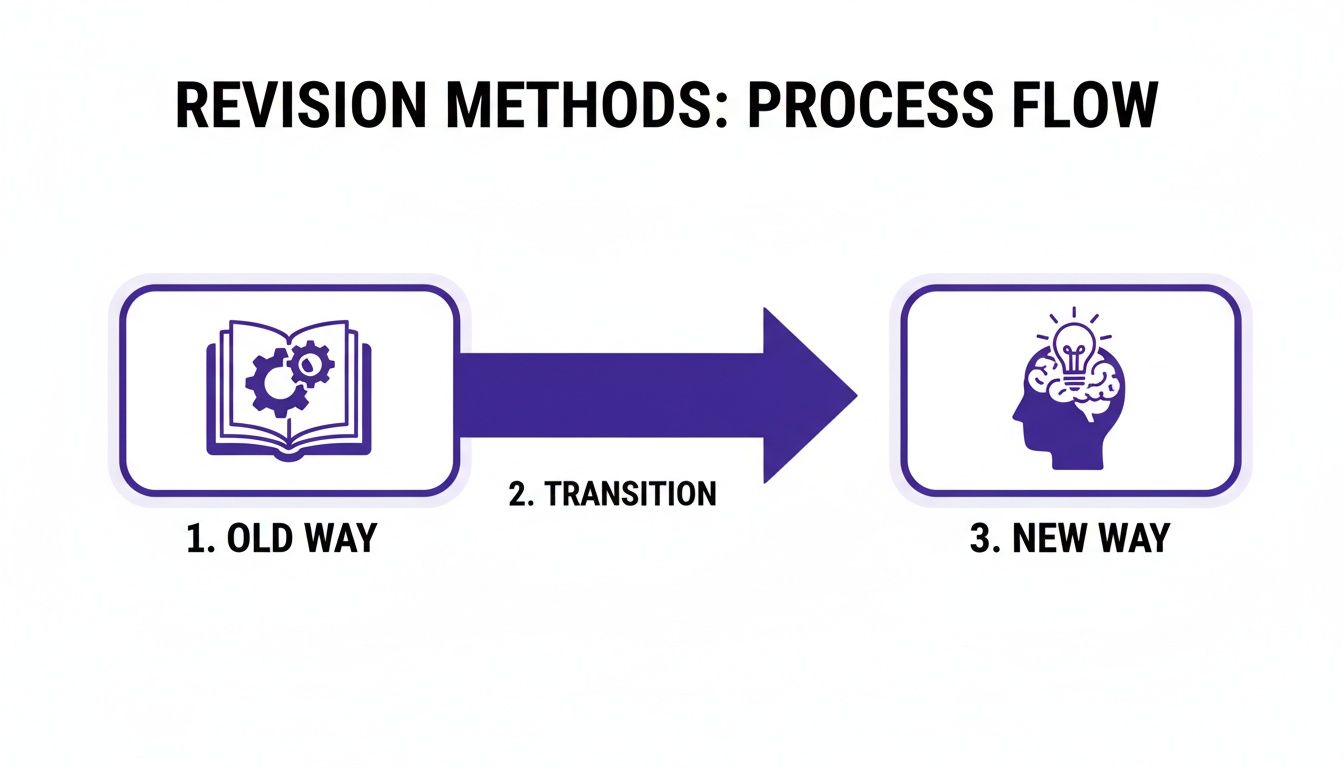
The real insight here is that effective revision isn’t about just cramming information in. It's about actively working your brain to build connections and retrieve knowledge on command.
Using Data to Refine Your Blueprint
So, how do you really know which areas are your weakest? Sometimes a topic feels hard just because it’s dense, but you might actually be pretty good at the exam questions. This is where a bit of tech can give you a massive advantage.
Using a platform with a progress dashboard gives you cold, hard data on how you're doing. For example, after blasting through a few quick-fire quizzes on MasteryMind, its dashboard might show you're consistently smashing 'Organic Chemistry' with an 85% average, but struggling with 'Thermodynamics' at just 45%.
This kind of data is gold dust. It takes all the guesswork out of planning. You can see, clear as day, where your time will have the most impact and adjust your blueprint on the fly. You might decide to swap a 'good' topic block for one that needs urgent attention. This data-driven revision ensures you’re always focusing your precious energy where it will make the biggest difference to your final grade.
Getting to Grips with Your Content: The Power of Active Recall
You’ve got your plan and your timetable is looking pristine. Fantastic. But a map is useless if you don't actually start walking the trail. This is where the real work begins—moving from just organising your time to properly embedding that knowledge deep in your brain.
So, let's talk about the single most effective way to learn: active recall.
Forget passively highlighting your textbook or re-reading your notes until your eyes glaze over. That’s not learning; it’s just familiarising. Active recall is the complete opposite. It’s the act of deliberately pulling information out of your brain, rather than just spoon-feeding it in.
Every time you force yourself to remember something—a specific date for your history exam, a tricky formula in physics, or a key quote from Othello—you strengthen the neural pathways to that information. Think of it like forging a path through a dense forest. The more you walk it, the clearer and easier it becomes to travel.
Why Active Recall Works (and Passive Revision Doesn't)
Here’s a simple way to think about it: passively reading your notes is like watching a YouTube video on how to build muscle. You see how it’s done, but you’re not getting any stronger yourself. Active recall is you actually in the gym, picking up the weights. It’s harder, no doubt, but it’s the only way to build real intellectual muscle.
Study after study has shown that testing yourself is miles more effective for long-term memory than simply re-reading. When you retrieve a piece of information from memory, you're not just remembering it; you're re-encoding it, making it stickier and linking it more securely to other ideas in your mind. This is the secret sauce for A-Level success.
Putting Active Recall into Practice
This all sounds great in theory, but how do you actually do it? The good news is there are plenty of simple but powerful techniques you can start using in your very next revision session.
Self-Quizzing: This is the most direct method. After covering a topic, close your books and write a few quiz questions for yourself. Don't go easy—challenge yourself to recall specific details. A tool like MasteryMind can automate this with quick-fire quizzes, forcing you to think on your feet.
The Feynman Technique: An absolute gem for those beastly, complex topics. Try to explain a concept (like photosynthesis or the causes of the Cold War) in the simplest terms you can, as if you were teaching it to a ten-year-old. Speaking it out loud is crucial. The moment you stumble or find yourself relying on jargon, you've pinpointed a gap in your understanding.
Smarter Flashcards: Don't just write a term on one side and a long definition on the other. That’s too passive. Instead, frame your flashcards as questions. Instead of a card that says "The Somatic Nervous System," make it ask, "What is the role of the Somatic Nervous System, and how does it differ from the Autonomic?" This prompts a much deeper retrieval process.
The big idea behind all of these methods is the same: you have to force your brain to produce the information from memory. It’s that initial struggle that builds strong, lasting knowledge.
Upgrade Your Revision with Spaced Repetition
Active recall on its own is powerful. But when you pair it with spaced repetition, the effects are magnified. Your brain is naturally wired to forget things over time—it's a phenomenon known as the 'forgetting curve'. Spaced repetition is the perfect antidote.
It works by getting you to review topics at increasing intervals. You might do a quick quiz on a topic the day after you learn it, then again three days later, then a week later, and so on. This clever timing sends a strong signal to your brain: "Hey, this stuff is important. Move it into long-term storage!" Many modern revision platforms have this built right in, automatically scheduling topics for you just before you’re about to forget them.
Verbalise It to Really Learn It
One of the most underused but incredibly effective active recall methods is just talking. When you verbalise your understanding of a topic out loud, you force your brain to structure its thoughts coherently. It’s a complete game-changer.
This is where voice-powered revision tools can make a huge difference. For example, MasteryMind's Blurt Challenge feature gives you a topic from your syllabus and simply asks you to talk about it.

This process of speaking and then having your response instantly analysed against the exam board’s mark scheme is active recall on steroids. It immediately shows you what you know well and, more importantly, where the gaps are. The system then generates targeted follow-up quizzes to help you plug those exact weaknesses.
Turning Knowledge into Top Exam Marks
Okay, so you’ve spent weeks grinding away with active recall and spaced repetition. You feel like you actually know your stuff. So why isn't that an automatic ticket to an A*?
Because knowing the content is only half the battle. The other half—the part that consistently separates an A from a B—is your exam technique.
Think of it this way: a Formula 1 car can have the most powerful engine on the grid, but without a skilled driver who knows every single corner of the track, it’s not winning any races. Your subject knowledge is that powerful engine; your exam technique is the driver. This is where you learn to navigate the trickiest questions, anticipate what the examiner wants, and strategically pick up every last mark.
It’s time to move from just knowing the material to proving you know it, under pressure, in the precise way the mark scheme demands.
Get Relentless with Past Papers
There is simply no substitute for doing past papers. None. It's the single most critical activity in the final weeks before your exams. But "doing" a past paper doesn't mean casually flicking through it with your textbook open. It means simulating the real deal.
Be strict with timing: If the paper is 90 minutes, you have 90 minutes. Set a timer and stick to it. You need to get a feel for that pressure and learn to manage your time effectively.
Go full exam-conditions: No phone. No notes. Clear your desk of everything but the paper, a pen, and maybe a bottle of water.
Mark it brutally: Get the official mark scheme and be ruthless. If your answer doesn't tick a box on their list, you don't get the point. This is how you start thinking like an examiner.
This kind of practice builds more than just knowledge; it builds mental stamina and hones your pacing. It's no surprise that students who consistently practise with past papers can see their final scores jump by 15-20%—a massive difference when grade boundaries are tight.
Deconstruct the Question Before You Even Think of Answering
Top-performing students don't just read the question; they take it apart. Every question is packed with clues telling you exactly how to frame your answer. The most important of these are the command words.
These are the verbs at the start of the question—'describe', 'evaluate', 'compare', 'analyse'. Getting this wrong is one of the easiest ways to throw away marks, even if your underlying knowledge is flawless.
An examiner's biggest frustration is seeing a student with excellent subject knowledge write a brilliant answer to a question that wasn't actually asked. Understanding command words is non-negotiable for top grades.
To get inside the examiner's head, you need to know what these words are really asking you to do.
Decoding A-Level Command Words
Here’s a quick-reference guide to some of the most common command words you'll encounter. Getting these straight in your head will revolutionise how you approach your answers.
Command Word | What It Really Means | Action to Take |
|---|---|---|
Describe | Give a detailed account. Just the facts. | State the key features or characteristics. Don't give opinions or reasons. |
Explain | Give reasons why something is the way it is. Show you understand the 'how' or 'why'. | Provide a detailed account with supporting reasons, causes, or mechanisms. Use 'because' or 'this leads to'. |
Analyse | Break the topic down into its core components and show how they link and interact. | Identify the key elements and explore their relationships. Uncover the underlying structure. |
Compare | Identify both the similarities and the differences between two or more things. | Directly address both what's the same and what's different. A 'contrast' question only wants differences. |
Evaluate | Make a judgement on the value, importance, or success of something. | Weigh up the strengths and weaknesses, or pros and cons. Come to a supported conclusion. |
To what extent | Form an argument and come to a reasoned conclusion, considering both sides of the issue. | Acknowledge the counter-arguments but build a case for your own viewpoint, supported by evidence. |
Once you start looking for these in past papers, you'll realise that your entire answer structure hinges on which word they've used.
Make the Mark Scheme Your Best Friend
The mark scheme is your secret weapon. Seriously. It’s a literal checklist of what the examiner has been told to award marks for. After completing a past paper under timed conditions, your next task is to analyse your own answers against this document.
Look for the Assessment Objectives (AOs)—things like AO1 (knowledge), AO2 (application), and AO3 (evaluation). Pay close attention to how many marks are allocated to each. If a 12-mark essay question gives 8 marks for AO3, you know that the bulk of your answer must be your own critical judgement, not just a summary of facts you've memorised.
This process quickly reveals where you're dropping easy marks. Maybe your knowledge is solid (good AO1), but you’re failing to apply it to the specific scenario in the question (weak AO2). This is where tools offering Exam Practice for A-Level can be game-changers. They provide instant, examiner-style feedback with these exact AO breakdowns, bridging that crucial gap between simply knowing the content and actually scoring the points.
Different Subjects Demand Different Revision Tactics
One of the biggest mistakes you can make is trying to revise for every subject in the exact same way. The active recall techniques that work wonders for Biology won't get you far in an A-Level Maths exam, and the essay-writing skills for History are pretty much useless for Physics problems. Each subject is its own unique beast, and your revision needs to be just as specific.
Let's be clear: a one-size-fits-all strategy is a fast track to wasted effort. To make your revision actually count, you need to learn how to switch gears depending on the subject in front of you. This isn’t about working harder; it’s about matching your technique to the task at hand.
STEM Subjects: Maths and Physics
For subjects like Maths, Further Maths, and Physics, revision is all about one thing: practice. You can understand the theory of integration perfectly, but that knowledge is worthless if you can’t apply it to a gnarly exam question you’ve never seen before.
Your main revision activity here should be solving problems, over and over again. Don't just read through worked examples in a textbook—that’s passive and gives you a false sense of security. The real learning happens when you're staring at a blank page, trying to figure out that first step.
Show Every Single Step: When you're practising, write down your working as if you're trying to win every single method mark. This trains you to think logically and makes it so much easier to spot where you went wrong.
Master the Formula Sheet: Know exactly what's on the formula sheet and, more importantly, what isn't. You should be able to recall the required formulas instantly and know precisely how and when to apply them.
Attack Your Weak Spots: It’s tempting to keep practising the topics you enjoy because it feels good. Instead, use past paper analysis to identify the question types that always make you stumble and hit them relentlessly until they're no longer a problem.
Essay-Based Subjects: History and English Literature
In subjects like History, English Literature, and Sociology, your knowledge is only as good as your ability to structure a compelling argument. Examiners aren't just looking for a brain-dump of facts; they want to see you analyse, evaluate, and persuade them.
Your revision should be focused on building and refining your essay-writing technique. A great way to do this is by creating detailed essay plans for a wide range of potential questions. This forces you to organise your thoughts and evidence logically before you even think about writing.
The difference between a good and a great essay is often the quality of the evidence. Don't just make a point; back it up with a specific quote, statistic, or historian's viewpoint that proves you know your stuff inside and out.
Content-Heavy Subjects: Biology and Psychology
Subjects like Biology and Psychology are notorious for the sheer volume of information you need to memorise. This is where the active recall techniques we've talked about become your absolute best friends. Passively re-reading your notes is a recipe for disaster in these subjects.
Blurting and Mind Maps: After studying a topic, put your notes away and scribble down everything you can remember on a blank sheet of paper. This "blurt" will immediately and brutally show you the gaps in your knowledge.
Targeted Quizzing: Use digital tools to create quick-fire quizzes on specific sub-topics. This is far more effective than just re-reading the chapter on the nervous system for the tenth time and hoping it sticks.
Explain it Out Loud: Try explaining a complex process like synaptic transmission to someone else (or even just to your wall). If you can't articulate it clearly and simply, you don't understand it well enough yet.
Practical and Logical Subjects: Computer Science
For a subject like Computer Science, your revision needs to be a solid mix of theory and practical application. Sure, you need to understand concepts like object-oriented programming, but you also need to execute practical skills perfectly under the pressure of an exam.
A common pitfall is neglecting the "pen and paper" skills that often appear in exams. You absolutely have to dedicate specific revision time to practising tasks like:
Trace Tables: Manually stepping through algorithms to track the value of variables, line by line.
Binary and Hexadecimal Conversions: Doing these by hand until they become second nature.
SQL Queries: Writing out database queries without the help of a computer to check your syntax.
MasteryMind's NEA Coach can be a huge help here, guiding you through these practical tasks with structured feedback that mimics how an examiner would assess your work. By adapting your approach for each subject, you ensure every single minute of your revision is as effective as it can possibly be.
Staying Focused Without Burning Out
A-Level revision is a marathon, not a sprint. I've seen countless students treat it like a mad dash to the finish line, and it almost always ends the same way: burnout.
Burnout isn't just feeling a bit tired. It's that deep, soul-crushing exhaustion that makes it impossible to focus, let alone remember complex information. It's the single biggest threat to any revision plan, no matter how perfectly organised it looks on paper.
The pressure is immense, I get it. It comes from everywhere—teachers, family, and most of all, from ourselves. But grinding away for hours on end without a proper break doesn't lead to better grades. It’s a classic case of diminishing returns, where the more you study, the less you actually retain. This section isn't about vague wellness tips; it's about building a robust, sustainable routine that keeps you sharp and sane.
Beat Procrastination with Structured Breaks
Feeling overwhelmed is the number one cause of procrastination. You look at the mountain of work ahead and your brain just shuts down. The best way to tackle this is to break it down into manageable, bite-sized chunks.
This is exactly where a proven method like the Pomodoro Technique comes in. It’s a game-changer for so many students.
The idea is brilliantly simple:
Pick one task from your revision schedule.
Set a timer for 25 minutes and work on only that task. Phone away, notifications off—total focus.
When the timer goes off, take a short 5-minute break. Stand up, walk around, grab a glass of water.
After four of these cycles, give yourself a longer, more substantial break of 15-30 minutes.
Why does this work so well? It reframes a daunting three-hour study block into a series of achievable sprints. Getting started feels so much easier, and it helps you maintain a high level of concentration throughout. Using a dedicated focus timer to structure your study sessions can really help embed this habit and keep you honest with your timings.
Take Your Downtime Seriously
Your brain isn't a machine; it needs rest to process information and form long-term memories. You need to start scheduling breaks, exercise, and sleep with the same importance as you schedule chemistry or history. They aren't an optional extra; they are a non-negotiable part of effective revision.
Sleep, in particular, is your secret weapon. Research consistently shows that sleep deprivation torpedoes memory consolidation. That's the crucial process where your brain sorts through the day's learning and files it away properly. Aim for a solid 7-9 hours per night to give your brain the time it needs to do its job.
Treat your wellbeing as a core component of your revision strategy, not an afterthought. A well-rested, mentally healthy student will always outperform a burnt-out one, no matter how many hours they put in.
Finally, nothing beats the feeling of seeing your hard work pay off. It’s a huge psychological boost. A progress dashboard that visually tracks the topics you've covered and mastered gives you that tangible proof. Seeing those progress bars fill up turns the long revision marathon into a series of rewarding wins, keeping you motivated and positive right up to exam day.
A-Level Revision Questions, Answered
Revision always throws up a few big questions. Let's tackle some of the most common ones we hear from students feeling the pressure.
How many hours a day should I actually revise for my A-Levels?
Forget the idea of a 'magic number' of hours. What truly matters is the quality of your revision, not just the quantity.
Aiming for three to five hours of genuinely focused revision each day during your study leave is a much smarter goal than trying to survive eight exhausting, unproductive hours. Think short, sharp bursts using a method like the Pomodoro Technique to keep your brain engaged. Consistency is your best friend here, not last-minute cramming.
When is the right time to start revising?
Honestly? The best time was yesterday, but the next best time is right now. Don't panic.
As a general rule of thumb, easing into a structured revision plan about three to four months before your first exam is ideal. This gives you enough breathing room to cover everything properly using spaced repetition, which helps you avoid that dreaded end-of-year burnout. If your exams are looming closer, the key is to start immediately with a clear, prioritised plan.
Ready to put this into practice? MasteryMind has the tools you need to build a revision plan that works for you, from AI-powered quizzes to examiner-style feedback. Start revising effectively with MasteryMind today.
Comments