How to Revise for GCSE English and Aim for a Grade 9
- Gavin Wheeldon
- Jan 29
- 18 min read

The secret to cracking GCSE English isn't memorising every quote or spending hours just re-reading notes. It's about being clever with your time. You need to get to grips with the exact structure of your exams, use active recall to make information stick, and get your hands dirty with past papers to nail your timing and technique. This is a marathon, not a sprint, and building a solid foundation from day one is what gets you over the finish line.
Your Smart Start to GCSE English Revision

Staring at a mountain of poems, plays, and language techniques can feel pretty daunting. Let's be honest, you're not alone if you feel a bit overwhelmed. But figuring out how to revise for GCSE English is all about finding the right path up that mountain, not just staring at the peak. This guide is your starting point—no fluff, just a clear, practical plan.
Whether you're playing catch-up or aiming to smash that top grade, a strong foundation is everything. Forget the fancy highlighters for a moment. Real progress starts with understanding exactly what the examiners are looking for.
Get to Know the Exam Papers Inside Out
First things first, you need to dissect the exam papers. Both GCSE English Language and Literature are broken down into different papers, each with its own quirks—specific question types, timings, and Assessment Objectives (AOs). Find out the precise layout for your exam board, whether that's AQA, Edexcel, or another.
Make sure you can answer these questions without hesitation:
How many papers are there for Language and Literature?
What’s the exact timing for each paper?
How many marks is each question worth, and how does that affect my timing?
Which specific AOs is each question designed to test?
Answering these turns the exam from a big, scary unknown into a predictable game you can train for. It’s all about being strategic.
A Quick-Start Framework for Your Revision
To give you a head start, here’s a simple table breaking down the most crucial parts of your revision plan. Think of it as your initial roadmap.
Your Quick-Start GCSE English Revision Framework
Revision Component | Why It Matters | First Actionable Step |
|---|---|---|
Exam Structure Analysis | Removes uncertainty and helps you manage time effectively under pressure. | Download the specification for your exam board and create a one-page summary of all papers, timings, and marks. |
Targeted Skill Practice | Focuses your effort on weaker areas, leading to faster, more noticeable improvement. | Do a quick self-assessment. Which skill feels hardest right now—unseen poetry or creative writing? Schedule 30 minutes on that this week. |
Active Recall Routine | Moves information from your short-term to your long-term memory, making it stick. | Instead of re-reading notes on Macbeth, write down five key quotes from memory. Then check your answers. |
This isn't just about ticking boxes; it's about building a sustainable and effective revision habit from the get-go.
Build a Revision Plan That Actually Works
With a clear picture of the exams, you can create a timetable that fits around your life. This isn't about booking every minute of your day. It’s about being smart and focusing your energy where it’ll have the biggest impact.
Pinpoint your weaker areas early on. Maybe it's analysing unseen poetry or structuring a persuasive article. Whatever it is, dedicate specific, focused time to tackling it head-on.
The hard truth is that just working hard often isn't enough. The statistics from exam seasons really highlight why smart revision is so critical. A focused plan is your single best tool for getting the grade you want.
This proactive approach is essential. In a recent exam season, 866,023 students took their GCSE English Language exams, but only 15.6% managed to secure a top grade of 7 or above. These numbers show just how much effective preparation matters. You can dig into these trends in more detail in this analysis by FE News.
This data isn't here to scare you. It’s here to show you that revising smarter, not just harder, is what will set you apart.
Getting to Grips with Your GCSE English Literature Texts
Let's be real about revising your English Literature texts. Whether you’re tackling your novel, the play, or that dense poetry anthology, simply re-reading them over and over is not revision. It might feel productive, but it’s one of the biggest time-wasters out there.
To actually hit the grades you're capable of, you need to make a crucial shift: stop being a passive reader and start thinking like an active analyst. This is all about breaking the texts down and knowing them so well that you can use them as tools to build a brilliant argument for any exam question they throw at you.
This isn't about memorising the entire plot of An Inspector Calls. It’s about getting under the skin of the text and understanding why Priestley constructed it the way he did—and what impact that has on you as the reader.
Digging Deeper Than the Plot
The examiner already knows what happens in Macbeth. What they don't know is your unique take on how Shakespeare presents ambition, guilt, or power. Just re-reading the play won’t give you those sharp insights.
So, how do you make your revision for novels and plays truly count?
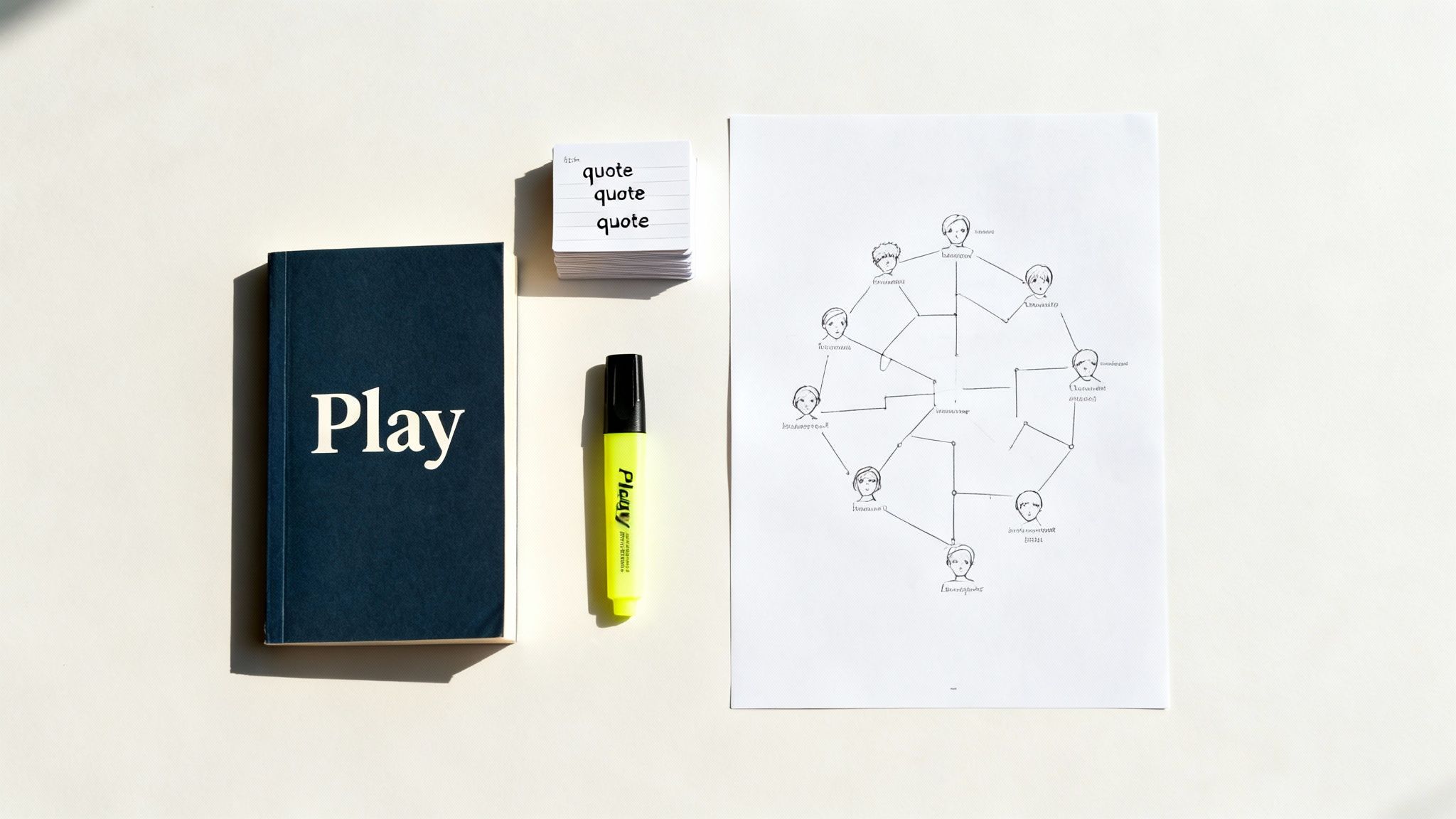
Map Your Characters: Don't just list traits. Grab a blank page and create a mind map for a key character like Sheila Birling. Link her pivotal quotes to themes like social responsibility, and then connect those points to specific moments in the play where she transforms. It’s a great way to visualise her entire journey.
Build a Smart Quote Bank: A long list of random quotes is useless. For every single one you choose, jot down the literary or dramatic technique being used (is it a metaphor? dramatic irony?) and a quick note on why it matters. Quality trumps quantity every time. A short, punchy quote you can analyse in detail is far more valuable than a long one you can only summarise.
Track Themes, Not Just Events: Pick a major theme, like 'power' in Animal Farm. Skim through the book specifically looking for 3-4 key moments where this theme evolves. Note which characters are involved and the specific language Orwell uses. Do this for a few themes, and you’ll have ready-made structures for potential essays.
Using Context That Actually Scores Marks
Examiners can spot a student who has just shoehorned in a random historical fact from a mile off. Simply stating that "JB Priestley was a socialist" isn’t going to impress anyone. The trick is to connect that fact directly to what's happening in the text.
The secret to hitting Assessment Objective 3 (AO3) for context is to explain how that information shapes the text. Always ask yourself: "So what?" Why does it matter that Priestley held those beliefs? How does that influence his scathing portrayal of Mr Birling?
For example, instead of that basic fact, you could write: "Priestley's socialist ideals are channelled through the Inspector, whose final speech acts as a direct mouthpiece for the author's views on collective responsibility, powerfully challenging the capitalist mindset embodied by Birling."
See the difference? You're not just dropping a fact; you're using it to strengthen your analysis. This applies to any text. For more in-depth strategies, our guides on GCSE English Literature revision can help you master this skill.
Active vs Passive Revision for Literature
It's easy to fall into revision habits that feel busy but don't actually move the needle on your grade. When it comes to literature, the difference between passive and active work is everything. Passive revision is about consuming information; active revision is about engaging with it.
Technique | Passive (Low-Impact) | Active (High-Impact) |
|---|---|---|
Reading | Re-reading the whole book or play from start to finish. | Reading a single chapter with a specific theme in mind, highlighting relevant quotes. |
Quote Learning | Copying out long lists of quotes onto a page. | Creating flashcards with a quote on one side and 3 analysis bullet points on the other. |
Character Notes | Writing down a simple list of a character's personality traits. | Creating a mind map showing how a character changes and linking them to key themes. |
Essay Practice | Reading through pre-written model essays online. | Writing a single paragraph under timed conditions and then marking it yourself. |
Ultimately, active revision forces your brain to work harder, which is precisely what makes the knowledge stick. It’s about creating, connecting, and questioning—not just passively absorbing.
Unlocking Poetry Comparison
Poetry comparison (a key part of AO2) often feels like the most daunting task, but there’s a clear logic to it. You’re not just playing "spot the difference." You’re comparing how two different poets tackle a similar theme using their own unique methods.
Before you even think about comparing, make sure you know each poem in the anthology inside and out on its own. You can’t build a comparative argument on a shaky foundation.
Once you’re confident, start comparing how the poets use:
Form and Structure: Does one poet use a rigid sonnet, while the other opts for chaotic free verse? What is the effect of that choice on the poem’s meaning?
Language and Imagery: How do both poets use metaphors, similes, or sensory details to explore a theme like 'conflict' or 'nature'? Are there any interesting contrasts?
Tone and Mood: Is one poem dripping with bitterness while the other feels more reflective and melancholic? Pinpoint the words and techniques that create these different feelings.
Exam statistics really hammer home why this sharp, analytical approach matters. In a recent summer, there were a staggering 608,215 entries for GCSE English Literature in England. With overall pass rates for English dipping, it's crystal clear that just "knowing the story" won't cut it for the top grades.
This data proves that rote learning isn't the answer. True mastery comes from being able to dissect a text and understand the writer's craft—which is exactly what these active revision methods will help you do.
Getting to Grips with the GCSE English Language Papers
The GCSE English Language papers can feel a bit daunting. Unlike the Literature exam, where you've studied the texts inside and out, here you’re faced with the completely unknown. But that’s only half the story.
While the texts are unseen, the questions are anything but. The exam boards use a very predictable, rigid structure for both papers. Once you understand that structure, the unpredictability vanishes. You can walk into that exam hall feeling prepared and confident, ready to show the examiner exactly what you can do.
Let's break down the blueprint for each paper so you know what to expect.
Paper 1: Explorations in Creative Reading and Writing
This paper is all about fiction. You'll get an extract from a story and be asked to do two things: first, analyse what the writer is doing, and second, write your own piece of creative writing. Both sections are worth the same number of marks, so you absolutely can't afford to neglect one for the other.
The reading questions are designed to build on each other, starting with simpler information retrieval before moving into the heavier analysis of language and structure.
The biggest mistake students make here is simply "feature spotting." Writing "The author uses a metaphor" is a classic example. It tells the examiner you can identify a technique, but it doesn't get you the marks.
The real skill is in explaining the effect of that technique on you, the reader. Why did the writer choose that metaphor? What does it make you think, feel, or picture? It’s all about answering the "So what?" question. That's what separates a grade 5 from a top-tier grade 9.
So, when you're tackling a language analysis question (usually AO2), your thought process should be methodical:
Identify: Pinpoint a specific, powerful word or phrase.
Quote: Weave a short, sharp quote into your sentence.
Analyse: Really dig into what that word or technique implies. What are its connotations? What ideas does it spark?
Link: Circle back to the question, explaining how your point contributes to the overall impression the writer is trying to create.
For the creative writing task, whether you're describing a place or writing a story, planning is everything. I can't stress this enough. Spending just 5-10 minutes sketching out a quick plan is the single best way to secure top marks. Examiners can spot an unplanned, rambling piece from a mile off.
A simple plan gives your writing a clear beginning, middle, and end:
Opening: Hook the reader straight away. Think about the senses.
Development: Build a bit of tension or shift the focus.
Climax: Introduce a key moment of change or drama.
Ending: Bring it to a satisfying, controlled conclusion.
You’re not trying to write the next great novel. A powerful, focused piece that zooms in on a single moment is always far more effective.
Paper 2: Writers' Viewpoints and Perspectives
Paper 2 shifts the focus entirely to non-fiction. You'll be handed two unseen non-fiction texts, often from different centuries, and asked to compare how the writers get their points across. This paper is a test of your ability to summarise, analyse, and synthesise different viewpoints.
The comparison question is the big one here, and it’s where a lot of marks are won or lost. This isn't about just listing similarities and differences. It’s about comparing the writers' methods and ideas. How do two writers, maybe a hundred years apart, both convey their passion for a topic, but use different language and techniques to do it?
A solid structure for a comparative paragraph looks something like this:
Start with a clear point of comparison that involves both texts.
Bring in a quote from Text A and analyse its effect.
Use a comparative connective like "In contrast," or "Similarly,".
Follow up with evidence from Text B, analysing how it proves your initial point.
The final challenge on Paper 2 is to write your own piece of non-fiction – maybe an article, a letter, or a speech. The question will give you a clear purpose, audience, and format (the 'PAF'). Your job is to nail the tone. A fiery speech to persuade your classmates requires a completely different style from a formal letter to a newspaper editor.
Before you even think about writing, quickly ask yourself:
Who am I writing for? (Audience)
What am I trying to achieve? (Purpose: to argue, persuade, advise?)
What format is required? (Layout, headings, salutation)
Dropping in a few persuasive techniques like rhetorical questions, addressing the reader directly ("You might believe..."), and using carefully chosen vocabulary will make your writing feel authentic and genuinely impactful. This is how you take a predictable exam and make it your own.
Using Spaced Repetition and Active Recall
Let’s be honest about how our brains actually work. You can forget about cramming for eight hours straight the night before an exam; it’s a one-way ticket to stress and, frankly, a shockingly bad way to revise for GCSE English. Real, lasting progress—whether you’re playing catch-up or shooting for a Grade 9—comes from working smarter, not just harder.
This is where a bit of brain science gives you a massive advantage. We're going to focus on two powerful techniques that are proven to work, blowing passive re-reading out of the water every single time: active recall and spaced repetition.
Stop Re-reading and Start Retrieving
Think about your usual revision session. Does it involve reading your notes, textbooks, or study guides over and over again? Most students do this. It’s called passive learning, and it feels productive because the information seems familiar. But this creates an "illusion of knowing." Your brain recognises the words on the page, but it can’t actually pull that information out of thin air when you need it in an exam.
Active recall is the total opposite. It forces your brain to actively retrieve information, which strengthens the mental pathways to that knowledge. It's the difference between watching a personal trainer lift weights and actually lifting them yourself. One builds real strength; the other is just observation.
So, how can you put active recall into practice for English?
Try ‘Blurting’: Pick a topic, say, the theme of ambition in Macbeth. Put your books away, set a five-minute timer, and just write down absolutely everything you can remember. Key quotes, character arcs, context, your own analysis—get it all on the page.
Teach It to Someone Else: Grab a friend, a parent, or even just explain it to your reflection. Try to talk through a concept like Priestley's use of dramatic irony in An Inspector Calls. If you stumble or can't explain it simply, you've found a gap in your understanding.
Mind Map from Memory: Start with a blank piece of paper and create a mind map for a character or a poetry theme completely from what’s in your head. Only when you've hit a wall should you peek at your notes to fill in the blanks.
This timeline gives you a good idea of how active practice fits into the bigger picture of your revision.
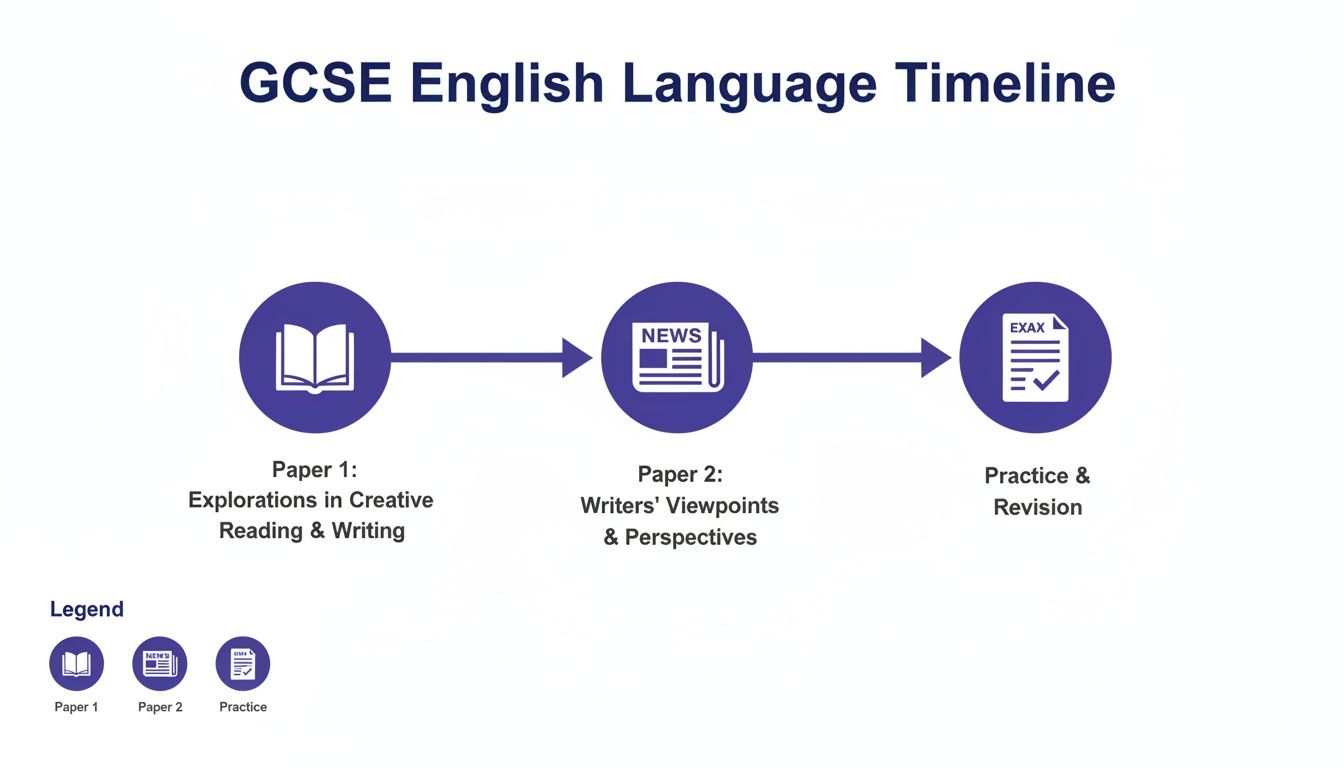
Notice how it moves from understanding the papers towards consistent, active practice. That's the crucial final piece of the puzzle.
Lock in Knowledge with Spaced Repetition
Once you've dragged that information out of your memory using active recall, spaced repetition is how you tell your brain, "Hey, this stuff is important—keep it." This whole idea is built around the "forgetting curve," which shows how we naturally lose memories over time.
Spaced repetition works by interrupting that forgetting process. You review information at increasingly longer intervals, just before it’s about to slip from your memory. Going over a topic one day later, then three days later, then a week later, is far more powerful than hammering it four times in one afternoon.
When you put these two techniques together, you have a genuine secret weapon. You use active recall to test yourself on a topic, and then you use spaced repetition to schedule when you’ll test yourself again. This is how you build deep, lasting knowledge that won't disappear under exam pressure.
Studies have shown that active recall can effectively double how much information you retain compared to just reading. This is huge, especially when you consider that 62.3% of students who resit their English GCSE in the summer miss a grade 4 the first time. For anyone facing the pressure of a resit, a structured, effective approach like this can be a complete game-changer. You can read more about the upturn in English GCSE resit pass rates and see for yourself why these methods matter so much.
A Simple Spaced Repetition Schedule
You don't need fancy software to get this working. A simple calendar or even just a set of flashcard piles will do the trick.
Here’s what a schedule for learning a new set of quotes could look like:
Day 1: Learn the quotes using flashcards (active recall).
Day 2: Review them.
Day 4: Review them again.
Day 8: One more review.
Day 16: Final review before moving them into your long-term revision pile.
Of course, platforms like MasteryMind can automate this for you, serving up the right topics and questions just when you need to see them. This combination of active recall and spaced repetition is how you break the endless cycle of learning and forgetting. It’s how you start building the unshakable confidence you need to walk into that exam hall and succeed.
Turning Practice Questions into Perfect Papers
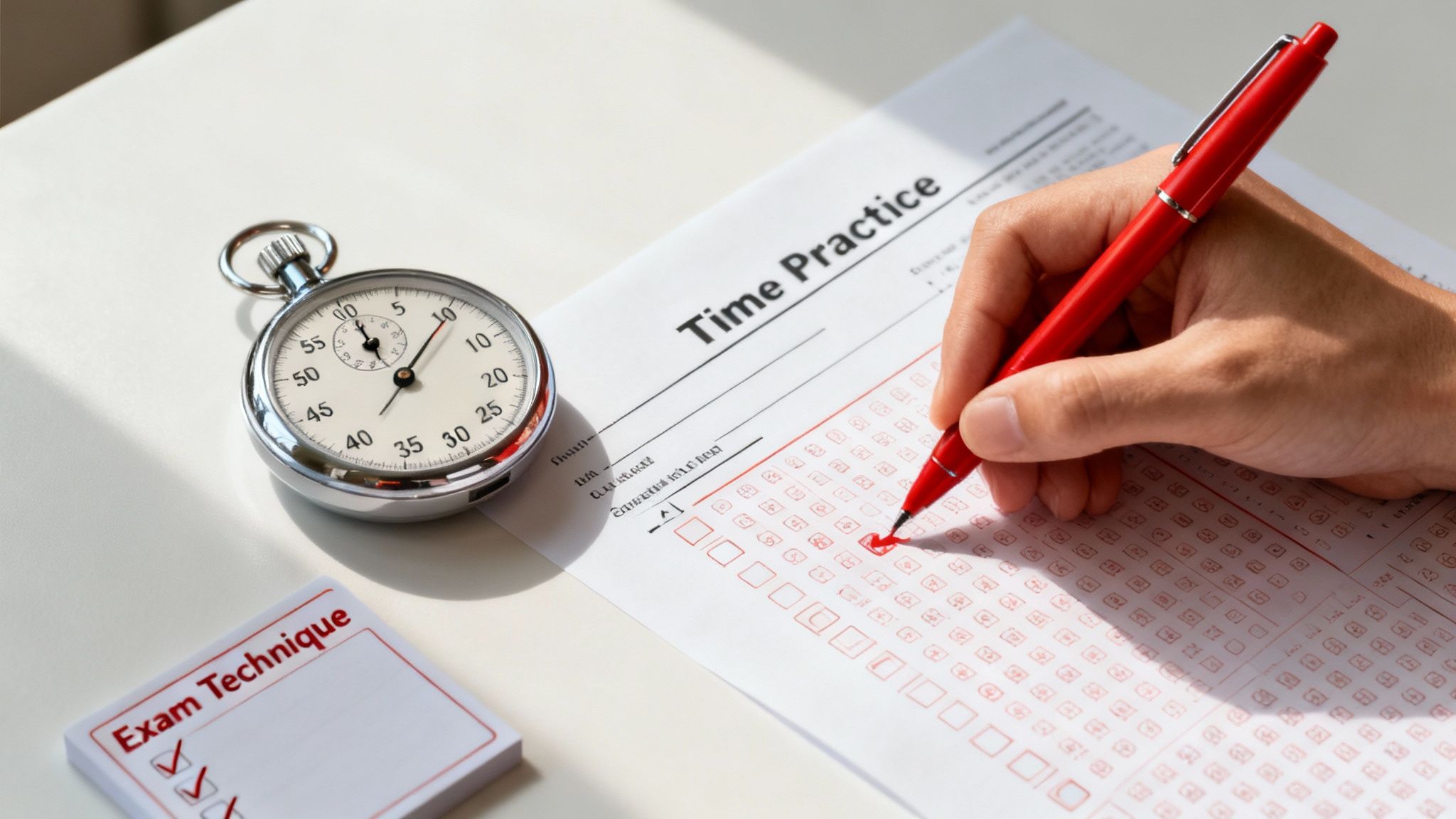
Knowing your texts inside out is only half the battle. The real test is performing when that exam clock is ticking. This is where all your hard work on themes, characters, and context comes together. Mastering exam technique is what separates a good answer from a great one—it’s about applying your knowledge with precision under pressure.
Too many students think that practice just means churning through endless past papers. It’s not. The real progress comes from treating practice as a training ground to sharpen your timing, your planning, and your ability to think like an examiner.
How to Dissect Any Exam Question
Before you even dream of writing a single sentence, you need to get good at decoding the question itself. Examiners are very deliberate with their wording. They use specific command words to signpost exactly what they're looking for, and misunderstanding them is one of the quickest ways to throw away marks.
Words like 'analyse', 'compare', 'evaluate', and 'explain' aren’t just synonyms. Each one is a direct instruction for how to shape your response and which Assessment Objectives (AOs) to hit.
Analyse: This is your cue to zoom in. Break down how the writer uses language and structure to create specific effects.
Compare: Simple enough, right? Look for both similarities and differences in how two texts handle ideas or use certain methods.
Evaluate: Now you need to go a step further. You’re being asked to make a judgement. You need to weigh up the evidence and decide 'how far' you agree with a given statement.
Get into the habit of highlighting these command words and the main focus of the question. It’s a simple trick, but it forces you to stay on track and stops you from just brain-dumping everything you know.
Planning Isn't Optional—It's Essential
Every minute in an exam feels precious, so the temptation to jump straight into writing is huge. Don't do it. Taking just five minutes to sketch out a plan is probably the single best investment you can make, especially for those longer essays.
A plan is your roadmap. It ensures your argument flows logically, your points are properly supported, and you don’t find yourself repeating things or running out of steam halfway through. Trust me, an examiner can spot a panicked, unstructured essay a mile off.
Your plan doesn't need to be a masterpiece. A few bullet points, a quick mind map, or a handful of topic sentences is all it takes. Think of it as your safety net if your mind goes blank and the structure that will carry you to a top-tier answer.
For a 30-mark essay, a quick plan might look like this:
Intro: Directly answer the question, outlining my three main points.
Para 1: Focus on the opening of the text – grab a quote, analyse a technique, explain the effect.
Para 2: Move to a turning point – another quote, link it to context, discuss reader impact.
Para 3: Analyse the ending – make a point about structure and link it all back to the question.
Conclusion: Reiterate my argument and cement my final judgement.
A Progressive Path to Full Timed Papers
Don't dive headfirst into two-hour mock exams. That’s like trying to run a marathon with zero training—you’ll just burn out. You need to build your stamina gradually.
Start small. Get comfortable answering short, 4- or 8-mark questions in the right amount of time. Once you feel confident hitting the mark consistently, move on to tackling a single, longer essay question under timed conditions. This method builds your skills and confidence without overwhelming you.
Save the full, two-hour papers under strict exam conditions for the final few weeks. This makes your practice more focused and a lot less daunting. To help guide this progression, you can use online tools that offer a huge library of GCSE English past paper practice broken down by topic and difficulty.
Using Mark Schemes Like an Examiner
The mark scheme is your secret weapon. After you’ve written a practice answer—whether it’s a single paragraph or a full essay—you absolutely have to learn how to mark it yourself. This is, without doubt, the most effective way to figure out where you're losing marks.
Download the official mark scheme for the paper you’re using. Don’t just glance at the ‘indicative content’ section; pay close attention to the level descriptors and the breakdown of the Assessment Objectives.
Be brutally honest: Read your answer through the eyes of a critical examiner. Where is your point a bit vague? Is your evidence flimsy?
Check your AOs: Have you actually discussed context (AO3)? Is your analysis of the writer’s methods (AO2) detailed enough? The mark scheme shows you the weighting for each.
Spot the patterns: Are you always forgetting to talk about structure? Is your evaluation at the end a bit weak? Self-marking helps you pinpoint your exact weaknesses so you know what to work on next.
This cycle of writing, marking, and reflecting is the crucial final loop in your revision. It turns passive practice into active learning, helping you transform your knowledge into exam-day excellence and pushing you towards those top grades.
Your GCSE English Revision Questions Answered
Even the best-laid plans can leave you with a few nagging questions. It happens. We’ve pulled together some of the most common queries we hear from students (and even teachers) to give you the straight-talking, practical answers you need.
How Many Hours a Day Should I Revise for GCSE English?
Honestly, there's no magic number here. The most important thing to remember is that quality beats quantity every single time. Stop thinking about hours on a clock and start thinking in terms of 'focused sessions'.
A single, 45-minute blast where you're genuinely tackling a past paper question is worth more than three hours of passively flicking through a textbook. As a starting point, aim for one or two of these focused sessions for English each day. Just make sure you switch between Literature and Language to keep your brain engaged.
And don't forget to schedule proper breaks. Consistency is what really moves the needle—a little bit of focused work every day is far more powerful than one massive, soul-destroying cramming session at the weekend.
What Is the Best Way to Learn Quotes for English Literature?
First, stop trying to memorise an endless list of quotes. It’s a recipe for burnout. The real trick is to learn a smaller, more powerful set of quotes and understand them inside out.
For each major character and theme in your texts, try to lock down 3-4 really flexible quotes—the kind you could slot into a bunch of different essay questions. This is about being strategic, not just a quote-hoarding machine.
Once you’ve picked your quotes, try this active learning method:
Make Flashcards: Get some index cards. Write the quote on one side.
Analyse It: On the back, jot down the answers to these three questions: 1. Who said it and when? (What’s the context?) 2. What literary techniques are in play? (Metaphor, sibilance, etc.) 3. What bigger idea does it reveal about a character or theme?
This turns a boring memory task into a mini-analysis exercise. Test yourself regularly with these cards, and you’ll find the quotes—and more importantly, their meaning—start to stick properly.
How Can I Quickly Improve My Creative Writing?
Let's get one thing straight: nobody is just 'bad' at creative writing. It’s a skill, not a magical talent. Like any skill, it gets better with practice and the right approach.
Start by reading, but read like a writer. When you pick up a book, pay close attention to how the author hooks you in, how they describe a setting to create a certain atmosphere, or how they build suspense. You’ll start to see the machinery behind the magic.
The biggest jump in marks almost always comes from one non-negotiable step: planning. Spend the first 5-10 minutes of your writing time sketching out a simple plan. You just need a clear beginning, a middle with a turning point, and an ending that feels deliberate. An examiner can spot a story that's just making it up as it goes along from a mile off.
Create your own 'toolkit' of sophisticated words and literary devices you feel confident using. Practice weaving in techniques like pathetic fallacy or using a mix of long and short sentences to control the pace. Getting feedback is crucial, so don't be shy about asking your teacher to look over a practice piece.
How Do I Deal with Exam Stress if My Mind Goes Blank?
First off, know that this is incredibly common. It’s a completely normal response to a high-pressure situation. The best defence here is preparation, which builds confidence and a sense of familiarity.
The 'blank mind' feeling often comes from a fear of the unknown. The more timed practice you do under exam conditions, the more the real thing just feels like another run-through. It takes the shock value out of the experience and helps you feel more in control.
If you feel panic creeping in during the actual exam, don't try to fight it. Manage it.
Stop: Put your pen down for 30 seconds. Just stop.
Breathe: Close your eyes and take three slow, deep breaths. This simple physical act helps reset your nervous system.
Look at Your Plan: That plan you made is your lifeline. It's your guide for what comes next.
Write One Sentence: Don't think about the whole essay. Just focus on writing the very first sentence of your paragraph. Once the ink is flowing, you'll be surprised how the momentum returns.
At MasteryMind, we've built a platform that tackles these challenges head-on. Our AI-powered revision tool gives you unlimited, examiner-aligned practice questions, instant feedback with AO breakdowns, and uses spaced repetition to make sure your knowledge sticks. It's the smart way to turn your revision into results. Start building your confidence for free.
Comments