How to Revise for Geography GCSE and Actually Remember It
- Gavin Wheeldon
- Feb 1
- 15 min read

Feeling like you’re drowning in a sea of coastlines, megacities, and tectonic plates? Whether you're playing catch-up or aiming for a top grade, you need a better plan than just re-reading your notes. Think of this guide as your game plan, starting with a smarter way to focus your energy where it actually counts.
Your Revision Needs a Smarter Plan – Here’s Why
Let's be real. Staring at a textbook crammed with river basins and urbanisation models is enough to make anyone feel overwhelmed. You’re probably wondering how on earth you’re supposed to revise for your Geography GCSE without getting lost in the detail.
The secret isn’t working harder; it’s working smarter. So many students fall into the trap of passive revision—things like highlighting notes or reading the same chapter over and over. It feels productive, but it does very little to lock that information into your long-term memory. An effective revision strategy starts by understanding the rules of the game.
First, Know What the Examiners Are Looking For
Before you even think about diving into the content, you need to get inside the examiner's head. What does your specific exam board (whether it's AQA, Edexcel, or OCR) actually want from you? They all have a slightly different focus, but their core structure is something you can use to your advantage.
Typically, they’re testing you on three main things:
Core Knowledge: Your grasp of key geographical concepts, processes, and the right terminology.
Case Studies: Real-world examples that bring all that theory to life.
Skills: Your ability to interpret maps, analyse graphs, and make sense of data.
Understanding how marks are split across these areas is crucial for prioritising your time.
A classic mistake is treating every single topic equally. Don't do it. Get a copy of your exam specification—it’s the official checklist from the exam board of everything you could be tested on. Use it as your map to make sure there are no nasty surprises on exam day.
To give you a clearer picture, here’s a simplified breakdown of how marks are often distributed.
A Typical GCSE Geography Paper Breakdown
Paper or Topic Area | Typical % of Total Marks | Key Skills Tested |
|---|---|---|
Paper 1: Physical Geography | 35-40% | Knowledge of natural processes, landforms, and ecosystems. Analysis of physical data. |
Paper 2: Human Geography | 35-40% | Understanding of urbanisation, development, and economic change. Case study recall. |
Paper 3: Fieldwork & Skills | 20-30% | Data collection methods, map skills, graph interpretation, and evaluative writing. |
This table shows why you can't just focus on your favourite topic. A solid performance requires a balanced effort across physical concepts, human examples, and practical skills.
There's a Reason It's Such a Popular Subject
Geography isn't just about colouring in maps, and its soaring popularity proves it. It’s one of the most relevant subjects you can study today. In fact, GCSE entries recently topped 302,000 across England, Wales, and Northern Ireland, making it the 6th most popular subject at this level.
That represents a massive 68% increase in students taking the subject over the last 15 years. You can read the full analysis on geography's growing popularity for yourself. With so many others competing for top grades, just "knowing your stuff" isn't enough. You need a revision plan that helps you stand out.
This guide introduces powerful, science-backed learning methods. Forget last-minute cramming. We’ll show you how to use techniques like active recall and spaced repetition to build a deep, lasting understanding of the subject. This approach isn't just about passing an exam; it's about making your learning stick. Let's get started.
How to Master the Content Without Drowning in It
Let’s be honest, the sheer amount of content in GCSE Geography can feel overwhelming. You’ve got a mountain of physical topics like river landscapes and tectonic hazards on one side, and a whole other peak of human geography covering urban challenges and resource management. If your revision plan is just to re-read your notes, you're going to struggle.
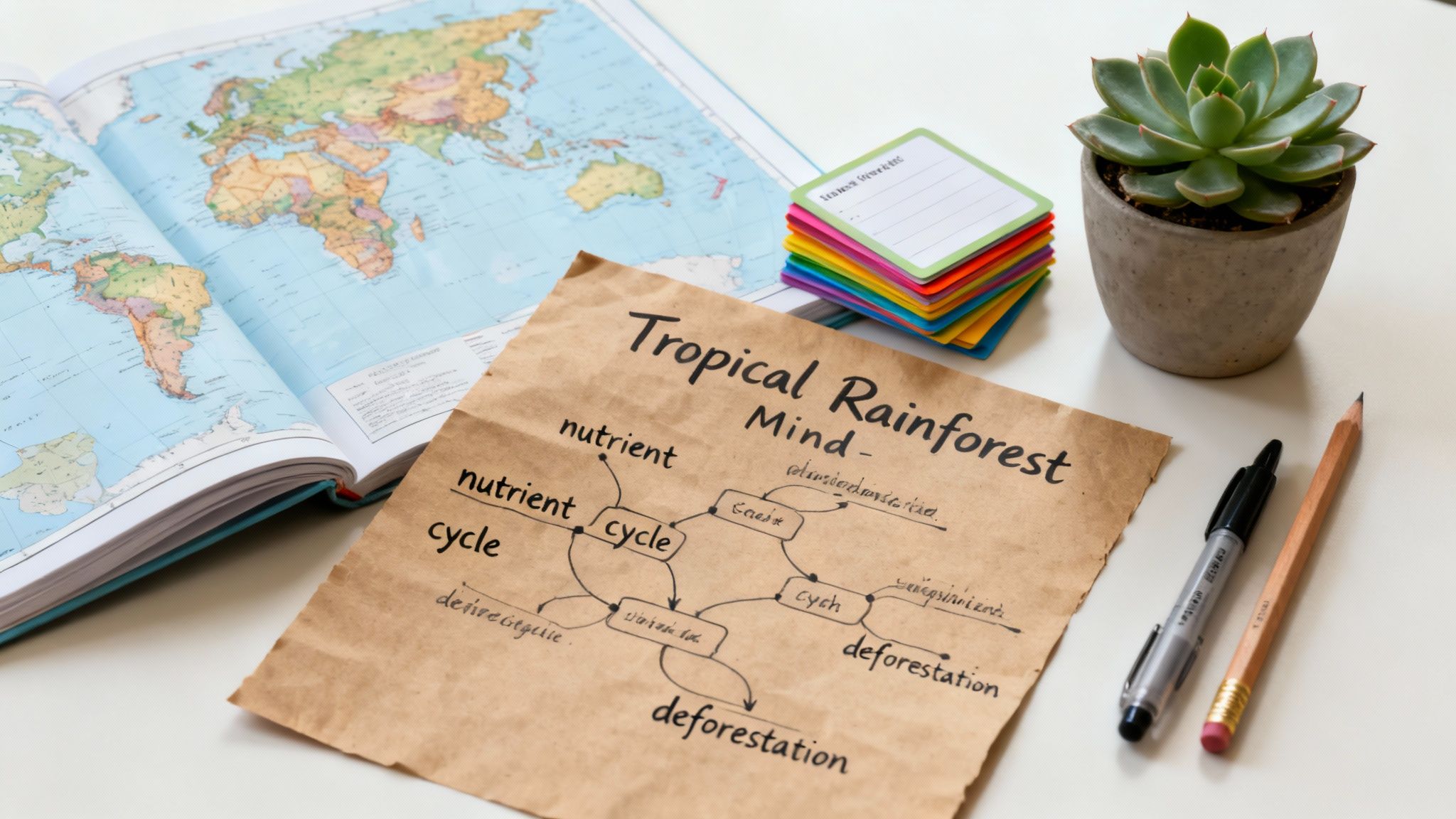
The secret is to move from passive reading to active learning. This is all about engaging with the material, questioning it, and forcing your brain to retrieve information from scratch. Think of it like this: you can watch videos of people swimming all day, but you'll only learn by actually getting in the pool.
Tackling Physical and Human Topics
A good first move is to split your revision into two clear piles: physical and human geography. This simple bit of organisation stops concepts from blurring together and lets you focus.
For physical geography, it's all about understanding natural processes. Concentrate on cause and effect. What chain of events leads a volcano to erupt? How does a river's energy carve out a valley? Don't just memorise definitions; get a grip on the sequence of events.
With human geography, the focus shifts to people and their complex interactions with the planet. Here, you need to think about the social, economic, and environmental impacts of everything. For instance, when looking at urban challenges, dig into the specific reasons for a city's growth and the resulting pressures on housing, transport, and services.
Examiner's Tip: The very best answers connect different parts of the syllabus. For example, a student who can explain how climate change (physical) threatens food security in a specific region (human) demonstrates a much deeper geographical understanding.
Active Revision That Genuinely Works
It's time to ditch the highlighter pen. Passively highlighting text creates an "illusion of knowing"—you recognise the words on the page, but you can't actually explain the concepts under pressure.
Instead, try these proven active learning strategies:
Mind Map from Memory: Grab a blank page and pick a topic, like 'Coastal Management'. Write the title in the middle and then jot down everything you can remember about it—hard vs. soft engineering, named examples, stakeholder conflicts. Only look at your notes afterwards to fill in what you missed. This process of retrieval is what builds strong memories.
Flashcards for Key Terms: Get some cards and write a key term on one side (e.g., 'Hydraulic Action') and a simple definition on the other. Test yourself constantly. This is brilliant for locking in the precise vocabulary examiners love.
Teach a Topic Out Loud: Find a willing victim—a family member, a friend, or even your bedroom wall—and explain a concept from start to finish. If you stumble or can't make it clear, you've just found a gap in your knowledge that needs fixing.
These methods feel more difficult than just reading a textbook, and that's a good thing. It means your brain is working hard to build the strong neural pathways you'll need in the exam hall.
Let’s Apply This: Tropical Rainforests
So, how would this work for a classic topic? Let's take Tropical Rainforests.
Sketch it out: Draw the Gersmehl model (the three circles for biomass, litter, and soil) on a blank piece of paper. Can you label the stores and the flows between them from memory? More importantly, can you explain why the biomass store is huge while the soil store is so small?
Explain it aloud: Stand up and pretend you're a teacher. Explain the causes and impacts of deforestation. Name the economic drivers (cattle ranching, mining, logging) and then detail the environmental fallout (soil erosion, loss of biodiversity, climate disruption).
Make the connection: Now, link this topic to others. How does deforestation contribute to the enhanced greenhouse effect? What are the global consequences for weather patterns? Answering these bigger-picture questions is how you start thinking like a real geographer.
When you actively engage with the information like this, you move past just memorising facts. You start to understand the complex systems and relationships at the heart of geography. Using smart revision tools, like the interactive quizzes available on MasteryMind, can be a great way to check your understanding with questions that mimic the real exam. It's not just about what you know, but how effectively you can apply it.
Making Your Case Studies Unforgettable
Let’s be honest: case studies are where the top grades in GCSE Geography are won and lost. Just dropping a place name into your answer isn’t going to impress anyone. Examiners want to see that you can use real-world examples to back up your geographical arguments with solid evidence.
Think of a case study as your star witness. It’s the proof that shows the examiner you’re not just repeating theory from a textbook. The goal is to build a bank of versatile, evidence-rich examples that you can adapt to almost any question they throw at you.
A Framework for Logical Notes
A classic mistake is ending up with pages of messy notes for each case study, making it impossible to find what you need in an exam. You need a simple, logical structure that gets straight to the point. This is where a framework like the PLACE model is an absolute lifesaver.
It prompts you to organise your notes under five crucial headings:
P - Place: The specific name of the location.
L - Location: Where is it? Think country, continent, or nearby physical features.
A - Actors: Who are the key groups involved? This could be governments, local residents, TNCs, or NGOs.
C - Causes/Characteristics: What caused the event, or what are the defining features of the area?
E - Effects/Evaluation: What were the social, economic, and environmental impacts? How successful were the responses?
Using a structure like this helps you instantly recall the most important details and ensures you’ve covered all the angles examiners are looking for.
From A4 Page to Single Revision Card
The real test of your understanding is condensing a complex case study onto a single revision card. This process forces you to be ruthless, focusing only on the details that score marks. Forget long sentences; you need punchy facts, figures, and dates that scream expertise.
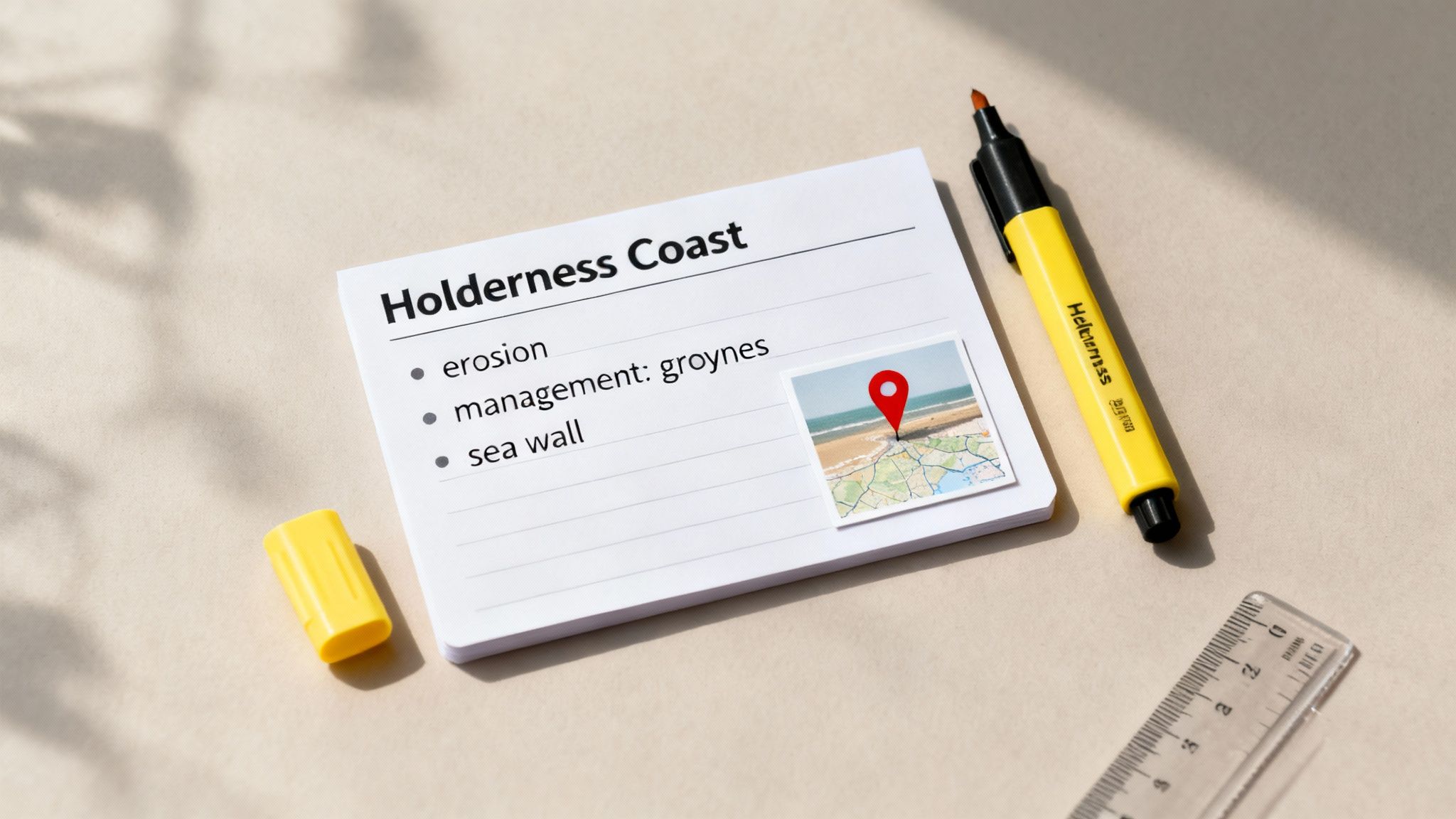
Let's try this with a classic: coastal management at the Holderness Coast.
Instead of writing, "The Holderness Coast erodes quickly," a top-grade revision card would have: "Holderness Coast, East Yorkshire: Europe's fastest-eroding coastline, retreats 1.8 metres/year avg. Caused by weak boulder clay & powerful North Sea destructive waves."
See the difference? Specifics earn marks. Your revision card should be a highlight reel of your most powerful evidence. This approach makes learning how to revise for your Geography GCSE much more effective.
Linking Evidence to Geographical Theory
Simply listing facts won't get you into the top bands. The highest marks are for students who can explicitly connect their case study evidence back to the geographical concepts it illustrates.
Let’s take another example: the challenges of urban growth in Lagos, Nigeria.
The Theory: Rapid, unplanned urbanisation in a Lower Income Country (LIC) leads to the growth of squatter settlements with a poor quality of life.
The Evidence: In Lagos, over 60% of people live in informal settlements like Makoko. These areas often lack basic services—Makoko has only one primary school, and communal toilets are shared by up to 15 households.
The Connection: In your answer, you’d make the link crystal clear: "The situation in Makoko perfectly illustrates the theory of marginalisation, where new migrants are forced into precarious living conditions on undesirable land due to a lack of affordable, formal housing."
This direct link between your example and the underlying theory shows you're thinking like a geographer. Building this skill is a core part of effective revision and is especially vital for the Geography Fieldwork Investigation, where you must connect your findings to broader concepts. By mastering your case studies, you build a powerful toolkit that can be deployed across a massive range of questions, turning a major source of anxiety into your biggest strength.
Cracking the Code: How to Tackle Exam Questions and Beat the Clock
Knowing your geography is one thing, but performing under pressure is a different beast. It’s a classic story: a student with rock-solid knowledge loses marks simply because they misread the question or ran out of time. This section is all about mastering your exam technique, so you can turn everything you’ve learned into the marks you deserve.
Make no mistake, it’s a competitive field. With over 302,706 students sitting GCSE Geography exams each year, just knowing the content won’t make you stand out. The data shows that to secure a top grade, you need sharp analytical and evaluative skills. It all starts with decoding what the examiner is really asking you to do.
You can explore the latest GCSE results data yourself to get a sense of the national picture. It quickly becomes clear that practising your exam craft is just as important as revising your case studies.
Getting to Grips with Command Words
The most important word in any question? The command word. It’s the verb that tells you exactly what the examiner wants. Getting this wrong is like trying to build IKEA furniture without the instructions – you’ll end up with something, but it won’t be what you were hoping for.
Let's break down the common ones you’ll see:
Describe: Think "what" or "where." You’re just painting a picture with words. For "Describe the distribution of tropical rainforests," you'd simply state where they are, mentioning the Equator and the Tropics. No need for any "why" here.
Explain: This is your cue to give the "why" or "how." You have to provide reasons. So, for "Explain the formation of a coastal spit," you need to walk the examiner through the process of longshore drift and deposition.
Assess / Evaluate / To what extent: These are the big-ticket words that separate good answers from great ones. They demand a balanced argument. You need to look at different sides of the story, weigh up the evidence, and then come to a solid, justified conclusion. Simply listing points won't cut it; you have to make a judgement.
For an 'evaluate' question, a top-tier answer always lands on a clear, well-supported final judgement. Try starting your conclusion with something like: "Overall, while the economic benefits were significant, the long-term environmental damage suggests the scheme was ultimately unsustainable."
Structuring Answers for Different Mark Allocations
Not all questions are created equal, so your approach shouldn't be either. A quick 2-mark definition needs a totally different strategy to a sprawling 9-mark essay. A good rule of thumb is to allocate roughly one minute per mark.
Low-Mark Questions (2-4 marks):Be short, sharp, and factual. For a 2-mark 'describe' question, two distinct, relevant points will do the job. For a 4-mark 'explain' question, aim for two points, each developed with a connector like "because" or "this leads to...". Forget introductions or conclusions; just get straight to the point.
High-Mark Questions (6-9 marks):These are all about structure and a clear line of argument. A simple but incredibly effective way to build your paragraphs is using the PEE chain.
Point: Kick off with a topic sentence that tackles the question head-on.
Evidence: Back it up with the goods – specific facts, statistics, or details from your case studies.
Explain: Now, connect that evidence back to the question, showing how it supports your initial point.
For a 9-marker, you’d be looking to write two or three of these well-developed PEE paragraphs, exploring different sides of the argument. Then, cap it all off with a powerful, evaluative conclusion that answers the question directly.
How to Manage Your Time and Finish the Paper
Running out of time is a common nightmare, but it’s completely avoidable. Before your pen even touches the paper, take the first two minutes to scan the entire exam. Mentally block out how much time you'll spend on each section based on the marks available.
If a paper is 90 minutes long and worth 90 marks, you’ve got one minute per mark. Be ruthless with this. If you spend 10 minutes on a 6-mark question, you've just robbed four minutes from a potentially bigger question later on.
It is always, always better to write a decent answer for every question than a perfect answer for only half of them. Keep an eye on the clock in the exam hall and have the discipline to move on. This is the final piece of the puzzle that ensures all your hard revision pays off.
Building a Realistic Revision Timetable That Works
All the study techniques in the world won’t help without a solid plan. It’s time to pull everything together and build a revision timetable you can actually stick to. This isn’t about creating a colour-coded masterpiece that gets abandoned after three days; it’s about building a sustainable routine that prevents burnout and cements your learning.
The goal is to stop random, panicked revision. A smart plan built on spaced repetition and mixed-topic practice is what locks knowledge into your long-term memory. Instead of grinding one topic into the ground, you’ll revisit different concepts at carefully planned intervals. This forces your brain to work a little harder to retrieve the information, which is exactly what strengthens those memory pathways for exam day.
The Two Timetable Approaches
Everyone revises differently, so a one-size-fits-all schedule is useless. The right plan for you depends on how much time you have left and what you're aiming for.
Let's look at two practical approaches you can adapt.
The 6-Week ‘Catch-Up’ Sprint: This is your go-to if the exams are looming and you feel behind. It's an intensive plan focused on covering the essential ground quickly. The priority here is hitting the high-impact topics and patching up major knowledge gaps before it's too late.
The 3-Month ‘Consolidation’ Plan: This is for students aiming for those top 8s and 9s. It’s a steadier, more methodical approach that allows for a much deeper understanding. This schedule has spaced repetition and mixed practice baked in, giving you time to draw crucial links between topics and master evaluative skills.
Whichever path you choose, the secret ingredient is consistency. Little and often will always beat mammoth cramming sessions that just leave you exhausted.
Designing the Perfect 60-Minute Session
One of the biggest revision mistakes is thinking you need to study for hours. The truth is, a highly focused, well-structured 60-minute session can be far more productive than three hours of passive, distracted reading. The structure below ensures you’re actively learning and testing yourself, not just staring at a textbook.
Here’s a simple but incredibly effective template for a one-hour study block. It forces you to switch between recalling knowledge, applying it under pressure, and then critically analysing your own work – the most efficient way to prepare.
The Ultimate 60-Minute Geography Revision Session
Time Allotment | Activity | Purpose |
|---|---|---|
0-10 Mins | Quick Content Review | Glance over your notes, a mind map, or revision cards for the topic. This isn’t deep reading; you're just priming your brain. |
10-30 Mins | Active Recall Practice | Put everything away. Do a 'brain dump' on a blank page, blast through flashcards, or try explaining the topic out loud. |
30-50 Mins | Timed Exam Questions | Find a relevant past-paper question. Tackle it under timed conditions (e.g., a 9-mark question in 10-12 minutes). This hones your exam technique. |
50-60 Mins | Mark and Review | Use the official mark scheme to mark your answer ruthlessly. Pinpoint exactly where you lost marks and why. This feedback is where real learning happens. |
This isn't just about what you revise; it's about how you revise. This focused, multi-stage approach within a single hour ensures you’re making genuine progress every single time you sit down to study.
This simple flowchart shows the core process of planning, writing, and reviewing your exam answers, which should be at the heart of your revision sessions.
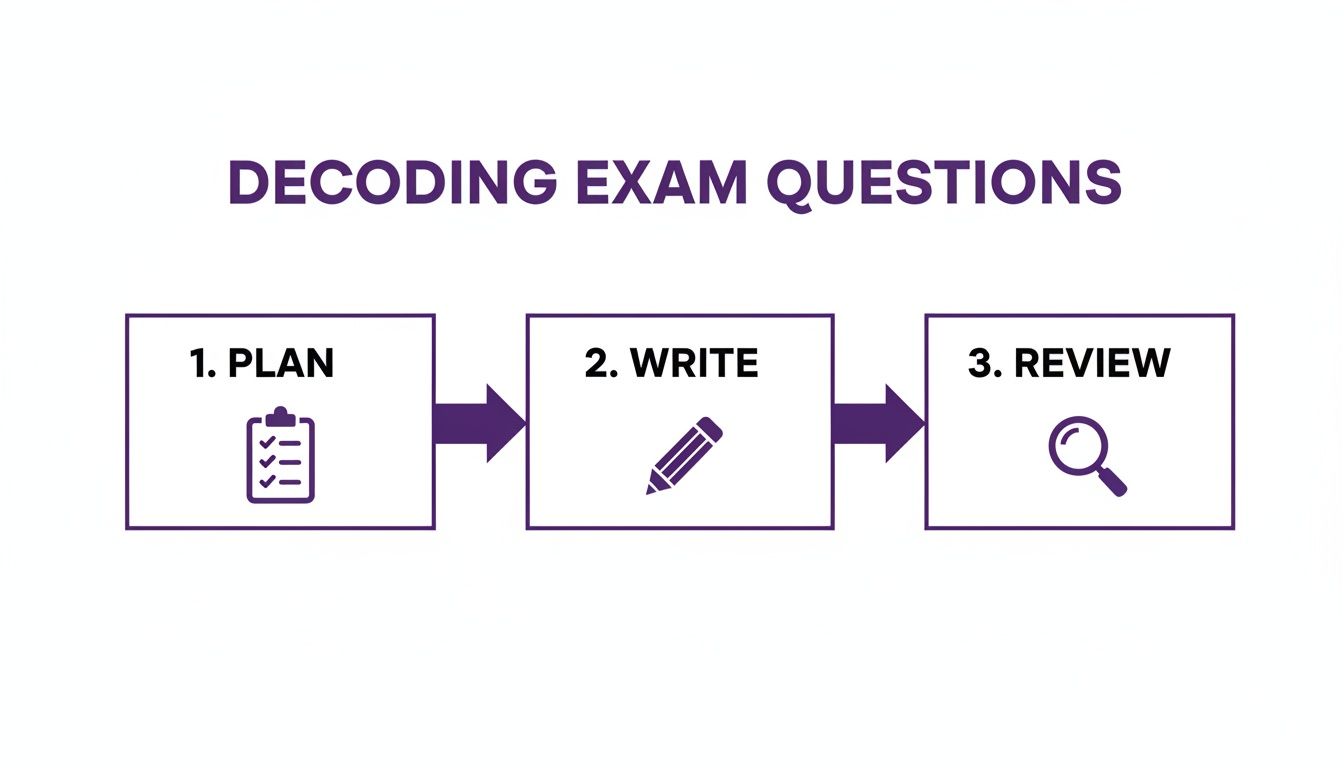
Embedding this systematic approach into every practice question you do will transform your performance under pressure.
A great timetable isn't just about scheduling topics; it's about scheduling effective methods. Your plan should be specific. ‘30 mins of active recall on coasts’ is infinitely better than just writing ‘revise coasts’.
In the end, the best timetable is the one you actually follow. Start with one of these templates, but don't be afraid to tweak it to fit your other subjects and commitments. A good plan gives you control and confidence, turning the huge task of GCSE Geography revision into a series of small, achievable wins.
Got Questions About Your GCSE Geography Revision?
Even with the best plan, revision can throw up questions. Let’s tackle some of the most common worries students have, with some quick, practical fixes.
"How on Earth Do I Revise for the Fieldwork and Skills Paper?"
Ah, the paper that often causes the most headaches. This one isn’t just about what you know; it’s about what you can do.
For your own fieldwork, you need to know it inside out. Think of it like telling a story – the examiner wants to know why you made every decision. Why that sampling strategy? Why present your data in a kite diagram and not a bar chart? Be ready to justify everything.
As for the unfamiliar skills section, there's no way around it: you have to practise. Get your hands on every past paper you can find and get comfortable with these core skills:
Map Skills: Nailing four and six-figure grid references, using the scale to measure distance, and reading contour lines to picture the shape of the land.
Graph Skills: This is about more than just reading the numbers. You need to confidently spot trends, describe patterns, and pinpoint anomalies in everything from scatter graphs to choropleth maps.
A quick tip: pay attention to the command words. ‘Describe the pattern’ and ‘Explain the pattern’ are two totally different things. One gets you a couple of marks; the other opens the door to the top grades.
"I've Got a Mountain of Case Studies to Learn – How Do I Remember Them All?"
First, stop trying to memorise the entire textbook for each one. That’s a fast track to burnout. The secret is being selective and strategic. You’re looking for the killer facts that win marks.
For any case study, aim for just 2-3 specific, solid pieces of evidence. These are your golden nuggets. Think a crucial statistic, a key date, or the name of a specific scheme. For instance, don't just say 'an earthquake happened in a rich country'. Instead, lock this in: ‘The L’Aquila earthquake hit Italy in 2009, causing $15 billion in damage.’ See the difference? One is vague, the other is grade-A evidence.
A game-changing technique is to stop learning case studies in isolation. Create a summary table that puts them head-to-head. Line up your notes on an earthquake in a High-Income Country (HIC) right next to one in a Low-Income Country (LIC). This forces you to analyse the critical differences in preparation, impact, and response—a much higher-level skill that examiners love.
"How Much Time Should I Actually Be Spending on Geography Revision?"
This is the classic ‘how long is a piece of string?’ question. But there’s a smart way to figure it out. The time you give a subject should depend on two things: how tricky you find it and its volume of content. Geography is a beast for content, so it needs consistent, regular attention.
A great starting point is to rank all your GCSE subjects from your weakest to your strongest. The subjects at the top of that list need the most time, but don't neglect the ones at the bottom. For most students, 2-3 focused one-hour geography sessions per week is a solid baseline. You’ll want to ramp this up in the final month before the exams.
"What's the Best Way to Use Past Papers?"
Just doing paper after paper is busy work, not smart work. The real progress comes from how you analyse your performance. You need to treat every past paper like the real deal.
Start by sitting a full paper under strict, timed conditions. No phone, no notes, no 'just five more minutes'. This is about building stamina and getting used to the pressure.
Then comes the most important part: mark it. And be brutal. Use the official mark scheme and for every single mark you dropped, ask yourself why. Was it a genuine knowledge gap? Did you misunderstand the command word? Did you run out of time? This forensic analysis gives you a personalised to-do list for your next revision session. It’s the difference between just practising and practising with a purpose.
At MasteryMind, we’ve designed a platform that makes this kind of smart, examiner-focused practice easy. With thousands of questions tailored to your specific exam board and instant, detailed feedback, you can stop the guesswork and focus on what actually moves the needle on your grade. Find out how MasteryMind can level up your revision at https://masterymind.co.uk.
Comments