Mastering the AQA Chemistry Specification for Exam Success
- Gavin Wheeldon
- Jan 30
- 15 min read

Feeling snowed under by the AQA Chemistry specification? You’re not the only one. But here’s a tip: stop seeing it as a boring rulebook and start thinking of it as the ultimate cheat sheet for your exams. It’s the official guide that tells you, your teachers, and the examiners exactly what you need to know and how you'll be marked.
The AQA Spec: Your Exam Blueprint
Whether you’re just starting your revision or you’re in the final countdown to exams, that official document from AQA can look pretty intimidating. It’s dense and full of jargon. But here’s the secret: it’s your most powerful weapon. It's the blueprint the examiners use to write every single question and build the mark scheme.
Getting to grips with it is the single biggest advantage you can give yourself, whether you're chasing a top grade or just want to secure a solid pass. In this guide, we'll break down both the GCSE (8462) and A-Level (7405) specifications, showing you how to turn them into a practical roadmap for success.
Why is the Specification Such a Big Deal?
Loads of students fall into the trap of only revising from their textbooks or class notes. And while those are definitely important, they don't tell the whole story. The specification is the only document that guarantees you’re covering 100% of what can actually appear on your paper.
It helps you:
Focus your revision: You’ll know exactly which topics carry the most weight, letting you put your energy where it really counts.
Avoid wasted effort: Stop learning extra details that won't earn you any marks. The spec draws a clear line around what’s in and what’s out.
Understand the 'how': It doesn’t just list topics; it explains the skills you need, from handling data in practicals to mastering specific calculations.
Think of it like preparing for a driving test. You wouldn't just drive around hoping for the best; you’d get a copy of the Highway Code to learn the exact rules and manoeuvres you'll be tested on. The AQA Chemistry specification is your Highway Code for exam success.
The specification isn’t just a list of facts to memorise. It’s a detailed guide on how to think, apply your knowledge, and solve problems in the exact way that examiners want to see.
By the end of this guide, you won't see the specification as just another checklist. You'll understand its structure, its language, and most importantly, how to use it to build a smarter, more effective revision plan that gives the examiners exactly what they’re looking for.
Getting to Grips with the GCSE Chemistry Specification
Right, let's break down the AQA GCSE Chemistry specification. Think of this as your game plan—if you know what’s coming, the match is a whole lot less daunting. I'm going to cut through the official jargon to show you exactly what to expect, from the topics you'll study to how you'll be marked.
The entire course is built around 10 core topics. These are split across two separate exam papers, and you'll get 1 hour and 45 minutes for each one. Both papers are worth 100 marks and contribute 50% to your final GCSE grade. It's a perfectly even split, so you can't afford to neglect either one.
The Topic-by-Topic Breakdown
The AQA course is structured logically. It starts with the fundamental building blocks of matter and gradually expands to explore their real-world applications. When you see how the topics connect, revision stops being about memorising isolated facts and starts feeling like you're learning a single, coherent story.
Here's a quick look at what each paper involves:
Paper 1: The Foundations
Atomic structure and the periodic table: This is square one. We're talking atoms, isotopes, and the logic of the periodic table.
Bonding, structure, and the properties of matter: Here, you'll uncover how atoms join forces (think ionic, covalent, and metallic bonds) and why this dictates whether something is a solid, liquid, or gas.
Quantitative chemistry: For many, this is the scary one. It's all the maths—calculating moles, working out concentrations, and balancing those all-important equations.
Chemical changes: This section gets into the nitty-gritty of reactions, covering everything from acids and alkalis to the reactivity series.
Energy changes: You'll explore the difference between exothermic and endothermic reactions, getting to grips with what makes things heat up or cool down.
Paper 2: Applications and the Wider World
The rate and extent of chemical change: This topic dives into why some reactions are lightning-fast and others take ages. You'll cover collision theory and reversible reactions.
Organic chemistry: Welcome to the fascinating world of carbon. This is where you'll learn about crude oil, plastics (polymers), and the molecules that form the basis of life.
Chemical analysis: Think of this as chemical detective work. You’ll learn the techniques chemists use to identify unknown substances, from flame tests to chromatography.
Chemistry of the atmosphere: This topic looks at the big picture—how our atmosphere formed, what it's made of, and the science behind climate change.
Using resources: This is all about sustainability. We'll look at how we can manage Earth’s resources responsibly, from purifying water to recycling.
A key tip: Don’t treat these topics as separate islands. AQA examiners love to build bridges between them. A question on chemical changes (Paper 1), for instance, might ask you to explain it using your knowledge of bonding (also Paper 1).
Mastering the Maths and Practicals
Let’s be honest, the maths in chemistry can be a real stumbling block for some. But here's the secret: the calculations are highly predictable. A big chunk of your marks in the aqa chemistry specification comes from your mathematical skills, particularly in quantitative chemistry.
Examiners will almost certainly test things like titration calculations, mole conversions, and percentage yields. These aren't just abstract problems thrown in to confuse you; they are directly tied to the required practicals you'll be doing in class. Since its introduction, the AQA GCSE Chemistry specification (8462) has put a huge emphasis on applying this knowledge. The June 2023 exams, for example, had students calculating the moles of Na₂CO₃ from a titration—a direct reflection of lab work. Nail these calculations, and you'll turn tricky questions into easy marks.
The required practicals are far more than just a box-ticking exercise. Questions about them are guaranteed to pop up in your final exams. You’ll need to know the methods inside out, be able to identify variables, discuss potential errors, and suggest improvements. A solid understanding of these experiments is absolutely vital for reaching the top grades.
For a deep dive into revising these topics effectively, check out our complete AQA GCSE Chemistry resources. Getting comfortable with these key areas of the aqa chemistry specification is a non-negotiable part of your exam prep.
Stepping Up to the A-Level Chemistry Specification
Making the jump to A-Level Chemistry is a serious step up. The depth and complexity ramp up significantly, but once again, the AQA specification is your best friend for navigating the journey. This isn't just about memorising more facts; it’s about learning to weave together ideas from different parts of the subject in a much more sophisticated way.
The entire A-Level course is built on three massive pillars: Physical, Inorganic, and Organic chemistry. Unlike at GCSE, where topics are often neatly separated, A-Level chemistry expects you to see the connections. You'll need to apply principles from physical chemistry (like thermodynamics) to explain why a reaction in organic chemistry happens the way it does.
The Three Pillars of A-Level Chemistry
Think of it like building a house. Physical chemistry lays down the fundamental rules and mathematical foundations—it’s the physics that dictates how chemical reactions actually work. Inorganic chemistry then uses those rules to explore the behaviour of the elements, while organic chemistry focuses on the vast and intricate world of carbon-based molecules.
Physical Chemistry: This is the 'how and why' of chemistry. It covers topics like atomic structure, thermodynamics, reaction rates (kinetics), and equilibria. Be prepared, as this is where you'll find most of the maths.
Inorganic Chemistry: Here, you'll dive deep into the periodic table. You'll study periodic trends, the chemistry of transition metals, and the reactions of ions in solution. It's all about understanding the unique personality of each element.
Organic Chemistry: This is the study of carbon compounds. You’ll learn about different functional groups, reaction mechanisms, and powerful analytical techniques like NMR spectroscopy.
Crucially, these three areas aren’t assessed in isolation. They are all interconnected, a key feature of the A-Level’s linear format. This means everything you learn from your very first lesson is fair game in your final exams two years later. There's no dropping Year 1 content; it all builds towards that final hurdle.
Decoding the Three Exam Papers
The AQA A-Level Chemistry course culminates in three exam papers, each designed to test different skills and content areas. Paper 1 and Paper 2 are quite similar in format, with a mix of long and short answer questions, but Paper 3 is a different beast altogether.
It's vital to get your head around how these papers are structured. Let’s break it down.
A-Level Paper Breakdown and Weighting
Paper | Content Focus | Marks & Time | Weighting |
|---|---|---|---|
Paper 1 | Relevant Physical & Inorganic Chemistry | 105 marks / 2 hours | 35% |
Paper 2 | Relevant Physical & Organic Chemistry | 105 marks / 2 hours | 35% |
Paper 3 | All content, practical skills, synoptic questions | 90 marks / 2 hours | 30% |
As you can see, Paper 1 and Paper 2 carry equal weight, covering specific areas of the course. But Paper 3 is where it all comes together. Understanding this structure is essential for planning your revision effectively. In 2023, of the 28,500 students who sat these exams, 26.4% achieved A*-A grades by mastering this structure. You can get more detail from the official AQA specification overview.
Paper 3: The Synoptic ChallengeThis paper is often what separates the top students from the rest. It includes questions on practical skills and data analysis, multiple-choice questions that can come from anywhere on the spec, and synoptic essay questions that force you to pull together knowledge from completely different topics.
The Practical Endorsement (CPAC)
Alongside your written exams, you’ll work towards the Common Practical Assessment Criteria (CPAC). This isn't a graded exam but a pass/fail endorsement that proves you've got the essential hands-on lab skills. Don't be fooled by the "pass/fail" label—it’s incredibly important.
Universities, especially for science-based degrees, often make a pass in the practical endorsement a condition of their offer. More importantly, a whopping 15% of the marks in your written exams are directly linked to practical chemistry. This means you need to know your 12 required practicals inside and out—not just how to do them, but the theory behind them, where errors can creep in, and what the results actually mean.
Successfully navigating the A-Level course means mastering the content across all three pillars and getting comfortable with how they connect. To see how you can build a smarter study plan for this challenge, explore our in-depth AQA A-Level Chemistry resources.
Giving the Examiners Exactly What They Want
Ever had that sinking feeling when you get an exam paper back? You were sure you wrote a brilliant answer, but the marks just aren't there. It's a frustratingly common story, and the reason is often simple: you gave the examiners a great answer, just not the exact one they were looking for.
This is where understanding the rules of the game becomes your secret weapon. The AQA Chemistry specification isn't just a syllabus; it’s a detailed guide to the skills you need to demonstrate. To really get ahead, you have to master two key concepts: Assessment Objectives (AOs) and command words.
Think of AOs as the different types of thinking the examiners want to see. Command words are the specific instructions in each question telling you which type of thinking to use. Nailing this combination is like having the mark scheme before you even start writing.
Cracking the AO Code
Every single mark on your exam paper is awarded for demonstrating one of three core skills. Knowing what they are—and how the marks are weighted—helps you focus your revision on what actually scores points.
AO1: Demonstrate knowledge and understanding. This is the bedrock. It’s about recalling the core information you’ve learned, like definitions, equations, and describing chemical processes. This is your factual toolkit.
AO2: Apply knowledge and understanding. Here's where you start using your toolkit. This skill is all about taking the facts from AO1 and applying them to a new or unfamiliar situation. That could mean interpreting data, running a calculation, or explaining a phenomenon using your scientific knowledge.
AO3: Analyse, interpret, and evaluate. This is the top tier, where you really start thinking like a scientist. It involves pulling apart complex information, spotting patterns, judging the quality of data, drawing reasoned conclusions, and suggesting improvements to experimental methods.
At A-Level, the mark distribution is roughly 30-35% for AO1, 40-45% for AO2, and 25-30% for AO3. Just look at those numbers. Well over half the marks come from applying and analysing knowledge, not just remembering it. This is precisely why just memorising a textbook won't land you a top grade.
This map helps visualise the structure of A-Level Chemistry, where every topic demands a mix of AO1, AO2, and AO3 skills.
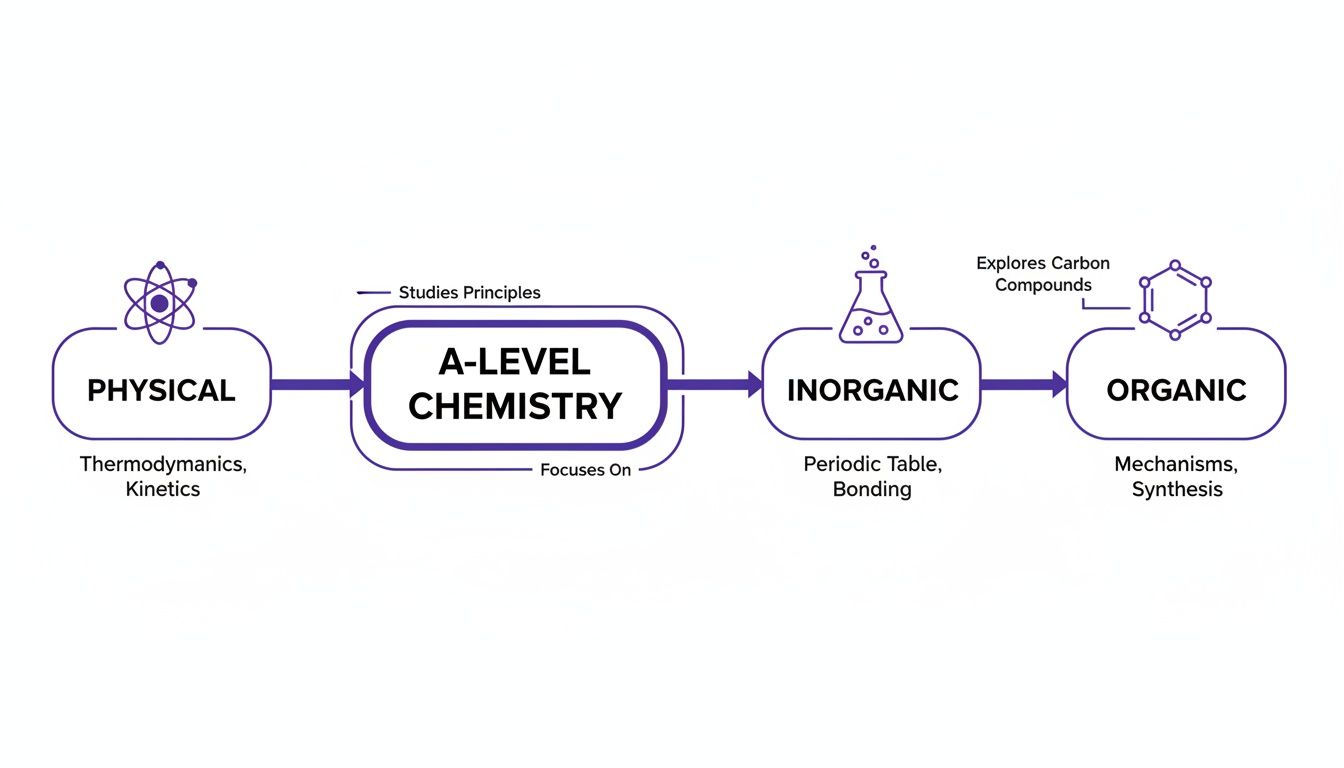
You can see how foundational principles from Physical Chemistry are applied across both Inorganic and Organic branches, which is a key part of how AQA tests your synoptic understanding.
Listening to the Command Words
Command words are your direct instructions from the examiner. Misinterpreting them is one of the fastest ways to throw away marks. If a question asks you to 'describe' but you 'explain', you've essentially answered the wrong question, no matter how good your chemistry is.
Here’s a quick translation of some common ones:
Describe: Just say what you see or what happens. It's a play-by-play. For "Describe what happens when magnesium is added to hydrochloric acid," you’d simply state that you see fizzing, the solid magnesium disappears, and the test tube gets warm. No 'why' needed.
Explain: Now you bring in the 'why'. You have to use your scientific knowledge (your AO1 facts) to say why it's happening. For the same example, you would explain that the fizzing is due to hydrogen gas being produced because magnesium is more reactive than hydrogen and displaces it.
Compare: This is a classic trap. It requires you to identify both the similarities and the differences between two things. So many students only list the differences and lose half the marks on offer.
Evaluate: This is a high-level AO3 skill. You need to use the information in front of you (plus your own knowledge) to make a considered judgement. This often means weighing up pros and cons, assessing the reliability of evidence, or deciding on the best course of action and justifying your choice.
Getting this right completely changes your approach to exam answers. You stop giving away easy marks and start building responses that are perfectly tuned to what the examiner is looking to reward. It’s the real difference between knowing your chemistry and knowing how to score marks in a chemistry exam.
Building a Smarter Revision Plan with the Specification
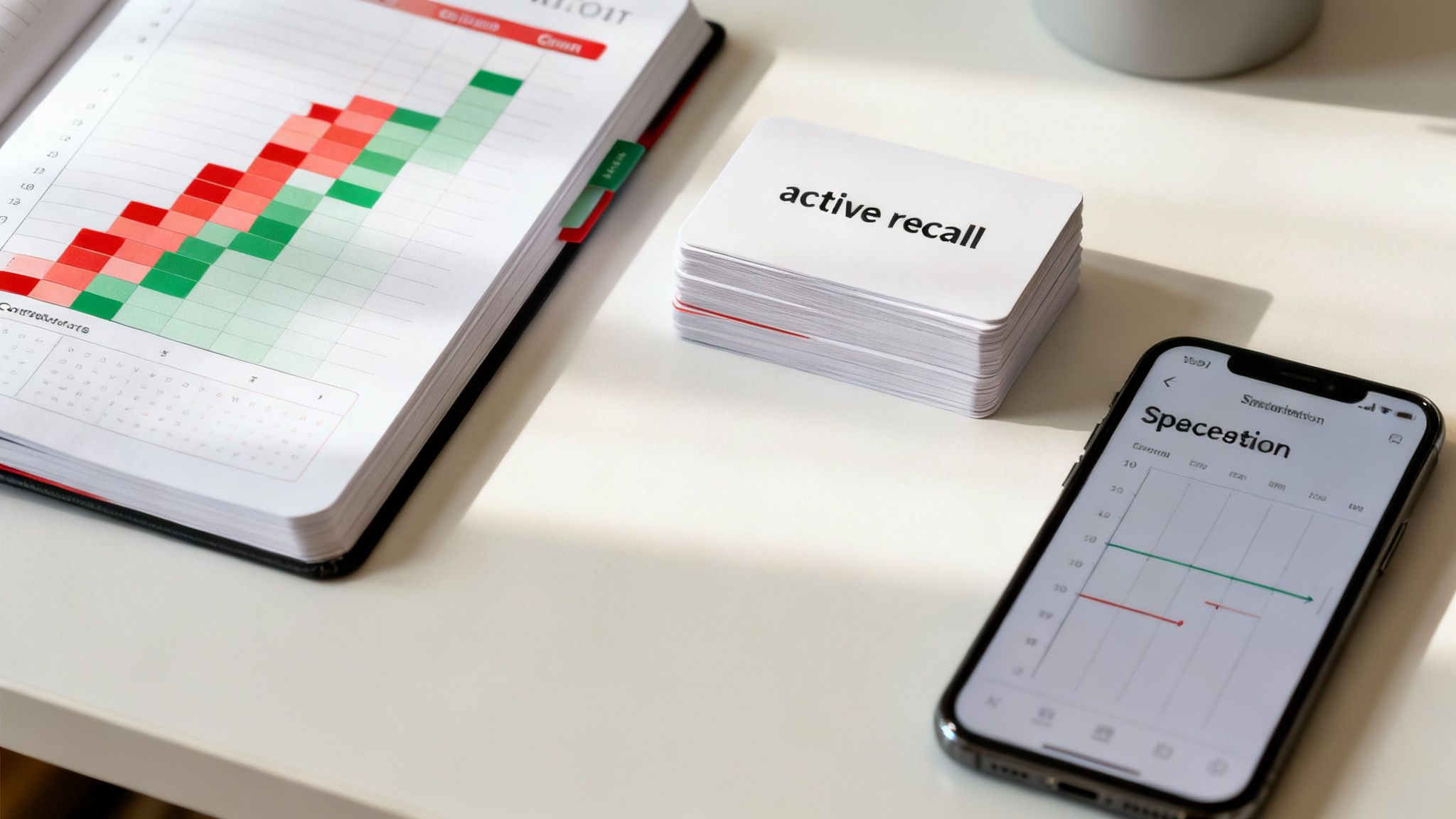
Knowing what’s on the exam is one thing, but knowing how to lock that information into your brain is another. It’s easy to fall into the trap of re-reading notes or highlighting a textbook. It feels productive, right? But the truth is, cognitive science shows these are some of the least effective ways to revise.
It’s time to stop revising harder and start revising smarter. And your best tool for that? The aqa chemistry specification itself. This isn’t about clocking more hours at your desk; it's about making every hour count by targeting your weak spots and building memories that hold up under pressure.
Turning the Specification into Your Personal Checklist
First things first, let’s turn that dense AQA document into a powerful, personalised tool. Don't just read it—interact with it. The most effective way to start is by creating a confidence checklist, often known as a Red-Amber-Green (RAG) rating system.
Go through the specification, point by point. For every single statement, give yourself an honest rating:
Red: "I have no idea what this is," or "I always get questions on this wrong." These are your top priority.
Amber: "I kind of get it, but I'm shaky." Maybe you get the questions right sometimes, but you wouldn't bet your grade on it.
Green: "I know this inside and out." You could confidently explain it to a friend and smash any exam question on it.
This simple exercise instantly sharpens your focus. Instead of wasting precious time passively going over "Green" topics you've already mastered, you can pour your energy into turning "Red" areas into "Amber" and "Amber" areas into solid "Green". It’s a laser-focused approach that guarantees your revision time is always well spent.
Ditching Passive Revision for Powerful Techniques
Once you know what to revise, you need to know how. This is where the real magic happens, thanks to two evidence-backed techniques: active recall and spaced repetition.
Active recall is all about pulling information out of your brain, rather than just pushing it in. It's the mental struggle of remembering something that strengthens the neural connections, making that memory stick.
So, instead of just reading about covalent bonding again, active recall looks like this:
Put the book away and try drawing the dot-and-cross diagram for a water molecule from memory.
Explain the properties of simple molecular substances out loud, as if teaching someone.
Tackle a practice question on the topic before looking at your notes.
It's definitely harder than just re-reading, but it's also dramatically more effective for building robust, long-term memory.
Making Your Learning Stick with Spaced Repetition
Spaced repetition is the perfect partner for active recall. The idea is simple: you review information at increasing intervals over time. Rather than cramming a topic all in one go, you revisit it just as you're about to forget it.
For instance, after you’ve tackled electrolysis, you might test yourself on it a day later. Then three days later. Then a week later, and so on. This process fights against the natural "forgetting curve" and signals to your brain that this information is important and needs to be stored for the long haul.
This is exactly how platforms like MasteryMind are designed to work. They use the aqa chemistry specification to generate questions that force you to use active recall. The clever bit is that the system then schedules topics for you to review based on how you're doing, creating a personalised spaced repetition plan automatically. It’s an efficient way to master the entire specification without the burnout that comes from endless, ineffective cramming.
Practice That's Built for the AQA Exam
Knowing the AQA specification is one thing, but performing under pressure on exam day is another beast entirely. The only way to close that gap is through practice—not just any practice, but sessions that feel like the real deal. This is where you shift from passively reviewing notes to actively training for the exam, all with one goal: hitting your target grade.
Think about it. What if every practice question you attempted wasn't just a random knowledge check? Imagine each one being precisely mapped to a specific topic, command word, and the exact Assessment Objective it’s designed to test. This method isn't just about getting questions right; it's about systematically building the skills that the AQA chemistry specification rewards.
With this kind of focused approach, none of your revision time is wasted. You’re not just guessing what might come up; you’re engaging with questions that perfectly mirror the style, structure, and quirks of a real AQA paper.
Getting Feedback That Thinks Like an Examiner
What’s the use in answering a practice question if the only feedback you get is a tick or a cross? A simple "incorrect" tells you nothing. To actually improve, you need immediate, detailed feedback that breaks down your answer just like an examiner would, showing you exactly where you gained or lost marks.
This means seeing your performance analysed against each Assessment Objective:
AO1 Marks: Did you remember the key facts and definitions correctly?
AO2 Marks: Were you able to apply that knowledge to the scenario in the question?
AO3 Marks: Could you properly analyse the data, evaluate the method, and come to a sensible conclusion?
Seeing this kind of breakdown is incredibly revealing. It shows you your strengths but, more importantly, pinpoints your weaknesses with laser focus. If you keep losing AO3 marks, for example, you know you need to spend more time working on your analysis and evaluation skills. This is how you start turning those weak spots into easy marks.
The point of smart practice isn't just to see what you don't know. It's to understand why you're not showing what you know in the way AQA wants to see it.
Tackling the Maths Questions Head-On
Let's be honest: for many, the maths-based questions in chemistry are a huge stumbling block. Tackling calculations on moles, concentrations, or energy changes under exam conditions can feel intimidating. Just reading through a worked example in a textbook often isn't enough—you need to get your hands dirty and work through the process yourself.
This is where step-by-step walkthroughs are invaluable. When you get a calculation wrong, seeing only the final answer is frustrating. What you really need is a clear, logical guide that takes you through every single step, from start to finish.
This is exactly what platforms like MasteryMind are designed for. They are built to align perfectly with the AQA chemistry specification, with features that directly target these critical skills. By breaking down complex maths problems into bitesize chunks, you don’t just learn the method; you build the confidence to handle any calculation the examiners can throw at you. It’s not just random practice; it’s targeted training for success.
Got Questions About AQA Chemistry? Let's Get Them Answered
When you're deep in the AQA Chemistry specification, certain questions always seem to pop up. Let's tackle a few of the most common queries I hear from students and teachers alike.
How Much Maths Is Actually in the GCSE Exam?
It’s a great question, and the straight answer is: quite a bit. AQA dedicates a minimum of 20% of the total marks in GCSE Chemistry to mathematical skills.
Don't panic, though. We're not talking about advanced calculus here. It's all about applying specific skills to chemical contexts. You’ll need to be comfortable rearranging equations, working out percentages, pulling data from graphs, and handling standard form. The maths is predictable and woven into topics like Quantitative Chemistry and Energy Changes, so if you nail those core calculations, you're securing a solid chunk of your grade.
Can I Still Pass A-Level if I Fail the Practical Endorsement?
Technically, you can. The Practical Endorsement (or CPAC) is a separate pass/fail grade your school awards. You can still sit the final exams and get an A-Level grade (A*-E) even with a 'Not Classified' on your practical skills.
But here’s the reality: it’s a massive gamble. First off, a chunky 15% of your A-Level exam marks are directly testing your understanding of practical work. If your lab skills are weak, your exam grade will suffer. More importantly, virtually every university science course will demand a "Pass" in the practical endorsement as a non-negotiable entry requirement. Failing it could mean an automatic rejection from your first-choice uni.
What's the Smartest Way to Use Past Papers?
The key is to be strategic, not just to plough through them blindly. Use the specification document as your map. Start by picking a topic you know you're shaky on—maybe one you've marked as 'Red' or 'Amber' on your RAG list.
Next, hunt down past paper questions that specifically test that part of the spec.
This approach flips revision on its head. It’s no longer a random memory test; it becomes targeted training. You're learning precisely how AQA examiners will test you on every single point in the syllabus.
Once you’ve answered a question, grab the official mark scheme and be ruthless with your marking. Look at the command words and see exactly where the Assessment Objective (AO) marks are coming from. This focused practice is what really moves the needle on your performance.
Ready to transform your revision with practice that’s perfectly aligned to the AQA chemistry specification? MasteryMind provides instant, examiner-style feedback and adaptive questions to help you master every topic. Start for free and see the difference at https://masterymind.co.uk.
Comments