Revision Timetable Generator GCSE: Your Ultimate Plan to Ace Your Exams
- Gavin Wheeldon
- Feb 11
- 13 min read

Feeling the pressure of GCSEs? Whether you’re aiming to ace every paper or staging a last-minute comeback, a revision timetable generator for GCSE can be a total game-changer. It ditches the classic mistakes of DIY planning—like spending all your time on your favourite subjects or, worse, running out of time completely. Instead, it uses actual learning science to build a smart, balanced schedule that fits you perfectly, preventing burnout and making sure every single topic gets covered before exam day.
Why Your Old Revision Timetable Isn't Working
Let’s be real. That colourful grid you spent hours creating? The one full of good intentions and perfectly boxed-out subjects? It’s probably not working. You’re not alone. The old-school approach to revision planning is often the very thing that leaves students feeling overwhelmed, burnt out, and completely unprepared when exams finally arrive.
The pressure is on, too. With a record 5.7 million GCSE and A-Level entries last year, the competition has never been tougher.
The problem usually starts with vague, unhelpful blocks like "2 hours of Maths." What does that actually mean? Are you meant to be tackling algebra? Geometry? Is it time for past papers or just flicking through your notes? Without a clear focus, it's far too easy to drift, get distracted, and finish a two-hour session feeling like you’ve worked hard but achieved almost nothing.
The Common Revision Traps
Most DIY timetables fall into the same predictable traps. We all naturally drift towards the subjects we enjoy or find easy because it gives us a quick hit of feeling productive. It feels good.
But while you're coasting through familiar territory, that dreaded Physics topic or that tricky Shakespearean play gets pushed to "tomorrow," then "next week," until it’s suddenly the night before the exam. This leads to the inevitable all-night cramming session—which, as any teacher will tell you, is one of the worst ways to try and learn anything.
Another classic mistake is just poor prioritisation. You might spend ages on a low-stakes topic you already know well, simply because it was at the top of your to-do list. An effective plan needs to weigh up everything: how difficult a topic is, how many marks it's worth in the exam, and how confident you feel about it. A static paper grid just can't do that. It’s this lack of strategy that creates performance gaps. In fact, you can see the difference in outcomes by reviewing GCSE exam insights, which often highlight the disparity between students with structured plans and those without.
The biggest flaw in a traditional timetable is its rigidity. It doesn’t account for a bad day, a topic that takes way longer than you thought, or a surprise homework assignment. The moment you fall behind, the whole thing collapses, leaving you more stressed than when you started.
From Good Intentions to Smart Strategy
The goal isn't just to block out your time; it's to make every minute of that time count. Simply listing subjects on a calendar won't magically improve your memory or understanding.
A basic schedule fails to incorporate proven learning techniques like spaced repetition (revisiting topics at increasing intervals) or interleaving (mixing up different subjects). These methods force your brain to work smarter, not just harder. Before we get into building a better plan, it’s vital to see why the old way is broken. It’s based on willpower, not science, and it sets so many students up for failure before they’ve even begun.
Gathering Your Intel for the Perfect Study Plan
Before you can build a revision plan that actually works, you need to know exactly what you’re up against. Think of it like a video game: you wouldn’t charge into the final boss battle without scouting its weaknesses, would you? This initial intel-gathering stage is what separates a plan that gets you the grades from one that just looks good on paper.
It's time for a personal 'GCSE audit'.
This isn't as complicated as it sounds. It’s simply about listing every single topic for each of your subjects—whether you're with AQA, Edexcel, or another board—and being brutally honest about where you stand with each one. This is the raw data that will power any smart revision timetable generator for GCSEs or manual plan you create.

Conducting Your Personal GCSE Audit
First things first, grab your exam specifications. Your teachers can point you to these—they are the blueprints for success, detailing every single thing you could be tested on. Go through them, subject by subject, and list all the major topics and the smaller sub-topics within them.
Once you have your master list, it’s time for some real honesty. Go through each topic and rate your confidence on a simple scale from 1 to 5.
1 (Red Alert): "I have no idea what this is." You’d probably skip any question on it.
3 (Amber Warning): "I sort of get it, but I’d really struggle in an exam." It feels a bit shaky.
5 (Green Light): "I could teach this to someone else." You know it inside out.
This simple rating system immediately flags where your revision energy needs to go. Don't just rely on guesswork, either. Dig out your mock exam results, end-of-topic tests, and any feedback from your teachers to make this audit as accurate as possible. If you need more material to properly test your knowledge, you can always find a bank of official GCSE past papers.
Prioritising What Really Matters
With a clear picture of your strengths and weaknesses, the final step is to prioritise. Not all topics are created equal; some carry more weight in the final exam. For example, a big, high-stakes topic in Maths like Algebra is almost guaranteed to be worth more marks than something more niche.
Combine your confidence score with the topic's importance. A topic you've rated a '1' that you know frequently appears in exams should be your absolute top priority. On the other hand, something you've rated a '4' that is only a minor part of the syllabus can be scheduled for quick reviews later on.
To help you visualise this, here’s a simple template you can adapt for your own subjects.
Example Topic Audit for GCSE Biology (AQA)
Topic Area | Sub-Topic | Exam Weighting | Confidence (1-5) | Priority Level |
|---|---|---|---|---|
Cell Biology | Eukaryotic & Prokaryotic Cells | High | 4 | Medium |
Cell Biology | Microscopy | Medium | 2 | High |
Organisation | The Human Digestive System | High | 5 | Low |
Infection/Response | Monoclonal Antibodies | Medium | 1 | Critical |
Bioenergetics | Factors Affecting Photosynthesis | High | 3 | High |
Ecology | Food Chains & Webs | Low | 5 | Low |
As you can see, a 'critical' priority isn't just about a low confidence score; it's the combination of low confidence and high importance. This structured approach makes your next steps so much clearer.
This audit is your strategic advantage. By taking the time to gather this intel, you’re ensuring every single revision session is targeted, purposeful, and directly addresses the areas that will have the biggest impact on your final grades.
Designing Study Sessions That Actually Stick
Right, you’ve audited your subjects and have a clear picture of the battlefield. Now it’s time to shift from what to revise to how. Let’s be honest, those endless, soul-destroying library sessions often leave you feeling more drained than prepared. The goal here is to use brain-friendly techniques that make information actually stay in your head long after you’ve closed the book.
This isn’t about working harder; it’s about working smarter. A four-hour slog trying to memorise an entire topic is nowhere near as effective as shorter, focused bursts of activity. It’s all about designing study sessions that work with your brain, not against it.
The Power of Short Bursts
One of the best ways to beat procrastination and stay focused is by using the Pomodoro Technique. It sounds fancy, but it’s incredibly simple and works wonders for preventing that mental burnout from long, unstructured study blocks.
Here’s how it works in practice:
Pick a single topic from your priority list.
Set a timer for 25 minutes and give that one task your undivided attention. That means phone away, social media off—just pure focus.
When the timer rings, take a 5-minute break. Seriously, get up, stretch, grab a drink—do anything but revise.
After you’ve done four of these "Pomodoros," give yourself a proper break of 15-30 minutes.
This method keeps you engaged and makes the thought of starting a session much less daunting. It’s no longer "I have to revise History for three hours," but simply "I need to focus on the Treaty of Versailles for 25 minutes." Anyone can do that.
Your Secret Weapon: Spaced Repetition
Ever crammed for a test, felt like you knew it all, and then forgotten everything a week later? That’s because cramming shoves information into your short-term memory. To lock that knowledge into your long-term memory where it counts, you need spaced repetition.
Spaced repetition is all about revisiting information at increasing intervals. Forgetting is actually a key part of learning; each time you retrieve a memory you were about to forget, you strengthen its pathway in your brain.
So, instead of studying a topic once and ticking it off, you revisit it strategically. For example, you might look over a Chemistry concept a day after learning it, then again three days later, and then a week after that. A good revision timetable generator for GCSE can automate this, making sure you never forget to circle back to the important stuff at the perfect time.
Mix It Up with Interleaving
Finally, let’s talk about interleaving. This just means mixing up different subjects or topics within a single study block, rather than doing one thing for ages. While it can feel a bit less productive at first, the results are powerful.
For example, instead of a solid hour of just Maths, you could try:
30 minutes tackling algebra problems.
30 minutes analysing a poem for English Literature.
Doing this forces your brain to switch gears and pull out different types of information, which builds stronger, more flexible connections. Think of it as a workout for your brain, making you much better at recalling the right formula or quote when you’re under exam pressure. To get a better handle on this, you can learn more about how to apply interleaved practice to your GCSE revision.
Creating a balanced revision timetable is a genuine game-changer. For UK students, the data shows that structured timetables can lift grades by up to 1.5 levels. Experts suggest revising 2-3 subjects per day, mixing essay-based subjects with numerical ones, and—crucially—building in rest days to avoid burnout. It's a marathon, not a sprint. Read more about how effective revision planning transforms student outcomes.
Using AI to Build Your Personalised Timetable
You’ve done the hard work of auditing your subjects and you understand the learning techniques that actually make revision stick. But let's be honest, putting it all together can feel like a full-time job in itself. Juggling priorities, scheduling spaced repetition, and mixing up topics is a logistical nightmare.
This is where a smart revision timetable generator for GCSE doesn't just save you time; it completely changes the game.
Forget wrestling with a basic calendar app. We’re talking about an intelligent study partner that does all the heavy lifting for you. A tool like MasteryMind automates the entire planning process, taking your subject audit, exam dates, and personal learning pace to build a genuinely optimised schedule in seconds.
Let the Algorithm Do the Work
The real magic is what happens behind the scenes. Once you've plugged in your subjects and confidence ratings, the generator gets to work, building your plan on a foundation of proven learning science.
It automatically weaves in the techniques we've already covered:
Spaced Repetition: The system calculates the perfect moment to revisit a topic—just before you’re about to forget it. No more guesswork or trying to track it all on a spreadsheet.
Interleaving: It intelligently shuffles subjects and topics to keep your brain engaged and forge stronger memory connections. This prevents the burnout you get from slogging through one subject for hours on end.
Prioritisation: It weighs everything up for you. Your weaker areas, high-value topics, and looming exam dates are all factored in to make sure you’re always working on what will have the biggest impact on your grades.
This diagram shows the core process perfectly: focused work, strategic repetition, and mixing things up for maximum retention.
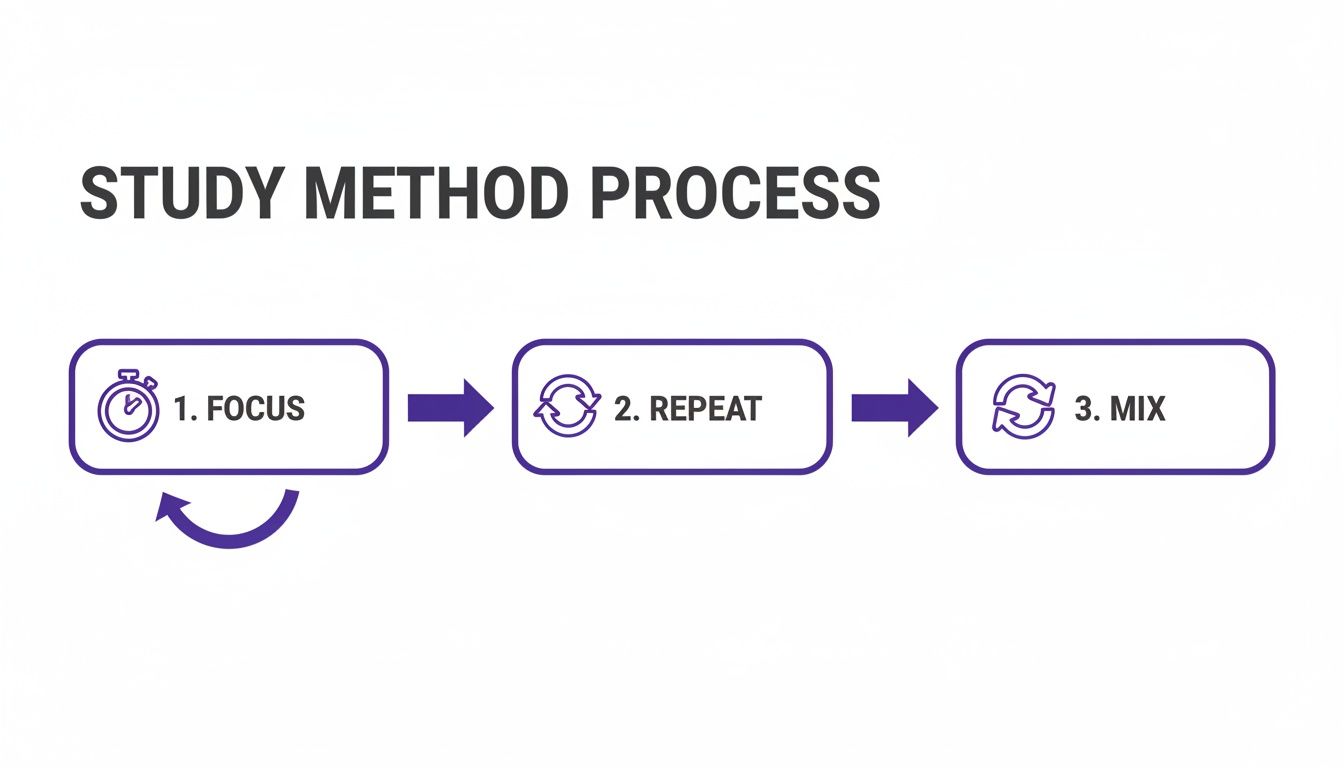
This cycle of focus, repetition, and variety is exactly what an AI planner automates. It ensures you revise smarter, not just harder.
Your timetable stops being a static, fragile grid. Instead, it becomes a dynamic, living plan that adapts to your actual life. Had a bad day and missed a session? The system automatically reshuffles your schedule to get you back on track. Mastered a topic faster than you thought? It reallocates that time to an area that needs more attention.
This single feature removes the biggest point of failure in manual planning: the stress of falling behind. The planner handles the logistics, so you can pour all your energy into learning. For big projects with firm deadlines, this is a lifesaver. You can even find dedicated support for coursework, like the NEA Coach, which applies these same principles to long-term assignments.
From Data Input to Daily Plan
Getting started is surprisingly straightforward. You simply feed the generator your key information—subjects, exam boards, and those all-important confidence ratings from your audit.
The system then takes that raw data and turns it into a clear, actionable schedule broken down into manageable sessions. Each session has a specific goal, completely removing the indecision of "What should I revise now?" from your day.
Making Your Revision Plan A Habit
So, you’ve got a perfectly optimised schedule. That's a brilliant first step. But even the smartest plan, built by the most intelligent revision timetable generator for GCSE, is completely useless if you don't actually follow it.
The real challenge isn’t just creating the plan; it's turning that plan into a routine you can stick with, even on the days you really don't feel like it. This is where your strategy moves from the screen into real life. It’s all about building good habits that make revision feel automatic, not like a chore you have to force yourself to do every day. Trust me, consistency beats cramming every single time.
Flexibility Is Your Friend
Let’s get one thing straight: life happens. You might have a family event, a mountain of homework, or just a day where your brain feels like total mush. A rigid timetable shatters the first time you miss a session, which often leads to giving up entirely. This is why a bit of flexibility is non-negotiable.
Don't panic if you miss a planned study block. The goal here is consistency, not perfection. If you're using a smart planner like MasteryMind, it will automatically reschedule and re-prioritise for you. If you're working manually, just aim to fit that missed session into a buffer slot later in the week.
A revision plan is a map, not a cage. If you hit a roadblock, you find a different route; you don’t throw the map away. The key is to get back on track at the next available opportunity.
Protect Your Downtime Fiercely
Revising for GCSEs is a marathon, not a sprint. Trying to study every waking hour is the fastest way to burn out, and a burnt-out student is an ineffective one. Your brain genuinely needs rest to process and store information. Without it, you’re just staring at words on a page.
Make sure your timetable includes non-negotiable downtime. Go ahead and schedule your social life, your hobbies, and time to just do nothing.
Schedule Social Time: Block out time for friends or family just as seriously as you would for a revision session.
Keep Up with Hobbies: Whether it’s football, gaming, or art, continuing activities you enjoy is absolutely vital for your mental health.
Prioritise Sleep: Getting a solid 8-10 hours of sleep is one of the most effective revision tools there is. It's when your brain actually solidifies what you've learned.
Treat these breaks as essential parts of your revision strategy—because that’s exactly what they are. Protecting your well-being ensures you can perform at your best when it really counts.
Track Your Progress and Stay Motivated
One of the biggest motivators is seeing that your hard work is actually paying off. This is where tracking your progress becomes an incredibly powerful tool. Watching your understanding grow can give you the push you need to keep going on those tough days.
Platforms like MasteryMind have a dashboard that visually represents your progress. You can literally see your mastery level for each topic improve, turning a vague sense of "getting better" into tangible, visible proof.
When you see a topic's rating go from a shaky ‘Amber’ to a confident ‘Green’, it provides a huge boost and reinforces the habit. It's the evidence that shows your plan is genuinely working.
Still Have Questions About Your GCSE Timetable?
Even with the best intentions, building a revision plan that actually works can feel a bit daunting. It's totally normal to have questions, whether you're a student trying to get your head around it all or a teacher looking for a better way to support your class. Let's clear up some of the common sticking points.
How Far in Advance Should I Make a Revision Timetable?
The sweet spot is somewhere around 10-12 weeks before your first exam. That might sound like a lot, but it gives you enough breathing room to cover everything properly using spaced repetition, which is far more effective than last-minute cramming. A generator is brilliant for this, as it can map out a long-term plan that intelligently weaves topics in and out over several months.
But what if you've left it a bit late? Don't panic. A good revision timetable generator for GCSE can still create a powerful, focused plan for the time you have left. It will just be more intense, zeroing in on your weakest areas and the topics that will give you the most marks.
Can an AI Generator Really Make a Better Timetable Than I Can?
Honestly, yes. It comes down to one thing: an AI has no emotional bias. It won't let you skip the topics you hate (we all have them!) and it can juggle dozens of variables at once without breaking a sweat.
You know your subjects, of course. But a generator takes all your inputs—your weak spots, exam dates, topic weightings—and instantly crunches the numbers. It applies learning science like spaced repetition flawlessly and can adjust your entire schedule on the fly if you miss a day. It takes the guesswork out of the equation, making sure your weakest areas get the attention they need.
Think of it this way: your job is to do the learning. The generator's job is to handle the logistics so you're always learning the right thing at the right time. It's a partnership that replaces planning stress with a clear, effective strategy.
What Happens If I Fall Behind on My Plan?
First off, don't worry. It happens to literally everyone. A dentist appointment runs late, you're not feeling well, or you just need a break. The absolute worst thing you can do is scrap the entire plan because you've missed a session or two.
If you’re using a paper timetable, this is where things get messy. You're left trying to manually shuffle everything around, and that's often when the whole system collapses. An adaptive AI tool, on the other hand, just handles it. It automatically reschedules what you missed and re-prioritises your upcoming sessions so you're still on track for what matters most. Remember, the goal is consistency, not perfection.
How Many Hours a Day Should I Actually Revise for GCSEs?
This is all about quality over quantity. Early on, aiming for 1-2 hours of focused revision each day is a fantastic, sustainable target. As exams get closer, you might naturally ramp this up to 3-4 hours, particularly on weekends or during the school holidays.
But here's the crucial bit: two hours of focused, active revision (think practice papers and flashcards) is infinitely more valuable than four hours of just re-reading your notes with your phone next to you. A smart timetable generator won't just block out time; it will suggest manageable 45-60 minute sessions with built-in breaks to keep your brain fresh and stop you from burning out.
Ready to build a smarter revision plan without the stress? Create your personalised, adaptive timetable with MasteryMind and see how our AI can help you ace your GCSEs. Start your free plan today.
Comments