The Best GCSE Revision Apps to Boost Your Grades
- Gavin Wheeldon
- Feb 7
- 17 min read

Finding the best GCSE revision apps isn’t about downloading the one with the flashiest design. It's about finding a tool that’s spot-on for your specific exam board, uses proven learning science like active recall, and gives you detailed, instant feedback. The top contenders offer features like adaptive quizzes, examiner-style marking for essays, and progress tracking, so you can focus your energy where it'll make the biggest difference.
How GCSE Revision Apps Can Transform Your Study Strategy
Let’s be honest, your revision strategy is everything, whether you're chasing top grades or need to pull off a serious comeback. For years, the standard approach was a mountain of textbooks, a rainbow of highlighters, and some battered past papers. But sticking only to those methods today is like trying to build a house with just a hammer—you're missing out on far more effective tools for the job.
The way students get ready for exams has properly changed. Digital tools aren't just a nice-to-have anymore; they're a core part of any smart revision plan. A huge survey of over 5,600 UK students found that 87% use online resources 'often' for their studies. This shows a massive shift away from purely traditional learning, with students preferring the interactive, bite-sized format of quizzes that can fit into any schedule. You can check out the full study on online learning statistics to see just how much things have shifted.
This isn’t just about convenience. The best GCSE revision apps offer a more structured, and frankly, less stressful, route to exam day. They push you to switch from passively reading your notes to actively engaging with the material—a much better way to make information stick.
What Makes a Revision App a Game Changer
So, what separates a genuinely useful study tool from just another digital distraction? It all boils down to a few key things that tackle the biggest hurdles of GCSE revision. A brilliant app doesn't just throw content at you; it provides a smarter way to actually learn it.
Here’s what really matters:
Precision and Relevance: The content must be a perfect match for your exam board, whether that's AQA, Edexcel, OCR, or WJEC. If it's not specific to your syllabus, it’s a waste of precious time.
Intelligent Feedback: Simply knowing you got a question wrong isn't helpful. You need to understand why. The best apps provide clear explanations, helping you correct your thinking so you don't make the same mistake again.
Built on Learning Science: The most effective apps are designed around proven memory techniques. Think active recall (forcing your brain to retrieve information) and spaced repetition (revisiting topics at just the right moments). These methods are crucial for embedding knowledge in your long-term memory.
A well-designed revision app is like having a personal tutor in your pocket. It pinpoints your weak areas, makes you actively engage with the content, and carves out a clear, personalised path to help you hit your target grades.
Ultimately, picking the right app is about making your study time count. It helps you shift from just "covering" the syllabus to truly mastering it, building your confidence one practice question at a time.
What Separates a Great Revision App From a Gimmick?
Let's be real, not all revision apps are created equal. In a seriously crowded market, it’s far too easy to download a tool that looks flashy but does next to nothing for your actual grades. The best GCSE revision apps are much more than digital flashcards; they're intelligent, targeted tools built on real educational science.
So, how do you spot the difference? The first and most critical test is exam board accuracy. An app is only useful if it speaks the same language as your examiner. This means its content must be precisely aligned with your specific exam board, whether that's AQA, Edexcel, OCR, or WJEC. Anything less is a waste of your valuable revision time.
Going Beyond a Simple Score
Getting a question right or wrong is just the start. A gimmicky app might just give you a percentage score and move on, but a great one tells you why your answer was correct or incorrect. This instant, detailed feedback is what stops you from repeating the same mistakes over and over.
Imagine writing a practice paragraph for English Literature. A basic app might not offer any feedback at all. A truly effective tool, however, will break down how your response meets the Assessment Objectives (AOs), suggesting where you could have used stronger evidence or analysed a quote more deeply. That's the kind of feedback that builds real understanding.
Rooted in Real Learning Science
The most powerful revision tools are built on proven cognitive science principles that help you actually remember information long-term. They don't just throw information at you; they make your brain work to retrieve it. For any teachers reading this, you'll know exactly how critical this is.
Two key principles separate the best from the rest:
Active Recall: This is the simple act of deliberately pulling information out of your memory. Instead of passively re-reading your notes, an app using active recall will force you to answer questions, explain concepts, or solve problems from scratch.
Spaced Repetition: Our brains are wired to forget things over time. Spaced repetition algorithms fight this by showing you topics you've struggled with more frequently, and topics you've mastered less often. It makes your revision so much more efficient.
A top-tier revision app doesn't just digitise a textbook. It actively diagnoses your knowledge gaps, applies proven memory techniques to fill them, and provides feedback that mimics a real examiner.
The Importance of Adaptive Difficulty
Finally, a brilliant app has to adapt to your level. If the questions are too easy, you'll get bored and stop learning. If they're constantly too hard, you'll just get frustrated and give up. The sweet spot is a system that keeps you challenged but not overwhelmed.
This is called adaptive difficulty. As you start getting questions right, the app should serve up more complex problems that test your analysis and evaluation skills. If you're struggling, it should dial back to reinforce the fundamentals. This personalised learning path ensures every minute you spend revising is as productive as it can be. You can learn more about how advanced features like these power effective study and what to look for.
A Detailed Comparison of Top GCSE Revision Apps
Choosing the right revision app can feel like a huge decision, especially with your grades on the line. It isn't just about picking the one with the slickest interface; it's about the learning method, the quality of the content, and how well it genuinely prepares you for the specific challenges of your exams.
Let's put some of the most popular options under the microscope. We’ll compare MasteryMind against two well-known alternatives, GCSEPod and Seneca Learning, to see how they really stack up. Each one takes a different approach, and understanding these differences is the key to finding the tool that will work for you, whether you're trying to patch up weak spots or pushing for those top grades.
The Core Learning Philosophy
At the heart of every app is a core idea about how students learn best. GCSEPod, for instance, is built around video content. It delivers curriculum-aligned, bite-sized videos—or 'Pods'—that are fantastic for visual and auditory learners. This method is great for getting your head around a new topic or recapping a lesson in an engaging, fairly passive way. You can watch them on the bus and absorb information without intensive effort.
Seneca, on the other hand, is all about gamification and quick-fire questions. Its platform uses colourful graphics, points, and leaderboards to make learning feel more like a game than a chore. The focus is on rapid, interactive quizzes that use spaced repetition to help you drum key facts and definitions into your memory. It’s brilliant for drilling that foundational knowledge.
MasteryMind’s philosophy is different. It’s centred on active recall and exam simulation. The entire platform is designed to make you think like you’re sitting in the exam hall. It pushes you beyond simply remembering facts, forcing you to apply knowledge to unfamiliar problems, analyse complex texts, and structure long-form answers—all benchmarked against the official exam board mark schemes.
Where GCSEPod helps you absorb content and Seneca helps you memorise it, MasteryMind is built to teach you how to apply it under exam pressure. It’s the difference between knowing the material and knowing how to get marks with it.
Feedback Quality: The Real Differentiator
The quality of feedback is where the differences between these apps become crystal clear. Good feedback doesn’t just tell you you’re wrong; it shows you precisely where and why, guiding you to the correct answer so you don't make the same mistake twice.
Seneca offers immediate right/wrong feedback for its multiple-choice and short-answer questions. It’s fast and effective for quick knowledge checks.
GCSEPod provides content but doesn’t really have a built-in interactive feedback loop for complex questions. The focus is on the videos themselves, with quizzes often serving as basic comprehension checks.
MasteryMind provides examiner-style feedback. For a 24-mark English essay, it breaks down your response against the Assessment Objectives (AOs). For a Computer Science trace table, it gives you a step-by-step verification, showing you exactly where your logic went off track. This level of detail is designed to mimic a teacher's marking.
This visual below highlights the key pillars of a strong revision app. It shows how features like exam spec alignment, feedback quality, and the use of learning science all contribute to an effective tool.
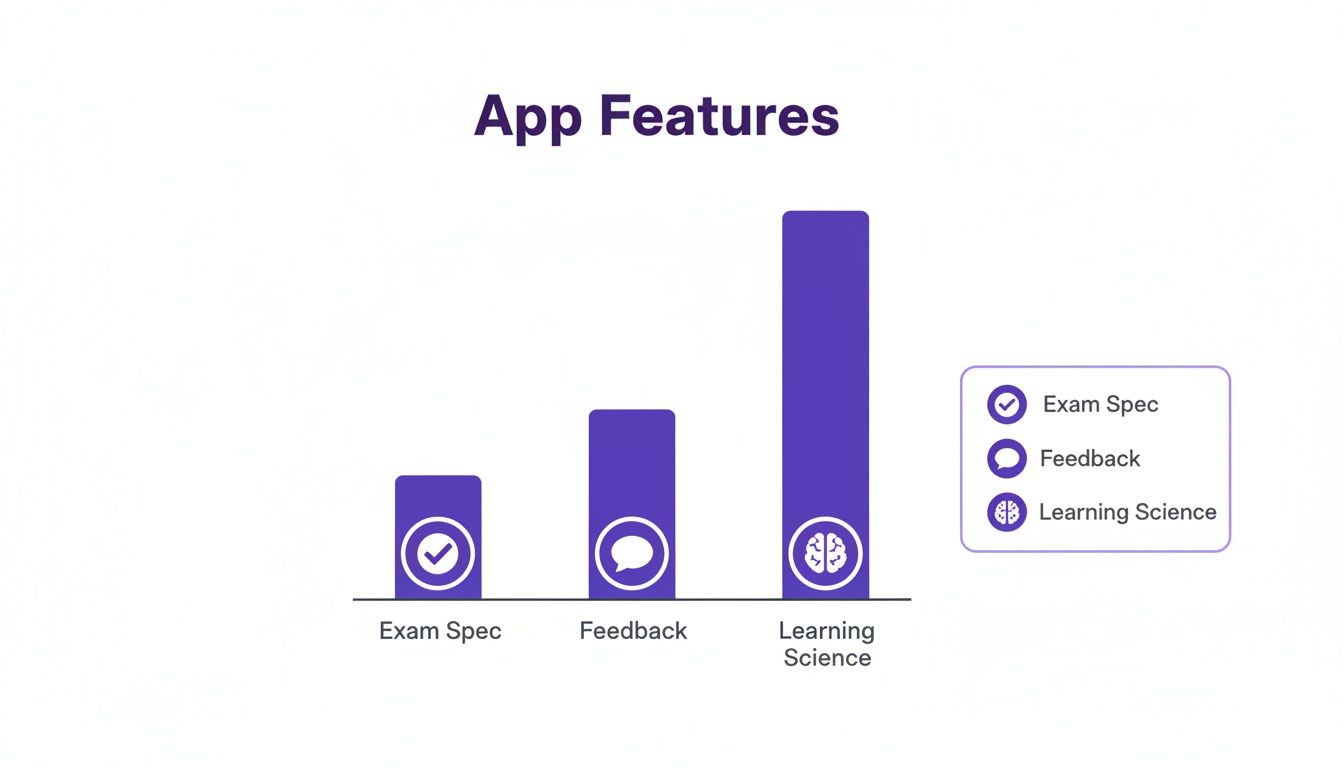
The chart makes it clear that while all good apps focus on exam specifications, the real game-changers are the depth of feedback and the application of learning science—the very things that directly impact how well you can apply your knowledge when it counts.
Depth of Question Types
The kind of questions an app offers tells you a lot about what it's for. Your GCSEs won't just be a string of multiple-choice questions, so your revision tool shouldn't be either. You absolutely need practice with the full range of question formats you'll face on exam day.
Seneca excels at multiple-choice, fill-in-the-blank, and other short-form questions that are perfect for building a solid foundation. GCSEPod’s quizzes are similar, usually designed to test whether you've understood the video content you’ve just watched.
This is where MasteryMind really stands apart. It's built from the ground up to handle the most complex, high-mark questions that often decide the top grades. This includes:
Extended Essay Questions: Practice structuring arguments for subjects like History and English Literature, with AI feedback that's aligned to the real mark schemes.
Complex Problem-Solving: Tackle multi-step Maths problems or practical coding challenges in Computer Science, like binary-to-hex conversions.
Source Analysis: Develop the crucial skills for evaluating historical sources or unseen poetry, a critical part of many GCSE exams.
This kind of functionality has become vital. GCSE revision apps are now widely used in UK schools, with platforms like GCSEPod adopted nationwide for their offline quizzes and teacher-set assignments that turn commutes into study time. Surveys show that 87% of UK students rely on online resources often, and 71% find them better for exam readiness. Bite-sized content is king: 18% favour quizzes and videos equally. This fits MasteryMind's model perfectly—AI quizzes that mirror real exams, from trace tables in CS to hex conversions, with 77% of users reporting a boost of at least one grade. You can discover more about how digital tools are shaping student learning on queensonlineschool.com.
Feature Deep Dive GCSE Revision App Comparison
To make the choice clearer, here’s a side-by-side analysis of how these leading revision apps perform against the most important criteria for effective GCSE preparation. This table cuts through the marketing to show you exactly where each app shines.
Feature | MasteryMind | GCSEPod | Seneca |
|---|---|---|---|
Primary Learning Method | Active recall and exam simulation with adaptive difficulty. | Passive learning through short, curriculum-based videos. | Gamified quizzes with spaced repetition for memorisation. |
Feedback Mechanism | Instant, examiner-style feedback with AO breakdowns and step-by-step solutions. | Basic comprehension quizzes related to video content. | Immediate right/wrong answers for short-form questions. |
Question Types | Full range, from multiple-choice to 24-mark essays and complex problem-solving. | Primarily multiple-choice and short comprehension questions. | Focuses on multiple-choice, fill-in-the-blanks, and matching pairs. |
Best For Students Who... | Are aiming for top grades and need to master exam technique and complex questions. | Are visual/auditory learners who need to build or review foundational knowledge. | Need motivation and enjoy gamified learning to memorise key facts and definitions. |
Teacher Scepticism Factor | High. The detailed, mark-scheme-aligned feedback provides credible, actionable insights. | Moderate. Trusted for content delivery but less for assessing application of knowledge. | Low to Moderate. Great for engagement but may be seen as less rigorous for deep analysis. |
Ultimately, the "best" GCSE revision app really depends on your specific needs. If you need to build a baseline understanding of topics in an engaging way, GCSEPod's videos are a fantastic resource. If you thrive on competition and need help memorising facts, Seneca’s gamified approach is hard to beat.
However, if you're serious about mastering exam technique, tackling the hardest questions, and getting feedback that truly prepares you for what examiners are looking for, then MasteryMind is designed specifically for that purpose.
Finding the Right App for Your Learning Style
A slick features list looks great on paper, but the real test is how an app performs in the hands of an actual student. Let's be honest, the best GCSE revision apps are not one-size-fits-all. They have to click with your specific goals, subjects, and even your personality. What a student aiming for grade 9 in an essay subject needs is a world away from what someone cramming for the sciences needs.
So, to cut through the noise, let’s walk through a few real-world scenarios. We’ll look at different types of students facing common challenges and see how the right app can genuinely make a difference. This is about getting practical and seeing these tools in action.
The Ambitious Student Chasing Grade 9s
First up, meet Chloe. She’s organised, driven, and aiming for top grades, particularly in History and English Literature. Her problem isn’t just remembering facts; it’s mastering the art of the 24-mark essay. She needs to sharpen her critical analysis, structure flawless arguments, and hit every single Assessment Objective (AO) to really impress the examiners.
A simple flashcard or multiple-choice app would be a complete waste of her time. Chloe needs a tool that can handle complex, long-form answers and give her feedback as detailed and critical as her teacher’s.
This is where an app like MasteryMind really comes into its own. Here’s how it helps her level up:
Examiner-Aligned Feedback: Chloe can type out a full practice essay, and the AI gives her an instant, detailed breakdown. It pinpoints where her analysis is sharp and, crucially, where she needs to develop her points further, referencing the specific AOs she’s missing.
Command Word Practice: The app generates questions using specific command words like ‘evaluate’ or ‘analyse’. This constantly pushes her beyond simple recall and forces her to develop the higher-level thinking skills needed for top marks.
Building Complexity: Thanks to its adaptive difficulty, as soon as she masters one skill, the app serves up more nuanced source material or challenging texts to work with. It grows with her ability.
For a student like Chloe, it's all about refinement. An app that provides examiner-level critique on demand means she can practise, get feedback, and improve far more quickly than waiting a week for her teacher to mark an essay.
The Last-Minute Learner Needing to Fill Gaps
Now, let's think about Leo. He's juggling a lot of subjects and, if he's being honest, has left his revision a bit late. The sheer volume of content is overwhelming, and he has no idea where to even start. His biggest hurdle? He has huge knowledge gaps across Biology, Chemistry, and Physics, but he isn’t even sure what he doesn’t know.
Leo desperately needs an app that can quickly diagnose his weak spots and build an efficient, targeted revision plan to get him back on track. Passively watching videos won’t cut it, and an essay-focused tool would be useless.
For a student in a time crunch, efficiency is everything. The right app acts like a diagnostic tool, finding the holes in your knowledge and then relentlessly drilling you on those specific topics until they stick.
An adaptive quiz platform is Leo’s new best friend. Here’s how it can rescue his revision:
Diagnostic Quizzing: He can jump into a quick quiz on a topic, and the app immediately flags up the concepts he’s shaky on. No more guesswork.
Spaced Repetition: The app's algorithm is smart. It brings back the questions he got wrong more often, a scientific approach proven to embed information in your long-term memory far better than just cramming randomly.
Interleaved Practice: Instead of grinding through one topic at a time (block practice), the app mixes up questions from different areas, forcing his brain to switch gears just like in a real exam. This is a game-changer for effective revision.
For Leo, the app provides a clear path through the chaos. It eliminates the panic of not knowing where to begin and replaces it with a structured, focused plan that ensures every minute of his study time is spent where it's needed most.
The Teacher Seeking Reliable Homework Tools
Finally, let’s look at this from a teacher’s point of view. Mrs Evans teaches Computer Science to a mixed-ability Year 11 class. She wants to set homework that properly reinforces her lessons, but the thought of marking 30 assignments is daunting. She’s also rightly sceptical of generic tools that can’t handle her subject's complexities, like trace tables or binary conversions.
What she needs is a tool that’s perfectly aligned with the curriculum, provides instant and accurate feedback, and gives her a clear overview of her class’s progress without piling on more work.
An app with robust, subject-specific features is non-negotiable. It has to deliver:
Curriculum Alignment: The questions must be a perfect match for the AQA specification she teaches. No generic content allowed.
Complex Question Types: The platform has to go way beyond multiple-choice. It needs to support things like SQL queries, pseudocode challenges, and hex conversion problems that are core to the subject.
Instant, Actionable Feedback: When a student gets a trace table wrong, the app should show them the step-by-step logic, highlighting exactly where they went astray. This immediate feedback helps them fix misunderstandings on the spot.
By using a platform like MasteryMind, Mrs Evans can set homework that marks itself. This frees her up to focus on lesson planning and giving one-on-one support to the students who need it most. The data dashboards also give her a quick glance at which topics the whole class is struggling with, so she can reteach them in the next lesson.
Why MasteryMind Is the Top Choice for Serious Students
After weighing up the different approaches, it’s clear that not all revision apps are trying to solve the same problem. Some are fantastic for drilling facts or watching quick video summaries, but a different kind of tool is needed when the goal is to truly master exam technique. This is precisely where MasteryMind stands out as the definitive choice for students and teachers who are serious about results.
It’s one thing to know your subject inside and out; it’s another thing entirely to know how to apply that knowledge to score marks under exam pressure. MasteryMind is built from the ground up on this principle. Every feature systematically ties back to the core criteria we looked at earlier—exam board alignment, the quality of feedback, and the practical application of learning science.
Uncompromising Exam Board Alignment
First things first: effective revision has to be relevant. One of the biggest mistakes you can make is wasting precious time on content that won't even be on your paper. MasteryMind tackles this with a level of precision that goes way beyond just covering the right subjects.
Every single question on the platform, whether it's a quick multiple-choice or a complex essay prompt, is meticulously aligned with the official specifications for AQA, Edexcel, OCR, and WJEC.
What this means in practice:
The command words are exact: The platform uses the precise phrasing your examiner will use, training you to instantly recognise what a question is really asking for.
Mark schemes are baked in: Feedback isn't just a generic "here's the right answer." It’s structured around the Assessment Objectives (AOs) that your marks actually depend on.
Topic weighting is realistic: The app naturally guides you towards the areas that carry the most weight in your exam, so your effort is always focused where it will make the biggest difference.
This obsessive focus on alignment guarantees that every minute you spend on the platform is a minute spent preparing for the real deal.
Feedback That Genuinely Teaches
Instant feedback is a huge plus for any app, but the quality can vary enormously. A simple "correct" or "incorrect" tick doesn't help you improve. To actually get better, you have to understand the 'why' behind the mark.
MasteryMind’s feedback system is designed to feel like an expert examiner is sitting right there with you, offering guidance the moment you need it. It moves beyond basic scoring to give you insights you can act on.
The most powerful learning doesn't happen when you get a question right. It happens when you figure out exactly why you got it wrong and what you need to do to fix it for next time.
For instance, if you're wrestling with a multi-step maths problem, the platform won’t just show you the final answer. It provides a full, step-by-step verification, pinpointing the exact moment your calculation or logic went off track. For a Computer Science trace table, it walks you through every single iteration so you can see your mistake in context. It's this granular detail that turns a wrong answer into a proper learning opportunity.
Making Learning Science Practical
Lots of apps talk about using learning science, but often that just means they have digital flashcards. MasteryMind embeds these powerful principles into its core features in a way that actively strengthens your memory and understanding. It’s not just about what you revise, but how you revise.
The Blurt Challenge is a perfect example of this. This unique, voice-powered feature is a direct application of active recall—arguably one of the most effective revision techniques there is. Instead of just passively reading your notes, you’re challenged to speak your knowledge on a topic out loud.
The app then analyses your response against key curriculum points, identifying any gaps in your explanation. From there, it automatically generates a targeted follow-up quiz to help you nail those specific weak areas. It’s a dynamic and incredibly effective way to force your brain to retrieve information, which is scientifically proven to make it stick.
Built for the Toughest Questions
At the end of the day, the top grades are often decided by how well you handle the most complex, high-mark questions. This is where many revision tools fall short. They might be great for drilling foundational knowledge, but they don't prepare you for the demands of detailed analysis or extended writing.
MasteryMind was specifically engineered to fill this exact gap. It gives you a space to practise and get feedback on the very question types that challenge students most, such as:
24-Mark Essays: Learn to structure your arguments for History or English Literature and get feedback that aligns with the official mark schemes.
Unseen Poetry Analysis: Develop your skills in interpreting new texts, a common stumbling block for so many students.
Complex Problem-Solving: Tackle practical challenges in subjects like Computer Science, from binary-to-hex conversions to writing pseudocode.
By building your confidence with these harder questions, you aren't just revising content—you are mastering the skills of application, analysis, and evaluation. This complete approach ensures you walk into the exam hall ready for anything they can throw at you. To see how these features come together, you can explore the MasteryMind platform and see its exam-focused tools in action.
Got Questions About GCSE Revision Apps? Let's Get Them Answered
Choosing the right revision tool throws up a lot of questions. It’s totally understandable – students, parents, and teachers all want to be sure that the time invested in an app will actually lead to better grades. Being a bit sceptical is a good thing. So, let’s tackle some of the most common worries head-on.
This isn't just about picking an app; it's about making a smart decision for a crucial part of your revision plan. We'll skip the marketing fluff and get straight to what it’s really like to use these tools for your GCSEs.
Are Revision Apps Actually Better Than Textbooks and Past Papers?
This is a classic question, and the honest answer is: it’s not an either/or situation. They shine when used together. Think of them as different tools in your toolbox, each with its own job.
An app gives you something a textbook can't: interactivity, instant feedback, and learning that adapts to you. It can pinpoint your weak spots in minutes and help you focus your efforts where they're needed most.
But past papers? They’re still non-negotiable. Nothing beats the experience of sitting down and tackling a full paper under timed conditions. It's essential for building exam stamina and mastering your timing.
The ideal strategy: Use an interactive app like MasteryMind for daily practice on exam-style questions with examiner-level feedback. Then, use full, timed past papers to test your performance under pressure. The app sharpens your skills; the papers prove you can deliver.
Can I Really Trust AI to Mark My Work Accurately?
It's completely right to be wary of this, especially for teachers marking hundreds of essays. The truth is, the quality of AI marking varies wildly from one platform to another. Some basic apps might just do a simple keyword check, which is next to useless for a nuanced subject like History or English.
A more advanced platform, however, is a different beast entirely. MasteryMind's AI, for example, isn't just checking for words. It has been meticulously trained on thousands of real student answers, all marked against official exam board mark schemes. It learns to recognise the structure of an argument and the quality of the evidence used, assessing your work against the very same Assessment Objectives (AOs) a human examiner uses.
While it's a tool to guide you, the best AI provides feedback that is incredibly accurate and—perhaps most importantly—available the second you need it, 24/7.
How Much Does a Good GCSE Revision App Cost?
Prices are all over the place. Some brilliant platforms, like GCSEPod, are often bought by schools, meaning students get access for free. Many others operate on a 'freemium' model, giving you a limited version to try before you commit.
MasteryMind, for example, has a free plan that gives you access to its quizzes and a feel for the core features. To unlock the really powerful tools—like the advanced, examiner-style essay feedback and detailed progress analytics—you’d look at a premium subscription.
A good way to think about it is as an investment in a private tutor who is available any time, day or night, for a fraction of the cost.
Ready to stop just revising and start mastering your exam technique? MasteryMind is built to give you the feedback, practice, and confidence you need to achieve your target grades. Try our examiner-aligned quizzes and see the difference for yourself. Start for free today.
Comments