Your Guide to the AQA Science GCSE Specification
- Gavin Wheeldon
- Feb 6
- 19 min read

Staring at the official AQA Science GCSE specification can feel like you're trying to decode an alien language. It's just page after page of dense text and weird codes. But hidden in plain sight, this document is your ultimate cheat sheet, laying out every single thing you could possibly be tested on.
Your Ultimate Roadmap to GCSE Science Success
Let's face it, the official AQA Science GCSE spec probably isn't your idea of a good time. It looks intimidating, formal, and, well, a bit dull. But here’s a secret every top-scoring student knows: this document is the most powerful tool you have for revision. It’s more than just a list of topics; it's a direct peek into the mind of the person writing your exam, showing you exactly what to know, what skills to demonstrate, and how your papers are put together.
Think of it like a video game rulebook. You wouldn't charge in to fight the final boss without knowing its weak points or how the scoring works, would you? The specification is your guide to the game, and learning how to read it is the first step to levelling up your grades.
What Exactly Is the AQA Science Specification?
The AQA specification is the official blueprint from the exam board that details the entire course. Whether you're taking Combined Science or Triple Science, this is the document your teachers use to plan lessons and the one examiners use to write your exam questions. It takes all the guesswork out of what might come up.
The vast majority of students will be following the AQA GCSE Combined Science: Trilogy course. Since it was launched in 2016, it's become a standard for science education in the UK. This course involves six exam papers in total—two each for biology, chemistry, and physics. Each paper is 1 hour and 15 minutes long and is worth 70 marks, all contributing to your final 'double award' grade. You can get a full overview of the course structure on AQA's website.
Here’s a quick breakdown of how the Combined Science course is structured.
AQA Combined Science Trilogy at a Glance
Subject | Paper 1 Topics Covered | Paper 2 Topics Covered | Exam Details |
|---|---|---|---|
Biology | 1. Cell Biology2. Organisation3. Infection and Response4. Bioenergetics | 5. Homeostasis and Response6. Inheritance, Variation and Evolution7. Ecology | 2 papers, 1hr 15m each, 70 marks each. |
Chemistry | 8. Atomic Structure9. Bonding10. Quantitative Chemistry11. Chemical Changes12. Energy Changes | 13. Rate of Reaction14. Organic Chemistry15. Chemical Analysis16. Chemistry of the Atmosphere17. Using Resources | 2 papers, 1hr 15m each, 70 marks each. |
Physics | 18. Energy19. Electricity20. Particle Model of Matter21. Atomic Structure | 22. Forces23. Waves24. Magnetism and Electromagnetism | 2 papers, 1hr 15m each, 70 marks each. |
This table shows exactly which topics will appear on which paper—a massive advantage when you’re planning your revision.
So, Why Should You Actually Bother With It?
Honestly? Because using the specification shifts your revision from passive cramming into a smart, strategic mission. Instead of just reading your textbook from cover to cover and hoping it sticks, you can actively target what really matters.
The specification isn’t just a document for teachers; it’s your personal checklist for success. It removes the guesswork from revision, ensuring every minute you spend studying is focused on what will actually earn you marks on exam day.
By really getting to grips with this document, you can:
Build a bulletproof revision checklist: Literally tick off every single point as you master it. No more gaps.
Pinpoint your weak spots: It becomes glaringly obvious which topics you feel less confident about and need to work on.
Understand how you'll be marked: This is a game-changer for learning how to structure your answers to hit the marking points.
In this guide, we're going to pull apart the AQA Science GCSE specification into simple, manageable pieces. We’ll walk you through how to read it, how to use it, and how to turn it into a clear roadmap for smashing the grade you want.
Mapping Out the Core Science Topics You Need to Know
Think of the AQA Science GCSE specification as your roadmap for the entire course. It’s not just some dry document; it's a detailed checklist of everything you could possibly be tested on. Getting familiar with this map helps you see the bigger picture, connect the dots between different ideas, and make your revision feel a lot less random.
Instead of just getting bogged down in one chapter of your textbook, the spec lets you see how different topics link together. Honestly, this is a game-changer for building a revision plan that actually covers all the bases without making you want to tear your hair out.
Let's break down what that map looks like for each science.
Your Journey Through AQA Biology
Biology takes you on an incredible journey, from the microscopic world inside a single cell all the way up to the massive, complex web of life in an ecosystem. AQA organises this journey into logical chunks, which really helps it all make sense.
The course essentially builds from the ground up:
Cell Biology: This is your foundation. You'll get to grips with the tiny structures inside animal and plant cells and figure out what makes them tick.
Organisation: From there, you zoom out to see how cells team up to form tissues, then organs (like the heart and lungs), and finally entire organ systems.
Infection and Response: This topic dives into the constant battle raging between your body and nasty pathogens, looking at how your amazing immune system fights back.
Bioenergetics: Here you’ll cover two of the most important processes for life on Earth: photosynthesis and respiration. These are classic topics that AQA examiners love to ask questions on.
The real secret to smashing Biology is seeing the connections. Understanding how a cell works (Topic 1) is vital for figuring out how a whole organism functions (Topic 2) and defends itself (Topic 3). It all slots together like a puzzle.
The second half of the course broadens your view even further, looking at how life continues and interacts with the world. You’ll cover everything from genetics and evolution to the environmental challenges we face today. To see a full list, check out this breakdown of the AQA GCSE combined science syllabus to guide your study sessions.
Connecting the Dots in AQA Chemistry
Chemistry is all about substances—what they're made of, how they behave, and how they change. The AQA spec structures this perfectly, starting with the fundamental building blocks of everything: atoms.
Your learning path will connect these key ideas:
Atomic Structure and the Periodic Table: This is where it all begins. You'll learn about protons, neutrons, and electrons and see how the periodic table is a work of genius for organising all the elements.
Bonding and Properties: Once you understand atoms, you can explore how they join together. This explains why something is a solid, liquid, or gas, and why materials have the properties they do.
Chemical and Energy Changes: This is where the action happens. You'll investigate different types of reactions and, crucially, what happens to energy during them. Getting this right is a huge step towards the higher marks.
Quantitative Chemistry: Don't let the name scare you! This is just the maths behind chemistry—things like calculating masses and using moles. They might seem tricky, but they are a fantastic way to pick up guaranteed marks once you nail the method.
From these foundations, the course then applies these core principles to bigger areas like organic chemistry (the chemistry of carbon) and how we analyse substances. It’s a subject where one topic really does build directly on the last.
From Energy to Electromagnets in AQA Physics
Physics explores the fundamental rules that govern our universe, from the movement of planets to the behaviour of tiny particles. AQA guides you through these big ideas, starting with the most universal concept of all: energy.
The topics flow logically from core principles to their real-world applications:
Energy and Electricity: These are the bedrock of physics. You’ll learn about energy stores and transfers, then apply these ideas to make sense of electrical circuits. You can expect these concepts to pop up in at least 20% of physics questions in some form.
Particle Model of Matter: This section is brilliant. It explains the properties of solids, liquids, and gases by imagining them as countless tiny, moving particles.
Forces: This is a huge topic, covering everything from gravity and friction to pressure and momentum. Understanding forces is the key to explaining why things move (or, just as importantly, stay still).
Waves, Magnetism, and Electromagnetism: These topics look at how energy moves around in waves (like light and sound) and explore the powerful and sometimes mind-bending relationship between electricity and magnetism.
Seeing how these topics are laid out in the official spec helps you plan a revision schedule that actually makes sense. You can tackle the basics of each science first and then progressively build your knowledge, making sure you have a solid foundation before you move on to the trickier stuff.
Understanding How AQA Awards Marks with Assessment Objectives
Ever had that moment? You get an exam paper back, see you’ve lost marks on a question, and think, "But I knew this topic inside out!" The reason you dropped those marks probably had nothing to do with what you knew, but everything to do with how you answered.
The secret to unlocking those marks lies in something called Assessment Objectives, or AOs.
Think of AOs as the examiner's rulebook. They're the specific criteria AQA uses to decide where every single mark comes from. Once you understand them, it’s a total game-changer. You'll know exactly what the person marking your paper is looking for, and you can give it to them. It's the difference between just dumping facts onto the page and crafting an answer that ticks all their boxes.
AQA splits this into three main categories.
AO1: Knowing Your Stuff
This one is the most straightforward. AO1 is all about demonstrating your knowledge and understanding of scientific ideas. Can you recall the key facts, definitions, and concepts from the AQA Science GCSE specification?
When a question uses a command word like 'State', 'Define', or 'Label', it’s a dead giveaway that it's targeting AO1. They just want you to prove you've done the learning.
For example: "State two differences between an animal cell and a plant cell."
What they want: Simple, factual recall. List two clear differences, like the cell wall or chloroplasts. No deep explanation is needed.
This is the foundation of your grade, making up 40% of the marks, but it’s only the beginning.
AO2: Applying Your Knowledge
Here’s where it gets more interesting. AO2 tests your ability to apply your scientific knowledge to new situations. It’s about taking a concept you've learned and using it to solve a problem or explain a scenario you've probably never seen before.
Command words like 'Explain', 'Suggest', or 'Calculate' are big clues that you're in AO2 territory. The examiner wants to see if you can connect the dots and use your knowledge in a logical way.
For example: "A new species of fish is discovered living in a dark cave. Suggest why it may not have functioning eyes."
What they want: For you to apply your understanding of evolution. You might suggest that since there’s no light, eyes offer no survival advantage, so energy is conserved by not developing them. This shows you can think scientifically, not just remember facts.
A huge chunk of your grade—a whopping 40%—comes from these AO2 application skills. This means that nearly half the marks depend on how well you can use what you’ve learned, not just repeat it.
AO3: Analysing and Evaluating
This is the top tier, worth the final 20% of your grade. AO3 is all about analysing information to interpret, evaluate, make judgements, and draw conclusions. This is where you have to think like a real scientist.
These questions often throw data at you in a table, a graph, or a description of an experiment. Look out for command words like 'Evaluate', 'Compare', or 'Analyse'. Those big, beefy 6-mark questions often live here, asking you to weigh up evidence or assess the validity of a scientific method.
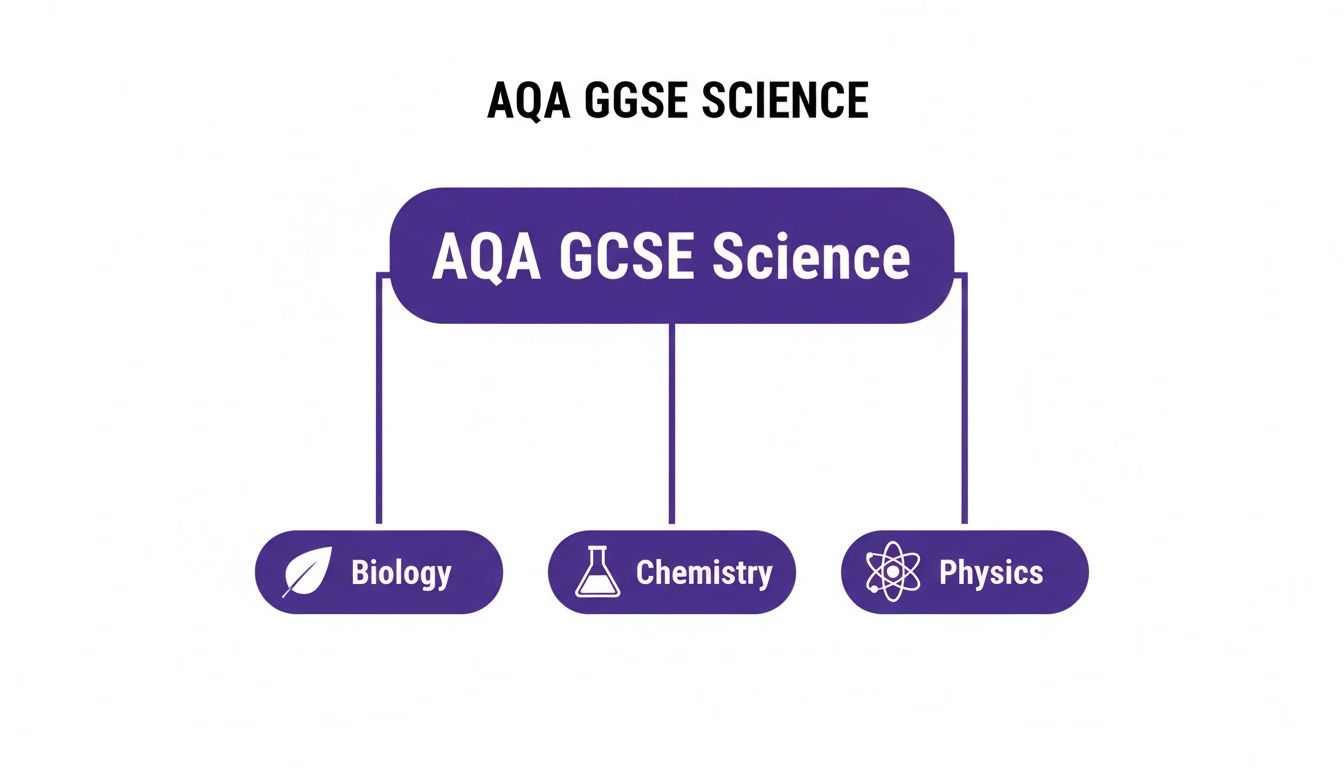
Whether you're studying Biology, Chemistry, or Physics, these AOs are applied consistently across the board.
Since the shift to 100% exam assessment, these skills have become even more critical. While coursework is gone, the 15 required practicals are now tested directly in the exams. Many of these questions are designed to test your AO3 skills in an experimental context, asking you to analyse results or critique a method.
Getting to grips with AOs isn't just theory; it’s a practical strategy. It allows you to focus your revision and, most importantly, structure your answers in the exam to hit every marking point.
Turning Required Practicals into Guaranteed Marks
Let’s be honest, when you’re in class doing a required practical, it can sometimes feel like you’re just following a recipe. But those experiments—whether it’s testing for osmosis in potato slices or building a simple circuit—are so much more than a box-ticking exercise.
They are a guaranteed part of your final exam. Understanding them properly is one of the smartest ways to lock in marks.
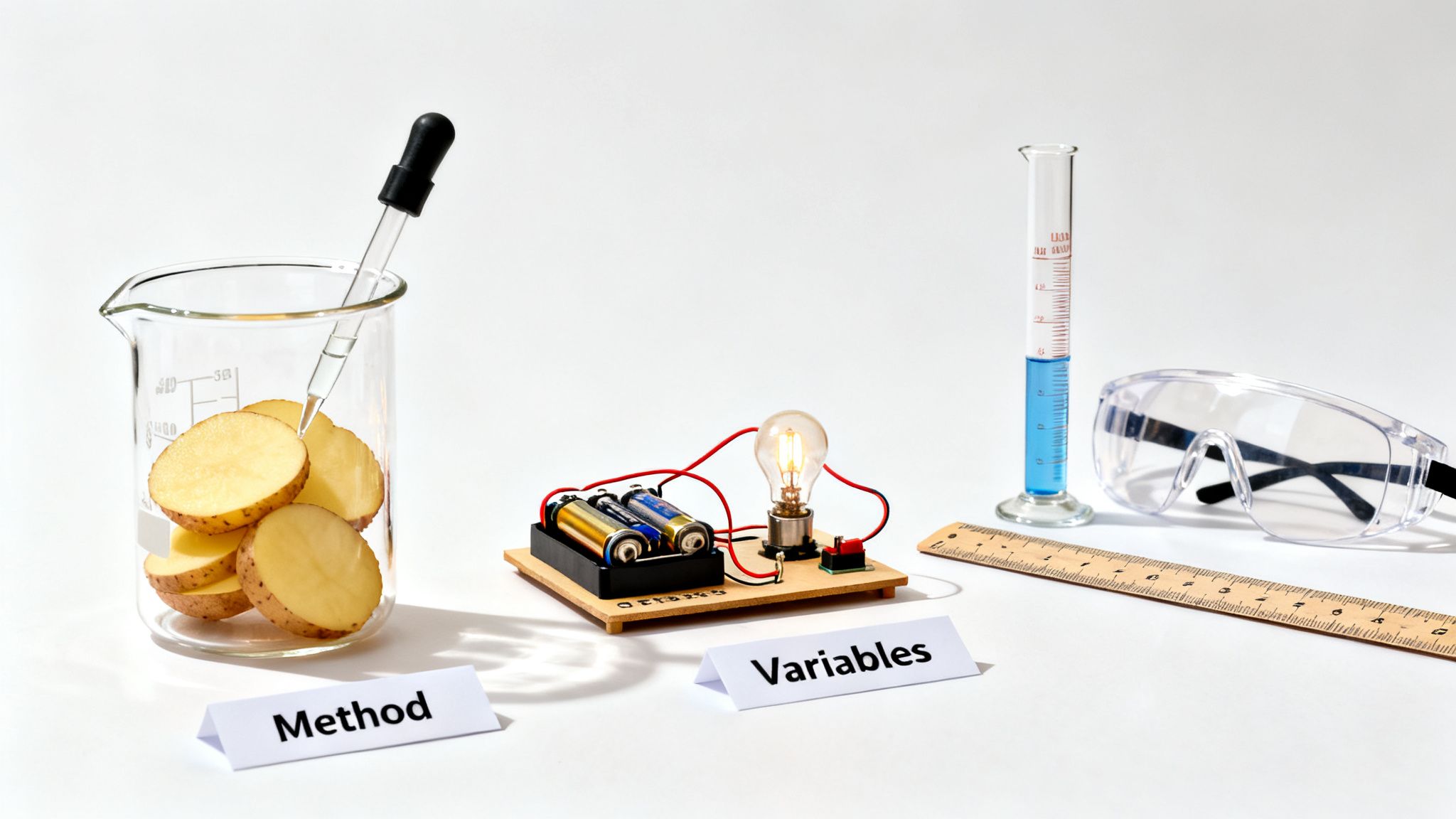
The AQA Science GCSE specification makes it crystal clear: questions about practical work will make up at least 15% of your final grade. That's a huge, predictable chunk of the paper you can absolutely prepare for.
If you’re studying Combined Science: Trilogy, you’ll cover 21 of these core practicals. If you’re doing the separate sciences, you’ll have a few more for each subject. These aren't just simple recall questions, either. They're designed to test your real understanding of the entire scientific process.
What Examiners Actually Want to See
It’s easy to get fixated on tiny details, like the exact colour change in a titration. But where students often trip up is not understanding the why behind the method. Examiners are far less interested in whether you can recite the steps from memory and much more focused on whether you’ve grasped the scientific principles at play.
They’ll probe your understanding across five key areas:
Apparatus and Technique: Why use a measuring cylinder instead of a beaker? How do you use a light gate correctly to get accurate readings?
Method: Could you write a clear, logical set of instructions for another student to follow and get the same results?
Safety Precautions: What are the specific risks involved (like handling acid or hot equipment), and what practical steps should you take to stay safe?
Variables: Can you confidently identify the independent and dependent variables? Crucially, can you pinpoint the control variables that must be kept constant for a fair test?
Analysing Results: Can you take raw data, draw a suitable graph, and then write a valid conclusion that’s backed up by your evidence?
Nailing these five areas means you can walk into that exam hall feeling confident, ready for whatever practical question AQA throws at you. For more hands-on practice, our guide on AQA GCSE Biology is a great place to drill down on these skills.
The biggest mistake you can make is treating each practical as a totally separate event. Think of them as case studies for the scientific method. The skills you learn in one—like controlling variables or calculating a mean—are the exact same skills you'll need for all the others.
To help you get into the examiner's mindset, here’s a quick checklist of the skills you’re really being tested on when you see a practical-based question.
Required Practicals Key Skills Checklist
Skill Area | What You Need to Be Able to Do | Example Practical |
|---|---|---|
Method Development | Write a step-by-step plan that is logical, safe, and will produce valid results. | Describing how to investigate the effect of light intensity on the rate of photosynthesis. |
Risk Assessment | Identify potential hazards and describe sensible precautions to minimise the risks. | Handling hydrochloric acid when testing reaction rates – wear eye protection. |
Variables | Correctly identify the independent, dependent, and key control variables for an experiment. | In an osmosis experiment, the sugar concentration is independent, the potato mass change is dependent. |
Data Handling | Record results in a suitable table, calculate means, and spot anomalous results. | Calculating the average time it takes for a cross to disappear in a reaction rate practical. |
Data Presentation | Draw a graph with labelled axes, correct scales, and accurately plotted points. | Plotting a graph of force against extension for a spring (Hooke's Law). |
Analysis & Conclusion | Describe the pattern in the data and use scientific knowledge to explain why it occurred. | Concluding that as temperature increases, enzyme activity increases up to an optimum point. |
Looking at this table, you can see it's all about the underlying scientific skills, not just the single experiment you did in class.
The Classic Exam Trap: Applying Your Knowledge
One of AQA’s favourite curveballs is to describe a practical you’ve never seen before and then ask you questions about it. This is designed to make you panic if you’ve only memorised the 21 experiments.
But look closer. It’s actually an AO2 (application) question in disguise.
They aren't testing your memory of an experiment you've never done. They are testing whether you can apply the principles of variables, methods, and analysis from the practicals you do know to this new situation. If you understand the core skills, you can tackle any scenario they give you.
Don't Forget the Maths
A surprising number of marks in practical-based questions come from maths skills. These are often easy marks just sitting there, waiting for you to pick them up.
Make sure you’re confident with these, as they pop up all the time:
Calculating means to smooth out random errors and spot anomalous results.
Drawing graphs with correctly labelled axes (including units!) and plotting points accurately.
Drawing a line of best fit, which could be a straight line or a curve.
Calculating the gradient of a straight-line graph, for example, to find a rate of reaction.
By focusing on these fundamental skills instead of just memorising methods, you can turn required practicals from something to worry about into a reliable source of guaranteed marks.
Decoding Command Words to Maximise Your Marks
‘Describe’, ‘Explain’, ‘Compare’, ‘Evaluate’. Ever stared at one of these words in an exam and felt that knot of panic in your stomach? They all seem to ask for something similar, but in the world of the AQA Science GCSE specification, they are incredibly precise instructions from the examiner.
Getting them wrong is like trying to unlock a door with the wrong key. It doesn’t matter how much science you know; you simply won’t get the marks. This section is your command word decoder ring. Understanding these terms is how you convert all that hard-earned knowledge into solid points on the board. It’s the difference between knowing the science and proving you know it under pressure.
From Describe to Explain: The Vital Difference
Let's start with two of the most common—and most commonly confused—command words. Misunderstanding these two can cost you easy marks on pretty much every paper you sit.
Describe: This is asking for the "what" or the "how." It’s a straightforward account of what you see or what happens. Think of yourself as a sports commentator giving a play-by-play. You’re just stating the facts without digging into the science behind them.
Explain: This one is all about the "why." Here, the examiner wants to see you use your scientific knowledge (your AO2 skills) to give reasons. If 'describe' is the 'what', 'explain' is the 'so what?'. You have to connect cause and effect using scientific principles.
Imagine a question about dropping a piece of potato into a concentrated sugar solution. A 'describe' answer would simply state: "The mass of the potato decreased." Job done.
But a strong 'explain' answer goes deeper: "The mass decreased because the solution had a lower water potential than the potato cells. This caused water to move out of the potato by osmosis, down the concentration gradient." See the difference? That word ‘because’ is your signpost for a great explanation.
Stepping Up to Compare and Evaluate
As you climb the mark scheme, especially towards those chunky 6-mark questions, you’ll meet more complex command words designed to test your analytical (AO3) skills.
A ‘Compare’ question needs you to identify both the similarities and the differences between two or more things. A classic mistake is to only list what’s different. To get full marks, you have to look for what they have in common, too. Using little connecting phrases like "whereas" for differences, and "similarly" or "both have" for similarities, is a great way to structure your answer.
Then there's the big one: ‘Evaluate’. This is asking you to make a judgement. You’ll be given some information—maybe a statement, a graph, or an experiment's conclusion—and you need to weigh up the pros and cons to decide how valid it is.
A great evaluation isn't just about having a strong opinion; it's about backing up your final judgement with the evidence you've been given. You need to act like a judge in a courtroom, coolly considering all the facts before delivering your verdict.
Essential Exam Technique Tips
Knowing your command words is half the battle. Applying that knowledge with smart exam technique is what wins the war.
Use the Marks as Your Guide: The number of marks available tells you how much detail is needed. A 2-mark question wants two distinct points. A 6-mark question requires a much more developed, structured answer. Don't write a novel for two marks, but don't give a single sentence for six, either.
Plan Your 6-Mark Answers: Before your pen hits the paper, take 30 seconds to scribble down a quick plan. A few bullet points will give your answer structure, make sure you hit enough points, and stop you from waffling. This is absolutely crucial for 'evaluate' questions.
Show Your Working in Calculations: This is non-negotiable. Even if you mess up the final number, you can still hoover up marks for showing a correct method. Lay out every single step of your calculation clearly. Think of it as a safety net that can save your grade.
Mastering these skills relies on understanding how the AQA specification pulls different areas of knowledge together. For example, solid maths skills are vital for questions on the required practicals. Before 2017, around 40% of UK students found analysing practical data tricky, but the new spec and better resources have really helped. You can get a better sense of the integration of maths in science specifications. This focus on application is a key reason why over 72% of students now find Trilogy papers more manageable after consistent practice.
Building a Revision Plan That Actually Works
You’ve decoded the command words, you get what the Assessment Objectives are all about, and you have a solid grip on what the AQA Science GCSE specification is asking of you. Brilliant. So, what’s next? It's time to turn all that knowledge into a smart revision plan that will actually make a difference.
This isn’t about just staring at your textbook for hours until your brain feels like mush. It’s about revising smarter, not just harder. With a proper strategy, you can walk into your exams feeling genuinely prepared, confident, and ready to show the examiner everything you know.

Use the Specification as Your Master Checklist
First thing's first: stop guessing what you need to revise. Grab the AQA specification for your course and treat it like your personal progress tracker. It’s literally a list of everything they can ask you.
Go through every single topic and sub-topic and give yourself a brutally honest rating using a simple traffic light system:
Red: You have absolutely no idea what this is, or you consistently get questions on it wrong. These are your top priority.
Amber: You kind of get it, but you often make silly mistakes or couldn't explain it clearly to a friend. These topics just need more practice.
Green: You’re solid on this. You can answer questions on it confidently and correctly every time. These just need a quick review now and then to keep them fresh.
This simple audit immediately shows you where to focus your energy. No more wasting time rereading stuff you already know inside out; you can dive straight into the red and amber topics that will make the biggest difference to your final grade.
The Power of Spaced Repetition and Active Recall
Now you know what to revise, let’s talk about how. The two most effective, scientifically-backed methods are spaced repetition and active recall. They might sound a bit technical, but the idea is actually very simple.
Active recall is all about pulling information out of your brain, not just passively reading it. Think doing a practice question without peeking at your notes. Spaced repetition means reviewing that same information at gradually increasing intervals over time.
Instead of cramming a topic in one session and then forgetting it a week later, you revisit it just as you're about to forget. For example, you might learn about osmosis on a Monday, do a quick quiz on it on Wednesday, and then tackle a full past paper question on it the following week. This process is proven to lock information into your long-term memory far more effectively than just reading notes over and over.
A Sample Revision Week
So, what does a smart revision week actually look like? It’s all about balance and variety. Don't dedicate a whole day to one subject; mix it up to keep your brain engaged and working efficiently.
Here’s a potential game plan for a productive week:
Monday & Tuesday: Hit your Red topics hard. Spend time re-learning the core concepts from scratch if you need to, and then immediately test yourself with some practice questions to see if it’s sticking.
Wednesday & Thursday: Move on to your Amber topics. This is the perfect time for timed practice questions from past papers. Afterwards, carefully review the mark schemes to pinpoint exactly where you dropped marks. You can find plenty of exam-style questions when you explore these AQA past papers and other resources.
Friday: Mix it all together. Do a full practice paper under timed conditions to get a feel for the real thing. This helps build your stamina and sharpens your timing.
Weekend: Review your work from the week. Go over any mistakes you made and update your Red-Amber-Green list. Then, do a quick-fire review of your Green topics just to keep them ticking over.
Following a structure like this ensures you’re consistently chipping away at your weaknesses, getting vital exam practice, and building confidence across the entire AQA Science GCSE specification.
Got a Few Questions?
It's completely normal to have a few things you're still not sure about when it comes to the AQA Science GCSE spec. You're definitely not alone. Let’s tackle some of the most common questions we get from students, and get you feeling crystal clear on what's what.
Combined or Separate Sciences – What's the Deal?
This is probably the biggest question on most people's minds. Think of it like this:
Combined Science: Trilogy is the all-rounder option. It gives you a solid grounding in the essentials of Biology, Chemistry, and Physics, all bundled together to award you two GCSE grades. It's a fantastic, broad science qualification.
Separate (or 'Triple') Science is for those who want to go deeper. You’ll study each science as its own subject, which means more content and more depth. This leads to three separate GCSEs and is a great pathway if you've got your eye on studying sciences at A-Level. The AQA spec lays out exactly which extra topics you'll cover.
Where Can I Get My Hands on Official AQA Past Papers?
Go straight to the source: the official AQA website. It's an absolute goldmine, packed with past papers, mark schemes, and examiner reports. Don't waste your time on anything else until you've used these.
Why? Because using official papers is the closest you can get to the real thing. It helps you get a feel for the specific way AQA asks questions and what they're looking for in your answers. It's much better than using unofficial resources that might be slightly off the mark.
Think of revising with official AQA papers as the final dress rehearsal before the big show. It’s where you learn the rhythm of the exam, spot the common traps, and figure out how to pace yourself when the clock is ticking.
Are Maths Skills Really That Important in the Science Exams?
In a word: massively. Maths isn't just for maths lessons; it's the language of science. AQA bakes maths skills into every paper, and they're worth a huge chunk of your final grade.
Get this: you can expect at least 10% of the marks in Biology, 20% in Chemistry, and a whopping 30% in Physics to come from your maths skills. We're talking about everything from rearranging equations and calculating percentages to reading graphs and using standard form. It’s all listed in the spec, so make sure you practise these skills within a science context.
What If I Mess Up the Required Practicals? Can I Still Pass?
You could, but you’d be fighting an uphill battle. Questions about the required practicals are guaranteed to come up, accounting for at least 15% of the total marks on your papers. If you skip over revising them, you’re basically throwing away a big pile of relatively predictable marks.
Besides, getting to grips with the practicals helps you think like a scientist. You'll get better at analysing data, picking apart methods, and applying what you know—skills that will score you points across the entire exam. Nail the practicals, and you've got a fantastic source of marks in the bag.
Ready to turn your knowledge of the AQA science GCSE specification into real exam results? That’s exactly what MasteryMind was built for. Our platform lines up every question with your exam board, covering everything from quick recall to tricky 6-mark questions. You get instant, examiner-style feedback with AO breakdowns that show you exactly where to improve. See your confidence grow and start for free at https://masterymind.co.uk.
Comments